

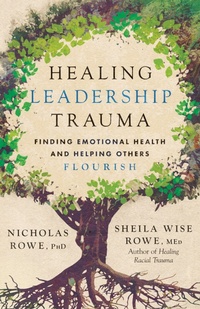
Healing Leadership Trauma
Description

Countless books are designed to help leaders to become better leaders. But most resources neglect the underlying emotional struggles of both emerging and established leaders, who are often isolated and suffering in silence. Leadership professor Nicholas Rowe and counselor Sheila Wise Rowe offer their expertise in helping leaders process painful and traumatic experiences. Trauma contributes to how we lead others in either empowering or dysfunctional ways. Understanding how these experiences formed us is the beginning of the path to healing.
Woven throughout each chapter are five themes-invitation, attachment, remembrance, healing, and reconnection. Healing Leadership Trauma lays out the emotional challengesof leadership and offers encouragement, prayer, and therapeutic tools to help leaders face their pain and begin to heal.
More details
Other editions
Additional editions
Persons
Sheila Wise Rowe (Tufts University, Cambridge College, M.Ed.) is a truth-teller who writes about faith and emotional healing. She advocates for the dignity, rights, and healing of abuse and racial trauma survivors and offers training and support to them and also emerging and established leaders. Sheila has lived in the USA; Paris, France; and Johannesburg, South Africa. For over twenty-five years she's been a counselor, educator, writer, spiritual director, and speaker. She's a member of the Community Ethics Committee of Harvard Medical School, a resource for its teaching hospitals. Sheila is a member of Entrusted Women, Spiritual Directors of Color, and Redbud Writers Guild. Her book Healing Racial Trauma was awarded a 2020 Foreword INDIES Book of the Year Award, Christianity Today Book Award, and a Publishers Weekly starred review. Her other books include Young, Gifted, and Black; Healing Leadership Trauma (co-authored with her husband, Nicholas Rowe); and Seeds of Racial Healing.
Nicholas Rowe (PhD, Boston College) is a historian and the Hansen Associate Professor of Leadership at Gordon-Conwell Theological Seminary. He has over thirty years' experience in senior leadership roles in higher education and nonprofit organizations and is a consultant in cross-ethnic reconciliation and conflict resolution in the United States and South Africa. Nicholas also provides spiritual direction for individuals and reconciling communities. He and his wife, Sheila Wise Rowe, live inBoston and have a daughter, son, daughter-in-law, and grandchild.
Content
Introduction 1. The Heart of the Matter 2. Our Relational God 3. The Roots of Detachment 4. The Pull of Temptation 5. The Myth of Self-Sufficiency 6. Healing the Harmed Heart 7. Gender Trauma 8. Racial and Ethnic Trauma 9. The Path of Forgiveness 10. The Heart of Restored Relationships 11. The Necessity of Rest 12. Finding Purpose Again Acknowledgments Appendix 1: Prayer of Surrender and Salvation Appendix 2: My Family Tree Appendix 3: My Transformation Plan Group Discussion Guide Glossary Notes
