

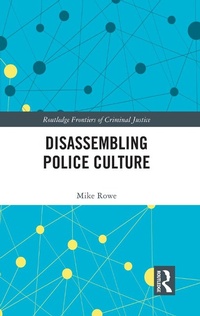
Disassembling Police Culture
1st Edition
Published on 10. February 2023
176 pages
978-1-000-83471-0 (ISBN)
Description

Drawing on six years of ethnographic research, this book critically examines police culture, exploring police behaviours, decisionmaking and actions. Police culture is a concept widely used, often critically, to characterise the working attitudes and behaviours of (usually uniformed) police officers. It is shorthand for a workplace imbued with machismo, racism, sexism, a thirst for danger and excitement, cynicism and conservatism. Rather than looking for culture or identifying how culture affects behaviours, this book identifies factors that influence the decisions and actions, including technology, targets, training, timing, intelligence, geography and supervision, thus reassembling police culture much as Bruno Latour sought to reassemble the social.
The analysis develops a clearer and critical understanding of culture by explicitly connecting the debates about police culture to those about organisational culture. Offering a detailed ethnography of two shifts, it grounds the analysis of the idea of police culture in a 'thick description' of the day- to- day activities observed in the police station and the patrol car, rather than using brief illustrative extracts. The book dispenses with any assumption of the utility of the concept of police culture, not least because it is opaque, and reassembles our understanding of policing and, if it retains any relevance, of police culture.
An accessible and compelling read, this book will appeal to students and scholars of policing, criminology, sociology, law, politics and all those interested in the day- to- day lives of police officers.
The analysis develops a clearer and critical understanding of culture by explicitly connecting the debates about police culture to those about organisational culture. Offering a detailed ethnography of two shifts, it grounds the analysis of the idea of police culture in a 'thick description' of the day- to- day activities observed in the police station and the patrol car, rather than using brief illustrative extracts. The book dispenses with any assumption of the utility of the concept of police culture, not least because it is opaque, and reassembles our understanding of policing and, if it retains any relevance, of police culture.
An accessible and compelling read, this book will appeal to students and scholars of policing, criminology, sociology, law, politics and all those interested in the day- to- day lives of police officers.
Reviews / Votes
"Mike Rowe has done us all a favor by taking on the hazy and protean concept of culture to explain all that is wrong (and some that is right) with police behavior. This is a timely and whip smart ethnography of everyday policing as carried out by officers on the streets in three urban departments located in England. Resting on six years of close observation of the working patterns of officers, Rowe argues with telling evidence that policing is far from the intense, breathtaking activity as portrayed in the movies and TV but is comprised of tedious, rather repetitive tasks in which highly specific features such as the varied social contexts in which the work takes place, the wide range of individual and group preferences held by officers, the day-to-day supervisory practices in the field (or lack thereof), and the unevenly enforced policies of a department matter far more when accounting for police behavior than the popular but flawed and flattening notion of police culture. This is hard slogging scholarship of a lively and relevant sort that deserves the close attention of those interested in just how the police shape and are shaped by the work that they do."John Van Maanen, Professor Emeritus of Organization Studies, MIT
"A timely, important, thought provoking and challenging book. Keenly observed and researched, conceptually rigorous and a real pleasure to read. Recommended for anyone interested in the crucial area of police culture, Science and Technology Studies in policing and the links between them - or, indeed, the realities and daily work of policing more broadly."
Abi Dymond, Senior Lecturer in Criminology, University of Exeter
More details
Series
Edition
1. Auflage
Language
English
Place of publication
London
United Kingdom
Publishing group
Taylor & Francis Ltd
Target group
College/higher education
Professional and scholarly
ISBN-13
978-1-000-83471-0 (9781000834710)
Copyright in bibliographic data and cover images is held by Nielsen Book Services Limited or by the publishers or by their respective licensors: all rights reserved.
Schweitzer Classification
Other editions
Additional editions
Mike Rowe
Disassembling Police Culture
Book
10/2024
1st Edition
Routledge
€62.30
Shipment within 10-20 days
Mike Rowe
Disassembling Police Culture
Book
02/2023
1st Edition
Routledge
€185.40
Shipment within 10-20 days
Person
Mike Rowe is Lecturer in Public Sector Management at the University of Liverpool, UK.
Content
1.Introducing police culture 2.Spencer and Carol: a shift 3.Turning blue? 4.On the record 5.Part of a whole 6.Billy and Timothy: a shift 7.No cultural dopes 8.Culture disassembled
