

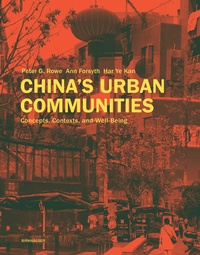
China's Urban Communities
Description

Mit ihrem schnellen Wachstum unterliegen die Städte Chinas einem hohen Entwicklungsdruck. Sie müssen sich anpassen und verwandeln, doch auf welchen Grundlagen und mit welchen Zielen?
Das Buch zeichnet die Transformationsprozesse nach, die seit drei Jahrzehnten in etwa 25 Nachbarschaften der Großstädte Beijing, Shanghai, Shenzhen und Suzhou ablaufen. Die Beispiele reichen von zentralen Wohnvierteln bis hin zu städtischen Randlagen, und ihre Darstellung erstreckt sich von der städtebaulichen Planung bis hin zu Untersuchungen der Bewohnerzufriedenheit.
Diese vertiefte Analyse urbaner Umgebungen schließt an das frühere Buch von Peter Rowe an, der mit Emergent Architectural Territories in East Asian Cities seinem Ruf als einem der weltbesten Kenner der Städte in Fernost gerecht wurde.
More details
Other editions
Additional editions
Persons
Ann Forsyth , Prof. of Urban Planning; Peter G. Rowe , Prof. of Architecture and Urban Design; Har Ye Kan , Research Assoc.; Harvard GSD
Content
- Intro
- CHAPTER 1. INTRODUCTION
- Urbanization, Housing, and Community
- Contexts and Cases
- Beijing
- Shanghai
- Shenzhen
- Suzhou
- Organization
- CHAPTER 2. CONCEPTS OF COMMUNITY IN CHINA
- Early Chinese Communities
- Legalist and Confucian Influences
- Enclosed Communities in Medieval and Imperial China
- The Baojia System and Its Evolution
- Other Late Imperial Urban Communities
- Self-Governing Communities in Republican China
- The Danwei, Xiaoqu, and the People's Communes in Communist China
- Building Community in Contemporary China: The Shequ
- Communities for Political Ends
- CHAPTER 3. URBAN TYPES AND PROJECTS
- Housing and Community Types
- Parallel-Block Arrangements
- High-Rise Developments
- Garden City Neighborhoods
- Traditional Forms
- Projects in Contemporary Settings
- Where Next?
- CHAPTER 4. HEALTH AND WELL-BEING IN RESIDENTIAL DISTRICTS
- Health and Well-being
- The Role of Place
- Well-being in China
- Exposures
- Connections
- Supports
- Conclusions
- CHAPTER 5. NEW PATHWAYS FORWARD
- Choices and Changes
- Housing Blocks on Megaplots
- Skyward Communities
- Seeking Unit Diversity
- Retrofitting Opportunities
- Ecological Gardening
- Tradition Returned
- Retention of Chinese Characteristics
- CHAPTER 6. CONCLUSION
- Communities, Places, and Well-being
- Community Futures
- APPENDICES
- METHODS APPENDIX
- Physical Surveys and Site Visits
- Interviews and Focus Groups
- Physical Representation
- Locational Analysis
- Modeling of Environmental Characteristics
- Air Pollution Monitoring
- Wind and Thermal Comfort Modeling
- Walkability
- NOTES
- ABOUT THE AUTHORS
- ACKNOWLEDGEMENTS
- ILLUSTRATION CREDITS
- INDEX
