

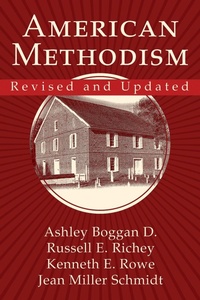
American Methodism Revised and Updated
Description

The essential guide to American Methodism revised and updated through 2020.
Four of Methodism's most respected teachers give us a vivid picture of 260 years of Methodist experience in America. The revised edition updates the Methodist movement's story through 2020, including the social, political, economic, technological, and global disruptions that cause faith communities and denominations to pull apart.
American Methodism Revised and Updated begins with the explosion of evangelical Pietism and revolutionary Methodism, the First Great Awakening, as an independent nation was formed.
It then highlights key 19th century themes and Methodist contributions, such as spreading scriptural holiness through missions and literature, planting tens of thousands of Sunday schools and churches by Circuit Riders, the pivotal Methodist schism between abolitionists and enslavers, the innovative building of schools and hospitals into the next century, and the revivalism of the Second Great Awakening.
Finally it explores the movements of 20th century Methodism, including the expansion of home and foreign missions, the Methodist drive for Prohibition, the decision for nationwide reunification on the cusp of World War II, reunification with the United Brethren during the Vietnam War, the Methodist ordination of women during the 1950s, Black Methodist leadership in the 1960s Civil Rights movement, and the liturgical renewal or reformation of worship (ancient and future).
More details
Other editions
Additional editions
Persons
Kenneth E. Rowe (Author)
Kenneth E. Rowe, a retired clergy member of the Eastern Pennsylvania Conference, the premier bibliographer of American United Methodism, was for 31 years Methodist Librarian and Professor of Church History at Drew University, as well as Professor of Church History in the Theological and Graduate Schools. He is also Emeritus Professor of Church History and Methodist Archives Librarian at Drew University Theological School in Madison, New Jersey.
Jean Miller Schmidt (Author)
Jean Miller Schmidt is Gerald L. Schlessman Professor Emerita of Methodist Studies, The Iliff School of Theology in Denver, Colorado.
Dr. Russell E. Richey (Author)
(2011) Russell E. Richey is Dean Emeritus of Candler School of Theology and the William R. Cannon Distinguished Professor of Church History Emeritus in Atlanta, Georgia.
Content
- Intro
- Title Page
- Copyright
- Dedication
- Contents
- Preface
- Methodist History in a Digital Age
- Using This Narrative with the Two MEA Volumes
- Complementary United Methodist Resources
- Introduction: Spontaneous Beginnings: 1760-68
- Conversionist Religion
- Colonial Awakenings
- Otterbein and Boehm
- Wesleyan Initiatives
- Spontaneity and Order
- Chapter I: Revolutionary Methodism: 1769-84
- Pilmore and Boardman
- Order(s)
- Liberty
- Conferencing
- Discipline
- Tensions and Controversies as Revolution Looms
- Collaborators, Loyalists, Pacifists, Persecuted, Patriots
- Americanization
- A First Schism
- Slavery and Revival
- Awaiting Wesleyan Directives
- Provisioning an American Church
- Planting an American Church
- Chapter II: Reforming the Continent and Spreading Scriptural Holiness: 1792-1816
- The Christmas Conference
- Otterbein in Baltimore
- Race, Gender, and Gentility
- Bishops and Conference
- Multiple Conferences and the Council
- General Conference
- Republican, Primitive, and African Methodists
- Denominationalism
- United Brethren and Evangelical Association
- Annual Conferences and General Conference (MEC)
- Spirituality: In the Home and in Camp Meetings
- The Early MEC and Racism
- A New Day Dawns
- Chapter III: Print, Nurture, Missions: 1816-50s
- Which Wesley to Emulate?
- Apologetics and the Course of Study
- Book Agents
- A Print Church
- Parsonages and Pastoring
- Sunday Worship, the Sunday School, and the Sunday School Union
- Missionary Societies
- A New Connectionalism
- Holiness Promoted
- Collegiate Enterprise
- Theological Seminaries and Brush Colleges
- Chapter IV: Connectional Strains and Contests: 1816-50s
- Racial Divisions
- German Methodisms
- Women's Ministries
- Indigenous Missions
- Colonization and Mission to the Slaves
- German, Spanish, and International Missions
- Democratic and Anti-Episcopacy Divisions
- A New Church
- Chapter V: Methodism and Slavery: 1830-60s
- Sectionalized Methodism
- Methodist Abolition and an Antislavery Church
- General Conference 1844
- Methodist Episcopal Church, South
- MEC vs. MECS
- Further Division over Slavery
- Chapter VI: A Methodist Civil War: 1860-65
- Methodist Confederacy
- Military Defeat and Moral Victory
- Northern Methodist Patriotism
- Ministry in the Army
- Mobilizing Methodist Women
- New Caring Institutions
- African American Conferences
- National Churches
- Chapter VII: Reconstructions: 1866-84
- Looking Back and Looking Forward
- Lay Rights in Episcopal Methodism
- Denominational Accountability
- Women's Organizational Revolution
- Seminaries
- Women in Seminary and in the Pulpit
- Foreign and Home Missions
- Southern African American Methodisms
- "Fraternal" Relations Among Methodists
- Local Methodism
- Chapter VIII: Rethinking Mission(s): 1884-1939
- Reordering Foreign Missions
- Lay Ministries at Home
- Korean Missions and Asian American Methodists
- Deaconess Movements
- Hospitals
- Social Christianity
- MFSS and the Social Creed
- Rethinking Missions
- Chapter IX: Methodism Conflicted: 1884-1939
- Laity Rights for Women
- Conflicts over Holiness
- A Methodist Social Gospel
- Drying up America
- Red Scare
- Liberalism and Fundamentalism
- MECS Women and Racial Reform
- Women's Ordination: Another Round
- Worship and Architecture
- Mission(s) in War and of Peace
- Reunification and Race
- Chapter X: Unifications and Wars: 1939-68
- War and a New World Order
- Holocaust, Japanese Internment, Hiroshima and Nagasaki
- Ordering the New Methodist Church
- Jurisdictions and the Central Jurisdiction
- Segregated Methodism-Segregated America
- Progress Toward Integration
- Uniting Methodist Women
- Full Clergy Rights for Women
- Youth Ministries
- The Evangelical United Brethren Church
- Worship: EUBC and Methodist
- Cold and Korean Wars
- Social Activism and Another "Red Scare"
- Ecumenical Efforts
- The United Methodist Church
- Mission Churches Exercise Options
- Chapter XI: The United Methodist Church: 1968-84
- Caucus and Commission
- African Americans in United Methodism
- Asian American United Methodists
- Latino/Hispanic United Methodism
- Native American United Methodism
- The UMC and the Vietnam War
- Merger Commissions-Social Principles, Structure, Doctrine
- New Women's Organizations
- Homosexuality: Cause and Caucus
- Elder Care
- Divorce
- Abortion
- Good News, a Forum for Scriptural Christianity
- Spirituality and the Language of Praise
- Chapter XII: From Bicentennial to Century's End: 1984-2000
- New Doctrinal Standards
- Episcopal Initiatives
- Native American Ministries
- Latino/Hispanic Ministries
- Korean American Ministries
- Abortion Policy
- Homosexuality
- Political Theologizing
- Christian Unity
- Sacraments, Worship, Hymnody
- Women Lead in Church and Nation
- Chapter XIII: Polity Pushed to the Breaking Point: 2000-2022
- Realignment Attempts and Global Membership Shift
- Budget Cuts and the General Agencies
- Theological and Ecumenical Developments
- The Bible and Ecumenism
- Acts of Repentance
- Division(s) Based on Sexuality
- The Commission on a Way Forward (CWF)
- A Virtual Connection
- Together/Apart: COVID-19
- Cliffhanger
- Abbreviations
