

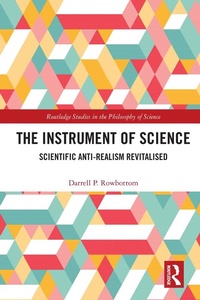
The Instrument of Science
Scientific Anti-Realism Revitalised
1st Edition
Published on 25. March 2019
228 pages
978-0-429-66629-2 (ISBN)
Description

Roughly, instrumentalism is the view that science is primarily, and should primarily be, an instrument for furthering our practical ends. It has fallen out of favour because historically influential variants of the view, such as logical positivism, suffered from serious defects.
In this book, however, Darrell P. Rowbottom develops a new form of instrumentalism, which is more sophisticated and resilient than its predecessors. This position-'cognitive instrumentalism'-involves three core theses. First, science makes theoretical progress primarily when it furnishes us with more predictive power or understanding concerning observable things. Second, scientific discourse concerning unobservable things should only be taken literally in so far as it involves observable properties or analogies with observable things. Third, scientific claims about unobservable things are probably neither approximately true nor liable to change in such a way as to increase in truthlikeness.
There are examples from science throughout the book, and Rowbottom demonstrates at length how cognitive instrumentalism fits with the development of late nineteenth- and early twentieth-century chemistry and physics, and especially atomic theory. Drawing upon this history, Rowbottom also argues that there is a kind of understanding, empirical understanding, which we can achieve without having true, or even approximately true, representations of unobservable things. In closing the book, he sets forth his view on how the distinction between the observable and unobservable may be drawn, and compares cognitive instrumentalism with key contemporary alternatives such as structural realism, constructive empiricism, and semirealism.
Overall, this book offers a strong defence of instrumentalism that will be of interest to scholars and students working on the debate about realism in philosophy of science.
In this book, however, Darrell P. Rowbottom develops a new form of instrumentalism, which is more sophisticated and resilient than its predecessors. This position-'cognitive instrumentalism'-involves three core theses. First, science makes theoretical progress primarily when it furnishes us with more predictive power or understanding concerning observable things. Second, scientific discourse concerning unobservable things should only be taken literally in so far as it involves observable properties or analogies with observable things. Third, scientific claims about unobservable things are probably neither approximately true nor liable to change in such a way as to increase in truthlikeness.
There are examples from science throughout the book, and Rowbottom demonstrates at length how cognitive instrumentalism fits with the development of late nineteenth- and early twentieth-century chemistry and physics, and especially atomic theory. Drawing upon this history, Rowbottom also argues that there is a kind of understanding, empirical understanding, which we can achieve without having true, or even approximately true, representations of unobservable things. In closing the book, he sets forth his view on how the distinction between the observable and unobservable may be drawn, and compares cognitive instrumentalism with key contemporary alternatives such as structural realism, constructive empiricism, and semirealism.
Overall, this book offers a strong defence of instrumentalism that will be of interest to scholars and students working on the debate about realism in philosophy of science.
Reviews / Votes
"The book is impressive, very readable, and offers an anti-realist position that deserves very careful consideration . . . It will be of great interest to anyone concerned with the realism/anti-realism debate, as well as to those interested in scientific understanding, scientific progress, models and analogies, since it develops interesting new positions on each of these issues." - MIND"The book is a welcome and timely addition to the literature. It will certainly help the anti-realist cause, as it provides a number of serious challenges to realism . . . It will also be a valuable starting point for others interested in developing a new instrumentalism in philosophy of science." - Notre Dame Philosophical Reviews
"The book is impressive given its breadth . . . Rowbottom does succeed in . . . showing that cognitive instrumentalism is at least as plausible as its rivals, as well as managing to articulate new important challenges the realists face. The book contains some important insights and I believe it will play an important role in fuelling the scientific realism debate for years to come." - Metascience
"This accessible and engaging defence of instrumentalism is essential reading for all those interested in the debate between realism and instrumentalism in the philosophy of science." - Jon Williamson, University of Kent, UK
"Analyzing fascinating examples from the history of science, this book builds a compelling and carefully argued case for cognitive instrumentalism: that is, for a philosophy of science that takes seriously what we can understand, and do, with science in the world as we experience it." - Axel Gelfert, Technical University of Berlin, Germany
More details
Series
Edition
1. Auflage
Language
English
Place of publication
London
United Kingdom
Publishing group
Taylor & Francis Ltd
Target group
College/higher education
Illustrations
8 Halftones, black and white
File size
2,10 MB
ISBN-13
978-0-429-66629-2 (9780429666292)
Copyright in bibliographic data and cover images is held by Nielsen Book Services Limited or by the publishers or by their respective licensors: all rights reserved.
Schweitzer Classification
Other editions
Additional editions
Book
06/2021
1st Edition
Routledge
€67.20
Shipment within 10-20 days
Book
03/2019
1st Edition
Routledge
€206.30
Shipment within 15-20 days
Person
Darrell P. Rowbottom is Professor of Philosophy at Lingnan University, and serves as Editor in Chief of Studies in History and Philosophy of Science Part A. He is the author of Popper's Critical Rationalism: A Philosophical Investigation (Routledge, 2011) and Probability (2015). He also co-edited Intuitions (2014) with Anthony R. Booth. He has published numerous articles in leading journals, including Analysis, Australasian Journal of Philosophy, British Journal for the Philosophy of Science, Philosophy and Phenomenological Research, Philosophy of Science, Synthese, and Studies in History and Philosophy of Science (Parts A and C).
Content
Science as an Instrument: An Introduction
1. Scientific Progress and the Value of Science
2. The Limits of Scientific Discourse about the Unobservable
3. Unconceived Alternatives and the Contingency of Science's Content
4. Historical Illuminations: 1885-1930
5. Empirical Understanding
6. Objections and Comparisons
7. The Illusion of Scientific Realism
Appendix: What Is Scientific Realism?
1. Scientific Progress and the Value of Science
2. The Limits of Scientific Discourse about the Unobservable
3. Unconceived Alternatives and the Contingency of Science's Content
4. Historical Illuminations: 1885-1930
5. Empirical Understanding
6. Objections and Comparisons
7. The Illusion of Scientific Realism
Appendix: What Is Scientific Realism?
