

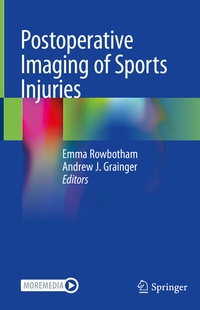
Postoperative Imaging of Sports Injuries
Description

This book describes and illustrates the normal and abnormal postoperative appearances that may be observed following common orthopaedic surgical procedures in patients with sports injuries. The majority of sports injuries comprise ligamentous, cartilage, and tendon injuries at and about the joints. While surgical repair techniques for such injuries have advanced immeasurably over recent years, it is essential that any postoperative abnormalities are recognized promptly. Therefore a key aim of Postoperative Imaging of Sports Injuries is to explain which imaging appearances are to be expected and which are not. The book is primarily organized according to the involved joints and covers procedures for shoulder, elbow, hand and wrist, hip, knee, and foot and ankle injuries. An additional chapter addresses articular cartilage repair techniques and their normal and abnormal imaging appearances. The authors are leading radiologists from Europe and North America who draw on their extensive experience. The book is copiously illustrated and readers will also have online access to ultrasound video clips.
More details
Other editions
Additional editions
Persons
Andrew Grainger is a Consultant Musculoskeletal Radiologist at Cambridge University Hospital and has particular interests in sports imaging and the imaging of joint disease. He has published extensively on the subject of musculoskeletal radiology, with multiple book chapters, peer-reviewed research papers, and review articles to his name. Dr. Grainger is an enthusiastic teacher, lecturer, and demonstrator and is in demand as a lecturer and tutor on national and international platforms. He has a particular interest in the teaching of musculoskeletal ultrasound and the imaging of sports injuries. In his clinical practice, Dr. Grainger is actively involved in the imaging of professional and amateur athletes and has been involved in providing imaging services at a number of large sporting events, including the Olympic Games in London 2012.
Emma Rowbotham is a Consultant Musculoskeletal Radiologist at Leeds Teaching Hospitals and an Honorary Senior Lecturer at the University of Leeds. Her first consultant post was at the Royal United Hospital in Bath, where she developed particular interests in sports radiology. Currently Dr. Rowbotham has a particular interest in ultrasound imaging, for both diagnostic and interventional purposes, and she provides imaging support for numerous sporting clubs and institutions in the north of England. She has edited and co-authored a successful textbook for the FRCR 2a examination, authored several peer-reviewed papers on musculoskeletal imaging, and written book chapters for both radiological and rheumatological textbooks.
