

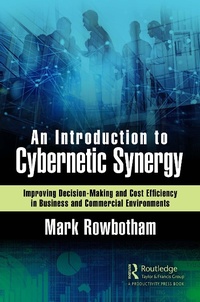
An Introduction to Cybernetic Synergy
Improving Decision-Making and Cost Efficiency in Business and Commercial Environments
1st Edition
Published on 24. May 2021
314 pages
978-1-000-37704-0 (ISBN)
Description

Cybernetics is about having a goal and taking action to achieve that goal. Knowing whether you have reached your goal (or at least are getting closer to it) requires "feedback", a concept that was made rigorous by cybernetics.
The subject of Cybernetic Synergy, although emanating from a socio-economic experiment of economic control by cybernetic means in Chile in the early 1970s, has never been approached as an applied subject in its own right. Indeed, the subject of applied cybernetics has never been addressed as a separate issue, although it has been shown that the overall subject of cybernetics applies to a wide range of disciplines, from biology to business via mathematics and engineering.
Cybernetic synergy is the study of relationships and controls of and between corporate entities, on an external basis, and departments within corporate entities, on an internal basis. It concerns the decision-making process, and how decisions can be made based on feedback from any part of the organization being managed. It therefore concerns the issue of input of raw material or information, the output of the transformed information and materials, and the rectification of any issue based on negative feedback related to the productive process. It investigates not only the basic theory of the subject but also its applications in the commercial and business environment, as well as touching on government and administrative issues where shortcomings have emerged owing to a lack of synergy and communication.
There are already several books available on the subject to cybernetics, but they are all concerned with mathematical approaches along with very heavy technical texts, most of which are completely alien to the layman or the simple practitioner. Furthermore, other than references to business or economic practice in some books, there has never been a book published purely about the subject of applied cybernetics relating to business practices.
The book covers the subjects of management and economic cybernetics, and how the theory of cybernetic control can be used to manage business and government functions, whether small, medium or large. It looks at the history of cybernetics, and how some pioneering cybernetic concepts were used in Chile in the early 1970s to manage the Chilean economy. It uses these same principles, along with later cybernetic models, to show how such concepts can be applied to the present-day economy and business practices. It examines present-day business practices and shows how weaknesses in these systems can be addressed and eliminated by the application of cybernetic practices.
The aims of the book are to provide an insight into the subject of management and business cybernetics, using the principle of cybernetic synergy, to resolve intra-corporate issues and create more efficient business practices based on simple command-and-control processes. Essentially, this book provides an in-depth insight into the use of cybernetics in business and administration environments, and would explain how cybernetics is a valuable tool in resolving corporate issues concerning efficiency and overall control. It would give a detailed explanation of the various practices and functions involved in business operations and practices.
The subject of Cybernetic Synergy, although emanating from a socio-economic experiment of economic control by cybernetic means in Chile in the early 1970s, has never been approached as an applied subject in its own right. Indeed, the subject of applied cybernetics has never been addressed as a separate issue, although it has been shown that the overall subject of cybernetics applies to a wide range of disciplines, from biology to business via mathematics and engineering.
Cybernetic synergy is the study of relationships and controls of and between corporate entities, on an external basis, and departments within corporate entities, on an internal basis. It concerns the decision-making process, and how decisions can be made based on feedback from any part of the organization being managed. It therefore concerns the issue of input of raw material or information, the output of the transformed information and materials, and the rectification of any issue based on negative feedback related to the productive process. It investigates not only the basic theory of the subject but also its applications in the commercial and business environment, as well as touching on government and administrative issues where shortcomings have emerged owing to a lack of synergy and communication.
There are already several books available on the subject to cybernetics, but they are all concerned with mathematical approaches along with very heavy technical texts, most of which are completely alien to the layman or the simple practitioner. Furthermore, other than references to business or economic practice in some books, there has never been a book published purely about the subject of applied cybernetics relating to business practices.
The book covers the subjects of management and economic cybernetics, and how the theory of cybernetic control can be used to manage business and government functions, whether small, medium or large. It looks at the history of cybernetics, and how some pioneering cybernetic concepts were used in Chile in the early 1970s to manage the Chilean economy. It uses these same principles, along with later cybernetic models, to show how such concepts can be applied to the present-day economy and business practices. It examines present-day business practices and shows how weaknesses in these systems can be addressed and eliminated by the application of cybernetic practices.
The aims of the book are to provide an insight into the subject of management and business cybernetics, using the principle of cybernetic synergy, to resolve intra-corporate issues and create more efficient business practices based on simple command-and-control processes. Essentially, this book provides an in-depth insight into the use of cybernetics in business and administration environments, and would explain how cybernetics is a valuable tool in resolving corporate issues concerning efficiency and overall control. It would give a detailed explanation of the various practices and functions involved in business operations and practices.
More details
Edition
1. Auflage
Language
English
Place of publication
London
United Kingdom
Publishing group
Taylor & Francis Ltd
Target group
Professional and scholarly
Illustrations
49 Line drawings, black and white; 49 Illustrations, black and white
ISBN-13
978-1-000-37704-0 (9781000377040)
Copyright in bibliographic data and cover images is held by Nielsen Book Services Limited or by the publishers or by their respective licensors: all rights reserved.
Schweitzer Classification
Other editions
Additional editions
Mark Rowbotham
An Introduction to Cybernetic Synergy
Improving Decision-Making and Cost Efficiency in Business and Commercial Environments
Book
05/2021
1st Edition
CRC Press
€101.60
Shipment within 15-20 days
Person
Mark Rowbotham is a Lecturer in the Maritime Studies Department of Liverpool John Moores University. He is also an independent Consultant, Trainer and writer in Marine and Customs issues, and has spent a considerable length of time working in both the Government, Commercial and Academic sectors.
Content
CYBERNETIC SYNERGY
1 - INTRODUCTION TO CYBERNETICS 2 - A BRIEF HISTORY OF CYBERNETICS 3 - THE VIABLE SYSTEMS MODEL 4 - INPUT, OUTPUT AND DECISION SUPPORT 5- MANAGEMENT CYBERNETICS AND FEEDBACK 6- ECONOMIC CYBERNETICS 7 - NEURAL NETWORKS, CONNECTIVITY, VARIETIES AND THE RATIONALE BEHIND THE VSM 8 - CYBERNETICS AND THE SUPPLY CHAIIN 9 - CYBERNETICS AND QUALITY CONTROL 10 - THE RELATIONSHIP BETWEEN CYBERNETICS AND AEO 11 - CONCLUSIONS
1 - INTRODUCTION TO CYBERNETICS 2 - A BRIEF HISTORY OF CYBERNETICS 3 - THE VIABLE SYSTEMS MODEL 4 - INPUT, OUTPUT AND DECISION SUPPORT 5- MANAGEMENT CYBERNETICS AND FEEDBACK 6- ECONOMIC CYBERNETICS 7 - NEURAL NETWORKS, CONNECTIVITY, VARIETIES AND THE RATIONALE BEHIND THE VSM 8 - CYBERNETICS AND THE SUPPLY CHAIIN 9 - CYBERNETICS AND QUALITY CONTROL 10 - THE RELATIONSHIP BETWEEN CYBERNETICS AND AEO 11 - CONCLUSIONS
