

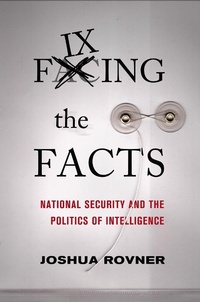
Fixing the Facts
National Security and the Politics of Intelligence
Published on 26. July 2011
280 pages
978-0-8014-6314-3 (ISBN)
Description

What is the role of intelligence agencies in strategy and policy? How do policymakers use (or misuse) intelligence estimates? When do intelligence-policy relations work best? How do intelligence-policy failures influence threat assessment, military strategy, and foreign policy? These questions are at the heart of recent national security controversies, including the 9/11 attacks and the war in Iraq. In both cases the relationship between intelligence and policy broke down-with disastrous consequences.
In Fixing the Facts, Joshua Rovner explores the complex interaction between intelligence and policy and shines a spotlight on the problem of politicization. Major episodes in the history of American foreign policy have been closely tied to the manipulation of intelligence estimates. Rovner describes how the Johnson administration dealt with the intelligence community during the Vietnam War; how President Nixon and President Ford politicized estimates on the Soviet Union; and how pressure from the George W. Bush administration contributed to flawed intelligence on Iraq. He also compares the U.S. case with the British experience between 1998 and 2003, and demonstrates that high-profile government inquiries in both countries were fundamentally wrong about what happened before the war.
In Fixing the Facts, Joshua Rovner explores the complex interaction between intelligence and policy and shines a spotlight on the problem of politicization. Major episodes in the history of American foreign policy have been closely tied to the manipulation of intelligence estimates. Rovner describes how the Johnson administration dealt with the intelligence community during the Vietnam War; how President Nixon and President Ford politicized estimates on the Soviet Union; and how pressure from the George W. Bush administration contributed to flawed intelligence on Iraq. He also compares the U.S. case with the British experience between 1998 and 2003, and demonstrates that high-profile government inquiries in both countries were fundamentally wrong about what happened before the war.
More details
Series
Language
English
Place of publication
Ithaca
United States
Product notice
Reflowable
Illustrations
1 line drawing, 5 tables - 1 Line drawings, black and white
ISBN-13
978-0-8014-6314-3 (9780801463143)
Copyright in bibliographic data and cover images is held by Nielsen Book Services Limited or by the publishers or by their respective licensors: all rights reserved.
Schweitzer Classification
Other editions
Additional editions
Book
09/2015
Cornell University Press
€50.94
Shipment within 15-20 days
Book
07/2011
Cornell University Press
€47.04
Shipment within 10-20 days
Person
Joshua Rovner is the John Goodwin Tower Professor of International Politics and National Security at Southern Methodist University, where he also serves as Director of Studies at the Tower Center for Political Studies.
Content
Preface1. A Basic Problem: The Uncertain Role of Intelligence in National Security
2. Pathologies of Intelligence-Policy Relations
3. Policy Oversell and Politicization
4. The Johnson Administration and the Vietnam Estimates
5. The Nixon Administration and the Soviet Strategic Threat
6. The Ford Administration and the Team B Affair
7. Intelligence, Policy, and the War in Iraq
8. Politics, Politicization, and the Need for SecrecyAppendix A: Pathologies of Intelligence-Policy Relations
Appendix B: Varieties of PoliticizationNotes
Index
2. Pathologies of Intelligence-Policy Relations
3. Policy Oversell and Politicization
4. The Johnson Administration and the Vietnam Estimates
5. The Nixon Administration and the Soviet Strategic Threat
6. The Ford Administration and the Team B Affair
7. Intelligence, Policy, and the War in Iraq
8. Politics, Politicization, and the Need for SecrecyAppendix A: Pathologies of Intelligence-Policy Relations
Appendix B: Varieties of PoliticizationNotes
Index
