

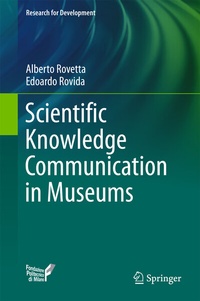
Scientific Knowledge Communication in Museums
Description

More details
Other editions
Additional editions
Persons
Alberto Rovetta is Professor of Innovative Design of Intelligent Robots and Autonomous Systems at the Politecnico di Milano, Italy, where he has held other academic posts over the past four decades, including in robot mechanics. He is also Emeritus Professor for Life at the Beijing University of Aeronautics and Astronautics, China (now known as Beihang University). During a distinguished career, Professor Rovetta has held leading positions in a variety of national and international organizations and committees, including as chairman of the International Federation for Theory of Machines and Mechanisms. In 1995 he was the chairman of the 9th World Conference of Theory of Machines and Mechanisms held in Milan. He has sat on the scientific committees of numerous international conventions and also has an extremely impressive record in design and project management. He has published more than 400 articles in Italian and international journals and holds a number of patents.
EdoardoRovida is Professor of Machine Design at the Politecnico di Milano, Italy. His research areas include methodical design, scientific and technical communication (including the interaction between industrial products and communication and problems in engineering education), and cultural heritage in the mechanical field. He has been involved in the design and realization of various exhibitions, including those celebrating the 125th and 150th anniversaries of the Politecnico di Milano (1988, 2013) and the invention of the battery by Alessandro Volta (1999). Professor Rovida is the author of 250 papers in the aforementioned fields and the book Machines and Signs (History of Mechanism and Machine Science), first published in 2013 by Springer.
Content
1 Scientific museums as scientific communication.- 2 General principles of the scientific communication.- 3 Presentation of posters.- 4 Presentation of objects.- 5 Auxiliary communications in the museums.- 6 Museums and multimediality.- 7 Case studies.
