

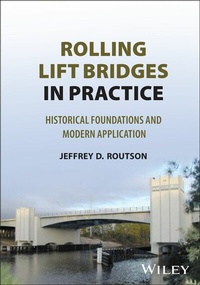
Rolling Lift Bridges in Practice
Description

PROVIDES A DEFINITIVE GUIDE TO THE DESIGN, EVOLUTION, AND PRACTICAL APPLICATION OF SCHERZER ROLLING LIFT BRIDGES
Rolling Lift Bridges in Practice: Historical Foundations and Modern Application addresses a critical gap in contemporary bridge engineering literature by offering both a historical framework and a modern technical guide to Scherzer rolling lift bridges. For engineers tasked with designing resilient, movable structures that accommodate growing transportation demands, this authoritative book delivers the essential understanding to integrate proven mechanisms with today's performance expectations.
Author Jeffrey Routson traces the lineage of the Scherzer rolling lift bridge from its origins, through its technological evolution, and up to its current role in infrastructure development. Routson's analysis details how these bridges have adapted to advancements in materials, mechanical systems, and aesthetics while maintaining the integrity of Scherzer's original concept. In-depth chapters discuss the integration of rolling lift systems with modern technologies, clarify design codes and standards relevant to movable bridge construction and rehabilitation, provide clear technical guidance on optimizing components and assessing and retrofitting aging bridges, and much more.
Empowering bridge and structural engineers to apply time-tested principles with confidence in a present-day context, Rolling Lift Bridges in Practice:
- Provides an annotated inventory of more than 500 bridges worldwide
- Features over 70 technical diagrams and photos illustrating bridge components, movement mechanisms, and structural systems of both early and contemporary Scherzer rolling lift bridge designs
- Includes examples of recent projects showcasing sustainability, efficiency, and cost-effectiveness
- Offers a detailed explanation of kinetic and structural performance factors unique to rolling lift bridges
- Clarifies technical misunderstandings and historical facts related to these bridges and their engineers
Supplying original engineering insights from the author's experience with award-winning bascule bridge projects, Rolling Lift Bridges in Practice: Historical Foundations and Modern Application is ideal for graduate and upper-level undergraduate courses in structural engineering, bridge design, or transportation infrastructure, particularly within civil engineering degree programs. It is also an invaluable reference for professional bridge engineers, infrastructure planners, historians, and consulting firms involved in movable bridge projects.
More details
Other editions
Additional editions
Person
JEFFREY D. ROUTSON, PE, SE, is a licensed Professional and Structural Engineer with more than five decades of experience in design, inspection, and construction of steel bridges and other complex structures. He has held leadership roles at major engineering firms, designed eleven bascule bridges-three of which received national awards-and provided post-event damage evaluation after Hurricane Katrina, Nisqually Earthquake, and multiple vessel-bridge allision events. He remains active in mentoring and standards development through AREMA, ASCE, and AWS. Routson combines historical expertise with hands-on technical knowledge to deliver comprehensive, field-informed insights into movable bridge engineering.
Content
About the Author xi
Preface xiii
Acknowledgments xvii
Abbreviations and Symbols xix
Part I Historical Considerations 1
1 Heaven and Earth, Water and Fire 3
Note 5
2 Seas, Lakes, Rivers, Canals 7
Notes 10
3 Chicago, Illinois 11
Note 13
4 Peru, Illinois 15
5 The Mid-nineteenth-Century Generation 17
Notes 21
6 The Hazelet and Meals Families 23
Notes 26
7 The Sanitary District of Chicago 29
8 William D. Scherzer, Engineer and Inventor 31
Note 34
9 Scherzer Rolling Lift Bridge Co. - The Early Years 35
Notes 40
10 Chicago's Bridge Department 41
Notes 47
11 Albert Scherzer's Death 49
Notes 55
12 Keller & Harrington 57
Notes 58
13 The Scherzer Rolling Lift Bridge Co. 1922-1936 59
Note 60
14 Hazelet & Erdal 61
Notes 65
Part II Technical Considerations 67
15 Early Movable Bridge Types 69
Notes 74
16 Modern Bascule Bridges 75
Note 81
17 Myths, Misunderstandings, and Factual Errors 83
Notes 95
18 Loads and Leaf Balance 97
Notes 104
19 Structural Forms for Bascule Spans 105
20 Foundations 111
Notes 116
21 Treads, Tracks, and Their Girders 117
Segmental Girders and Track Girders 141
Notes 145
22 Bascule Structure 147
Notes 161
23 Mid-span Shear Locks 163
Notes 169
24 Operating Systems 171
Notes 179
25 Safety Features 181
Notes 186
Appendix A List of Rolling Lift Bridges 187
Appendix B List of US Patents 201
Bibliography 205
Index 213
Preface
This is a book about rolling lift bridges. It provides a history of their creation and development. It is also about the engineers and others who were involved with their development. It is hoped that knowing the history of the bridges and the people, along with the technical content, will help to further one's professional abilities or to enhance their appreciation of these types of bridges.
The intended audience for this book includes, of course, movable bridge engineers. It also includes bridge engineers in general, bridge owners, bridge builders, those who maintain bridges, those who teach engineering, and students who are trying to decide on their career path. Historians may find much of the first 17 chapters useful, and if they are involved with preparing or using HAER, EIS, or similar documents, Chapter 17 should be of particular interest. The technical portions of this book focus on rolling lift bridges in particular, but some items may be applicable to other types of bridges as well.
Since 1895, hundreds of rolling lift bridges have been constructed throughout the world. The vast majority of them were constructed in the United States, but they have been built in at least 24 other countries and on all continents except Antarctica. These bridges have been successfully used for both railway traffic and for roadway traffic. William Donald Scherzer developed the modern concept for and patented the modern rolling lift bridge in 1893. That patented bridge was highly promoted by the Scherzer Rolling Lift Bridge Company. It was also derided by some engineers who had competing interests. Some criticism was probably valid, at least in part, but overall the bridge type is solid, economical, and offers some real advantages. After the initial patent protection expired, a number of other engineers and firms began to design rolling lift bridges.
To the author's knowledge, there are three widely accepted documents for the design and construction of movable bridges. These are the Manual for Railway Engineering, published by the American Railway Engineering and Maintenance of Way Association (AREMA); the AASHTO LRFD Movable Highway Bridge Design Specifications, published by the American Association of State Highway and Transportation Officials (AASHTO); and the Canadian Highway Bridge Design Code (CHBDC), published by the Canadian Standards Association (CSA). The American Railway Engineering Association (AREA) was the predecessor to AREMA, and the American Association of State Highway Officials (AASHO) was the predecessor to AASHTO. These abbreviations will be used throughout this book.
The portions of the AASHTO and CSA documents relating to treads, tracks, segmental girders, and track girders for rolling lift bridges are based on the AREA Specifications for Movable Railway Bridges published in 1935. The 2024 edition of the AREMA Manual included significant updates related to treads and tracks for rolling lift railway bridges and the related segmental girders and track girders.1 To a significant degree, those updates are based on a study by the Author and a resulting paper (unpublished) that was presented to AREMA Committee 15.2 To a significant degree, the information presented in Chapter 21 is based on the results of that study. It should be kept in mind that for at least a period of time, the specified design criteria for highway bridges will differ from the design criteria for railway bridges. It is hoped that in the future, when an engineer is designing a new rolling lift bridge or evaluating an existing bridge, the more conservative criteria contained herein are taken into consideration.
Regarding units, the information presented in this book is based on US Customary Units (USCU), since most of the historic information was given in that unit system and it is the system in general use in the US bridge industry. It should be noted that all equations in this book are applicable to either the USCU or the International System of Units (SI). All mathematical constants are independent of the unit system used. The same equation may be used with either system. The user is responsible to assure that dissimilar units (e.g. feet, inches, and pounds; or meters, millimeters, kilograms, and newtons) are used appropriately.
It is probably accurate to say that all types of movable bridges have experienced some forms of problems since 1900. These problems have affected the primary structural systems, the mechanical/hydraulic systems, and the electrical systems. Some problems may have affected a single type of movable bridge, and other problems may have affected multiple types of bridges. Most structural problems were probably related to fatigue, at least for bridges built before the 1970s.
It is important to realize that all current codes, specifications, and manuals are continuously revised and improved to reflect the ever-increasing body of knowledge. It is one thing to blindly follow the formulas and requirements of those documents; that should lead to an adequate and serviceable bridge. However, one should understand the degree of conservatism that is appropriate for each individual bridge and its details and incorporate that conservatism into the final work.
The state of knowledge for bridge engineering has always evolved and will continue to evolve. An undergraduate education in engineering may prepare an individual to enter the bridge engineering field, but if one desires to become truly knowledgeable, then it is imperative to understand what has been done in the past, why it was done, how it performed over time, and the lessons that can be learned.
James Buchanan Eads was a true American genius in the mid-1800s. When James was 13, his family decided to move from Louisville, Kentucky to St. Louis, Missouri. While James's father remained in Louisville to settle their financial affairs, James accompanied his mother and two sisters to St. Louis. Just before landing in St. Louis, a fire aboard the riverboat destroyed all of the family possessions. They disembarked with only the clothes that they wore. Instead of attending school, James helped to provide for his mother and sisters by selling apples on the streets. A businessman recognized his industriousness and gave Eads a job and access to his private collection of books. James worked during the day and read in the evenings. Later, he began working on riverboats. He studied the river and learned virtually everything there was to know about the Mississippi River. Realizing that there were numerous sunken riverboats, he started a salvage company. To recover the sunken cargo, he developed a diving bell and literally walked the river bottom from New Orleans, Louisiana to north of St. Louis. He eventually made a fortune.
During the American Civil War, Eads realized that control of the Mississippi River would be critical. He developed and built gun-boats for the Union, at his own cost. Nevertheless, he was reimbursed after the war.
With the fast growth of the railroads after the war, he recognized the need for a bridge over the Mississippi River, so he designed a double-deck bridge for railway traffic on the lower deck and horse and wagons on the upper deck. The expert bridge engineers of the time said that it could not be built, and if it was, that it would not last for long. In Europe, he learned about pneumatic caissons. Improving their design, he used that method to build bridge piers, founding them on bedrock. He dictated a new high-strength steel for the superstructure. Three main spans of 502, 520, and 502 ft, are each supported by four doubly redundant steel arches. Eads completed the bridge in 1874, and it has withstood everything thrown at it from Mother Nature, Father Time, and an errant towboat that severed one of the bottom chord members. Now supporting modern traffic, the bridge is still in service after 150 years.
Eads was not yet done. The mouth of the Mississippi River was shallow with shifting sandbars that made navigation difficult at best. He proposed a method to cure that problem, but the US Army Engineers said it would not work and would not let him proceed. Eads fought for his case all the way to Washington and won permission. He built it and it performed beyond even his expectations, thus opening the Mississippi River to reliable navigation by ocean-going ships.
In the 1880s, Eads promoted a multitrack railroad across Mexico that could transport ocean liners between the Atlantic and Pacific oceans. There was not only a lot of opposition to his proposal, but also a lot of support. After Eads passed away in 1887, that proposal died with him.
Knowing the life of James Buchanan Eads should be an inspiration to all, not just engineers. If one prepares thoroughly, works hard, and pursues their dream with determination, then they are likely to succeed.
Any serious engineer, whether young or not so young, should continue to read about historical figures and historical projects, along with keeping up with the current state of the art. There is no shortage of excellent books and other materials. The number of excellent books that are available is unlimited. Also, many surprisingly excellent videos may be found on the Internet. Just keep reading and learning.
Jeffrey D. Routson
Mason, Michigan
