

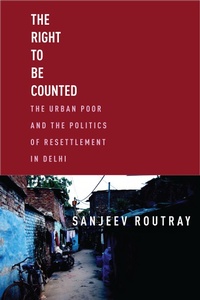
The Right to Be Counted
The Urban Poorand the Politics of Resettlement in Delhi
Published on 12. July 2022
368 pages
978-1-5036-3214-1 (ISBN)
Description

In the last 30 years, Delhi, the capital of India, has displaced over 1.5 million poor people. Resettlement and welfare services are available-but exclusively so, as the city deems much of the population ineligible for civic benefits. The Right to Be Counted examines how Delhi's urban poor, in an effort to gain visibility from the local state, incrementally stake their claims to a house and life in the city. Contributing to debates about the contradictions of state governmentality and the citizenship projects of the poor in Delhi, this book explores social suffering, logistics, and the logic of political mobilizations that emanate from processes of displacement and resettlement. Sanjeev Routray draws upon fieldwork conducted in various low-income neighborhoods throughout the 2010s to describe the process of claims-making as an attempt by the political community of the poor to assert its existence and numerical strength, and demonstrates how this struggle to be counted constitutes the systematic, protracted, and incremental political process by which the poor claim their substantive entitlements and become entrenched in the city. Analyzing various social, political, and economic relationships, as well as kinship networks and solidarity linkages across the political and social spectrum, this book traces the ways the poor work to gain a foothold in Delhi and establish agency for themselves.
Reviews / Votes
"The Right to Be Counted presents a rich ethnographic analysis of the range of strategies adopted by displaced populations crowding into urban slums to stake their claim to belong to the city. Routray's depiction of 'numerical citizenship' is persuasive and enlightening. This is a valuable addition to the growing literature on popular politics in megacities."-Partha Chatterjee, Columbia University "This is a 'how things work' book of top quality. With deep, analytical, thoughtful scholarship, Routray provides one of the clearest and most accessible accounts of how the poor fight to make a home in Delhi."-Durba Chattaraj, Ashoka University "Routray offers an impressive and authoritative account that displays a remarkable ability to synthesize interdisciplinary ideas from across disciplines and geographies, while always building his theorizing from a deep commitment to a historically informed ethnography. I learned so much about the relationship between housing, politics and citizenship in Delhi, and beyond. I am sure this text will resonate well beyond its origins."-Ryan Powell, Housing Studies "Routray's book highlights how the logics of planning are employed not only by the powerful to suit the interests of global city making but also by marginalized communities to resist processes of uprooting and work to secure the rights of urban citizenship. The author navigates the difficult task of arguing for the agency of Delhi's urban poor while documenting the profound injustice and suffering they endure in the process."-Shoshana Goldstein, Journal of the American Planning Association "[The Right to be Counted] is a fine-grained ethnography of the politics of the poor in Delhi, and it deserves commendation."-Diya Mehra, Contributions to Indian Sociology "The Right to be Counted is an ethnographic masterpiece on how politics 'actually' works in Delhi's informal settlements. Sanjeev Routray's analysis and arguments skillfully cover the multi-scalar and relational practices, agents, and sites that shape and realise citizenship for residents of these settlements."-Naomi Hazarika, Journal of Contemporary Asia "The Right to Be Counted: The Urban Poor and The Politics of Resettlement in Delhi by Sanjeev Routray offers a compelling analysis of citizenship struggles of the urban poor in contemporary times."-Paroj Banerjee, Society and SpaceAll prices
More details
Series
Edition
New edition
Language
English
Place of publication
Palo Alto
United States
Target group
Professional and scholarly
Edition type
New edition
Illustrations
20 s/w Abbildungen
3 tables, 20 halftones
ISBN-13
978-1-5036-3214-1 (9781503632141)
Copyright in bibliographic data and cover images is held by Nielsen Book Services Limited or by the publishers or by their respective licensors: all rights reserved.
Schweitzer Classification
Other editions
Additional editions
Book
07/2022
Stanford University Press
€91.50
Shipment within 15-20 days
Book
07/2022
Stanford University Press
€30.50
Shipment within 15-20 days

Book
06/2022
Stanford University Press
€30.00
Shipment within 15-20 days

Book
06/2022
Stanford University Press
€86.00
Shipment within 15-20 days
Person
Sanjeev Routray is Assistant Professor in the Institute of Asian Studies at Universiti Brunei Darussalam.
Content
- Intro
- Title Page
- Copyright
- Series Page
- Dedication
- Contents
- Tables and Figures
- Acknowledgments
- Abbreviations
- Introduction: Numerical Citizenship Struggles in Contemporary Delhi
- Part I: The Politics of Planning
- 1. The Political Economy of Urban Planning, Calculative Governmentality, and the Urban Poor
- 2. The Planning of Demolition and Resettlement: Structural Violence and Social Suffering of the Poor
- Part II: The Politics of the Poor
- 3. Infrastructure and Intermediaries: Mediated Politics of Pradhans, Samaj Sevaks, and Sarkari Karmacharis
- 4. Documentary Practices and the Counter-tactics of Enumeration
- 5. The Judiciary, the Middle Class, and the Poor
- 6. Cultural Idioms and Performances of Resistance
- Conclusion: Numerical Citizenship and the Political Agency of the Urban Poor
- Glossary of Hindi Terms
- Notes
- References
- Index
- Series List

