

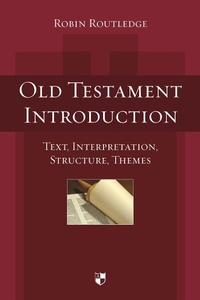
Old Testament Introduction
Description

The Old Testament is part of the canon of Christian Scripture and, as such, has continuing significance for the church. However, the writings are set within a different historical era, a different culture and a different religious context. To understand the Old Testament in a meaningful way, it must be read against its historical, cultural and theological background.
Here, Robin Routledge enables readers to engage with the text. He discusses:
? date, authorship, the writers' intention and purpose, and significant textual issues
? key scholarly approaches to the text, including historical-critical and literary approaches
To help us comprehend and interpret the Old Testament, and so apply it to current belief and praxis, Routledge includes an overview of exegetical and hermeneutical approaches. He also offers some guidance through the maze of new treatments and terminology.
The volume provides specific introductions to the sections and books of the Old Testament, following the canonical order of the Hebrew text. In addition, Routledge notes key distinctive issues and points to sources for further study.
The author's hope is that this volume will not only aid students but will also benefit others who want to take the Old Testament seriously, and to apply its message to the life and ministry of the church today.
'Scholarly and lucid, Old Testament Introduction is designed especially for those who want to understand how to read the Old Testament as Christian Scripture, while doing justice to its nuances and enormous diversity. I commend it warmly.'
Gordon McConville, Professor of Old Testament Theology, University of Gloucestershire
More details
Other editions
Additional editions
Person
Content
- Intro
- Preface
- Acknowledgments
- Abbreviations
- 1. The significance of the Old Testament
- What's in a name?
- The Christian significance of the Old Testament
- The Old Testament as revelation
- 2. What is the Old Testament? Canon and text
- The Old Testament canon
- The text of the Old Testament: textual criticism
- Historical criticism
- 3. The Old Testament in its context
- The geographical background
- The historical background
- The Old Testament and ancient Near Eastern literature
- 4. What kind of text?
- Genre criticism
- Poetry
- Old Testament narrative
- Prophecy
- Wisdom literature
- Apocalyptic
- 5. Interpreting the Old Testament
- The 'meaning' of a text
- Approaches to the interpretation of the Old Testament
- Meaning and the author's intention
- 6. The Pentateuch
- Introduction to the Pentateuch
- Genesis
- Exodus
- Leviticus
- Numbers
- Deuteronomy
- 7. The Former Prophets
- The Deuteronomistic History
- Joshua
- Judges
- 1 and 2 Samuel
- 1 and 2 Kings
- 8. The Latter Prophets
- Isaiah
- Jeremiah
- Ezekiel
- The Twelve (Minor Prophets)
- Hosea
- Joel
- Amos
- Obadiah
- Jonah
- Micah
- Nahum
- Habakkuk
- Zephaniah
- Haggai
- Zechariah
- Malachi
- 9. The Writings
- Psalms
- Job
- Proverbs
- The megillôt (scrolls)
- Ruth
- Song of Songs
- Ecclesiastes
- Lamentations
- Esther
- Daniel
- Ezra-Nehemiah
- Chronicles
- Further reading
- Old Testament canon
- Historicity of the Old Testament
- Wisdom teaching in the Old Testament
- Bibliography
- Search names for modern authors
- Search items for subjects
- Search items for Scripture references
- Notes
