

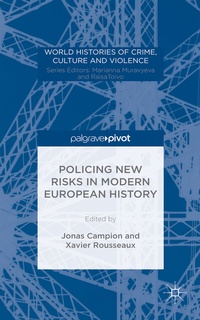
Policing New Risks in Modern European History
Description

Authorities often fear societal change as it implies finding a new balance to live together within society. Whether it is defined by economic, political, social or cultural factors, the transformation of life in society is considered by authorities as a 'risk' that needs to be framed and controlled. The state's response to this situation of transformation can be analysed through the prism of the police. Informally or not, police systems adapt their regulatory frameworks, their structures and their practices in order to respond risks, new threats and new rules. This process, which is mostly of a contemporary nature, is also deeply historic. Analysing it on the long run is therefore particularly relevant. From the late nineteenth-century until the second half of the twentieth-century, Policing New Risks in Modern European History provides a panorama of political and police reactions to the 'risks' of societal change in a Western European perspective, focusing on Belgium, France, and The Netherlands, but also colonial perspectives.
More details
Other editions
Additional editions
Persons
Xavier Rousseaux is Research Director at the National Funds for Scientific Research, FRS-FNRS, Belgium, and Professor at the Université Catholique de Louvain, Centre for Law and Justice History, Belgium. Working on the history of crime and justice, he is coordinating the IAP Network 7/22 (Belgian Science Policy), 'Justice & Populations: The Belgian Experience in International Perspective, 1795-1950'. He recently published 'A History of Crime and Criminal Justice in Europe' , in S. Body-Gendrot et al's, Handbook of European Criminology (2013).
Content
1. New Threats or Phantom Menace? Police Institutions Facing Crises; Jonas Campion and Xavier Rousseaux
2. Crossing Frontiers to Chase Offenders: The Hardships of French and Belgian Police Collaboration at the Beginning of the 20th Century; Laurent López
3. The Criminology and Forensic Police School: The Twofold Project to Humanize Judicial Practice and to Implement Technical Police in Belgium; David Somer
4. Suspect Cities and the (Re)Making of Colonial Order: Urbanization, Security Anxieties and Police Reforms in Postwar Congo (1945-1960); Amandine Lauro
5. The Dutch Police and the Explosion of Violence in the Early 1980s; Guus Meershoek
6. Conclusion: Risk Policing and the Art of Adaptation; Margo De Koster
