

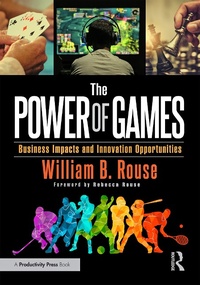
The Power of Games
Business Impacts and Innovation Opportunities
1st Edition
Published on 18. September 2024
150 pages
978-1-040-10524-5 (ISBN)
Description

Games have long played a central role in society - actually a central role in the animal kingdom. Their play provides primary behavioral mechanisms that enable animals to learn and socialize. Indeed, "play" is a core animal activity. The principal focus of this book is on how games foster human playing, learning, and competing, including how we can design games to do this better. The author provides a wealth of real-world examples of how he created games for clients in the domains of education, energy, healthcare, national security, and transportation. He has focused on training and aiding for strategic thinking, product planning, technology development, and business operations.
The technologies underlying these games became increasingly sophisticated. This has taken on greater significance as the gaming industry has grown and prospered. Gaming revenues now dwarf film and theater. New games released gain millions of sales within a few days of release. What makes games so appealing? What is the psychology of gaming? Does it vary for card games, board games, simulation games, and online games? What makes a game successful over years? What about sports games? What sociological roles do they play in our society? Why do they claim such energy and devotion? Why are sports stars able to earn enormous contracts? What is the business of these games? Why is it expected to be increasingly lucrative? What strategies might succeed or fail? Who might be the losers and winners? This book addresses all of these questions as well as an overarching question for society - Can online games fundamentally enhance the education of employees and students? The author is convinced they can.
This requires, however, that games be designed to achieve these ends. This book is intended to contribute to understanding how to create and evaluate such games. Essentially, games enable employees and managers to play, learn, compete, and achieve in terms of knowledge and skills gained, competencies attained, customers attracted, and economic outcomes. This book explains, illustrates, and motivates investments in these pursuits to these ends.
The technologies underlying these games became increasingly sophisticated. This has taken on greater significance as the gaming industry has grown and prospered. Gaming revenues now dwarf film and theater. New games released gain millions of sales within a few days of release. What makes games so appealing? What is the psychology of gaming? Does it vary for card games, board games, simulation games, and online games? What makes a game successful over years? What about sports games? What sociological roles do they play in our society? Why do they claim such energy and devotion? Why are sports stars able to earn enormous contracts? What is the business of these games? Why is it expected to be increasingly lucrative? What strategies might succeed or fail? Who might be the losers and winners? This book addresses all of these questions as well as an overarching question for society - Can online games fundamentally enhance the education of employees and students? The author is convinced they can.
This requires, however, that games be designed to achieve these ends. This book is intended to contribute to understanding how to create and evaluate such games. Essentially, games enable employees and managers to play, learn, compete, and achieve in terms of knowledge and skills gained, competencies attained, customers attracted, and economic outcomes. This book explains, illustrates, and motivates investments in these pursuits to these ends.
More details
Edition
1. Auflage
Language
English
Place of publication
London
United Kingdom
Publishing group
Taylor & Francis Ltd
Target group
College/higher education
Professional and scholarly
Illustrations
28 Tables, black and white; 33 Line drawings, black and white; 33 Illustrations, black and white
ISBN-13
978-1-040-10524-5 (9781040105245)
Copyright in bibliographic data and cover images is held by Nielsen Book Services Limited or by the publishers or by their respective licensors: all rights reserved.
Schweitzer Classification
Other editions
Additional editions
Book
09/2024
1st Edition
Productivity Press
€185.80
Shipment within 10-20 days
Book
09/2024
1st Edition
Productivity Press
€49.40
Shipment within 10-20 days
Person
William B. Rouse is a Research Professor in the McCourt School of Public Policy at Georgetown University, as well as a Senior Fellow in the office of the Senior Vice President for Research, Professor Emeritus, and former Chair of the School of Industrial and Systems Engineering at the Georgia Institute of Technology, and Principal at Curis Meditor, a firm focused on the health of people, processes, organizations, and society. His research focuses on understanding and managing complex public-private systems such as healthcare delivery, higher education, transportation, and national security, with emphasis on the mathematical and computational modeling of these systems for the purpose of policy design and analysis.
Rouse has written hundreds of articles and book chapters, and has authored many books, including most recently Design of a Human-Centered Society (Routledge, 2024), Beyond Quick Fixes (Oxford, 2023), Bigger Pictures for Innovation (Routledge, 2023), Transforming Public-Private Ecosystems (Oxford, 2022), Failure Management (Oxford, 2021), Computing Possible Futures (Oxford, 2019), Universities as Complex Enterprises (Wiley, 2016), Modeling and Visualization of Complex Systems and Enterprises (Wiley, 2015), Understanding and Managing the Complexity of Healthcare (MIT Press, 2014), Economic Systems Analysis and Assessment (Wiley, 2011), People and Organizations: Explorations of Human-Centered Design (Wiley, 2007), Essential Challenges of Strategic Management (Wiley, 2001) and the award-winning Don't Jump to Solutions (Jossey-Bass, 1998). He has edited or co-edited numerous books including Perspectives on Complex Global Challenges (Wiley, 2016), Engineering the System of Healthcare Delivery (IOS Press, 2010), The Economics of Human Systems Integration (Wiley, 2010), Enterprise Transformation: Understanding and Enabling Fundamental Change (Wiley, 2006), Organizational Simulation: From Modeling & Simulation to Games & Entertainment (Wiley, 2005), the best-selling Handbook of Systems Engineering and Management (Wiley, 1999, 2009), and the eight-volume series Human/Technology Interaction in Complex Systems (Elsevier).
Among many advisory roles, he has served as Chair of the Committee on Human Factors (now Board on Human Systems Integration) of the National Academies, a member of the advisory committee for the Division of Behavioral and Social Sciences and Education of the National Academies, a member of the U.S. Air Force Scientific Advisory Board, and a member of the DoD Senior Advisory Group on Modeling and Simulation. He has been designated a lifetime National Associate of the National Research Council and National Academies. Rouse is a member of the National Academy of Engineering and has been elected a fellow of four professional societies -- Institute of Electrical and Electronics Engineers (IEEE), the International Council on Systems Engineering (INCOSE), the Institute for Operations Research and Management Science (INFORMS), and the Human Factors and Ergonomics Society (HFES).
Rouse received his B.S. from the University of Rhode Island, and his S.M. and Ph.D. from the Massachusetts Institute of Technology.
Rouse has written hundreds of articles and book chapters, and has authored many books, including most recently Design of a Human-Centered Society (Routledge, 2024), Beyond Quick Fixes (Oxford, 2023), Bigger Pictures for Innovation (Routledge, 2023), Transforming Public-Private Ecosystems (Oxford, 2022), Failure Management (Oxford, 2021), Computing Possible Futures (Oxford, 2019), Universities as Complex Enterprises (Wiley, 2016), Modeling and Visualization of Complex Systems and Enterprises (Wiley, 2015), Understanding and Managing the Complexity of Healthcare (MIT Press, 2014), Economic Systems Analysis and Assessment (Wiley, 2011), People and Organizations: Explorations of Human-Centered Design (Wiley, 2007), Essential Challenges of Strategic Management (Wiley, 2001) and the award-winning Don't Jump to Solutions (Jossey-Bass, 1998). He has edited or co-edited numerous books including Perspectives on Complex Global Challenges (Wiley, 2016), Engineering the System of Healthcare Delivery (IOS Press, 2010), The Economics of Human Systems Integration (Wiley, 2010), Enterprise Transformation: Understanding and Enabling Fundamental Change (Wiley, 2006), Organizational Simulation: From Modeling & Simulation to Games & Entertainment (Wiley, 2005), the best-selling Handbook of Systems Engineering and Management (Wiley, 1999, 2009), and the eight-volume series Human/Technology Interaction in Complex Systems (Elsevier).
Among many advisory roles, he has served as Chair of the Committee on Human Factors (now Board on Human Systems Integration) of the National Academies, a member of the advisory committee for the Division of Behavioral and Social Sciences and Education of the National Academies, a member of the U.S. Air Force Scientific Advisory Board, and a member of the DoD Senior Advisory Group on Modeling and Simulation. He has been designated a lifetime National Associate of the National Research Council and National Academies. Rouse is a member of the National Academy of Engineering and has been elected a fellow of four professional societies -- Institute of Electrical and Electronics Engineers (IEEE), the International Council on Systems Engineering (INCOSE), the Institute for Operations Research and Management Science (INFORMS), and the Human Factors and Ergonomics Society (HFES).
Rouse received his B.S. from the University of Rhode Island, and his S.M. and Ph.D. from the Massachusetts Institute of Technology.
Content
1. Playing Games 2. Types of Games 3. History of Games 4. Psychology of Games 5. Sociology of Games 6. Politics of Games 7. Games for Learning 8. Serious Games 9. Game Industry 10. Future of Gaming
