

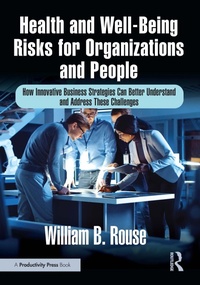
Health and Well-Being Risks for Organizations and People
How Innovative Business Strategies Can Better Understand and Address These Challenges
Published on 19. December 2025
182 pages
978-1-040-75352-1 (ISBN)
Description

From climate disasters to technological disruptions, society faces an unprecedented wave of risks that threaten global stability and economic security. Each year, over 20 million people die due to pollution, disease, accidents, and environmental hazards, while millions more suffer long-term health effects. Yet, within these challenges lie vast business opportunities for industries prepared to lead in risk mitigation.
This book examines how the healthcare, insurance, construction, and manufacturing sectors can adapt, innovate, and thrive in a world increasingly characterized by unpredictable risks. From addressing systemic vulnerabilities in the healthcare industry to integrating sustainability into manufacturing practices, leaders must reassess their strategies to strike a balance between resilience and profitability.
As technology accelerates societal integration, whether through cyber advancements or social media, the pace at which risks emerge and propagate continues to grow. Companies that embrace this new reality, integrating risk mitigation into their business models, will not only safeguard their operations but also unlock new opportunities for innovation, market expansion, and sustained competitive advantage. Those that fail to adapt will be left behind in the wake of creative destruction.
This book is a roadmap for forward-thinking professionals, providing insights, strategies, and frameworks to navigate emerging risks and position their businesses for long term success.
This book examines how the healthcare, insurance, construction, and manufacturing sectors can adapt, innovate, and thrive in a world increasingly characterized by unpredictable risks. From addressing systemic vulnerabilities in the healthcare industry to integrating sustainability into manufacturing practices, leaders must reassess their strategies to strike a balance between resilience and profitability.
As technology accelerates societal integration, whether through cyber advancements or social media, the pace at which risks emerge and propagate continues to grow. Companies that embrace this new reality, integrating risk mitigation into their business models, will not only safeguard their operations but also unlock new opportunities for innovation, market expansion, and sustained competitive advantage. Those that fail to adapt will be left behind in the wake of creative destruction.
This book is a roadmap for forward-thinking professionals, providing insights, strategies, and frameworks to navigate emerging risks and position their businesses for long term success.
More details
Language
English
Place of publication
London
United Kingdom
Publishing group
Taylor & Francis Ltd
Target group
Professional and scholarly
Illustrations
18 Tables, black and white; 16 Line drawings, black and white; 16 Illustrations, black and white
File size
7,22 MB
ISBN-13
978-1-040-75352-1 (9781040753521)
Copyright in bibliographic data and cover images is held by Nielsen Book Services Limited or by the publishers or by their respective licensors: all rights reserved.
Schweitzer Classification
Other editions
Additional editions
William B. Rouse
Health and Well-Being Risks for Organizations and People
How Innovative Business Strategies Can Better Understand and Address These Challenges
Book
approx. 12/2025
1st Edition
Productivity Press
€196.00
Not yet published
William B. Rouse
Health and Well-Being Risks for Organizations and People
How Innovative Business Strategies Can Better Understand and Address These Challenges
Book
approx. 12/2025
1st Edition
Productivity Press
€55.60
Not yet published
Person
William B. Rouse, PhD, is Professor Emeritus and former Chair of the School of Industrial and Systems Engineering at the Georgia Institute of Technology. He has served on the faculties of Tufts University, University of Illinois, Delft University of Technology, Georgia Tech, Stevens Institute of Technology, and Georgetown University. He was founder and CEO of two software companies, Search Technology, Inc. and Enterprise Support Systems, Inc.
His research focuses on understanding and managing complex public-private systems such as healthcare delivery, higher education, energy, transportation, urban systems, and national security, with emphasis on mathematical and computational modeling of these systems for the purpose of policy design and analysis. His recent books include Innovations for Transformation (Routledge, 2025), Essential Business Challenges (Routledge, 2025), Innovation Ecosystems (Routledge, 2024), The Power of Games (Routledge, 2024), From Human-Centered Design to Human-Centered Society (Routledge, 2024), Beyond Quick Fixes (Oxford, 2023), Bigger Pictures for Innovation (Routledge, 2023), Transforming Public-Private Ecosystems (Oxford, 2022), Failure Management (Oxford, 2021), and Computing Possible Futures (Oxford, 2019).
Among many advisory roles, he has served as Chair of the Committee on Human Factors (now Board on Human Systems Integration) of the National Academies, a member of the advisory committee for the Division of Behavioral and Social Sciences and Education of the National Academies, a member of the US Air Force Scientific Advisory Board, and a member of the DoD Senior Advisory Group on Modeling and Simulation. He has been designated a lifetime National Associate of the National Research Council and National Academies.
Rouse is an elected member of the National Academy of Engineering and has been elected a fellow of four professional societies-the Institute of Electrical and Electronics Engineers (IEEE), the International Council on Systems Engineering (INCOSE), the Institute for Operations Research and Management Science (INFORMS), and the Human Factors and Ergonomics Society (HFES). He received his B.S. from the University of Rhode Island, and his S.M. and Ph.D. from the Massachusetts Institute of Technology.
His research focuses on understanding and managing complex public-private systems such as healthcare delivery, higher education, energy, transportation, urban systems, and national security, with emphasis on mathematical and computational modeling of these systems for the purpose of policy design and analysis. His recent books include Innovations for Transformation (Routledge, 2025), Essential Business Challenges (Routledge, 2025), Innovation Ecosystems (Routledge, 2024), The Power of Games (Routledge, 2024), From Human-Centered Design to Human-Centered Society (Routledge, 2024), Beyond Quick Fixes (Oxford, 2023), Bigger Pictures for Innovation (Routledge, 2023), Transforming Public-Private Ecosystems (Oxford, 2022), Failure Management (Oxford, 2021), and Computing Possible Futures (Oxford, 2019).
Among many advisory roles, he has served as Chair of the Committee on Human Factors (now Board on Human Systems Integration) of the National Academies, a member of the advisory committee for the Division of Behavioral and Social Sciences and Education of the National Academies, a member of the US Air Force Scientific Advisory Board, and a member of the DoD Senior Advisory Group on Modeling and Simulation. He has been designated a lifetime National Associate of the National Research Council and National Academies.
Rouse is an elected member of the National Academy of Engineering and has been elected a fellow of four professional societies-the Institute of Electrical and Electronics Engineers (IEEE), the International Council on Systems Engineering (INCOSE), the Institute for Operations Research and Management Science (INFORMS), and the Human Factors and Ergonomics Society (HFES). He received his B.S. from the University of Rhode Island, and his S.M. and Ph.D. from the Massachusetts Institute of Technology.
Content
Chap. 1 Risk Ecosystem Chap. 2 Climate & Weather Chap. 3 Water & Food Chap. 4 Technologies & Practices Chap. 5 Overall Ecosystem Chap. 6 Prospects
