

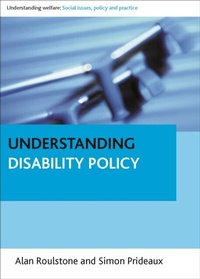
Understanding Disability Policy
1st Edition
Published on 18. January 2012
256 pages
978-1-4473-1449-3 (ISBN)
Description

In an era of scarce social resources the question of the changing social policy constructions and responses to disabled people has become increasingly important. Paradoxically, some disabled people are realising new freedoms and choices never before envisioned, whilst others are prey to major retractions in public services and aggressive attempts to redefine who counts as 'genuinely disabled'.
Understanding disability policy locates disability policy into broader social policy and welfare policy writings and goes beyond narrow statutory evaluations of welfare to embrace a range of indicators of disabled people's welfare. The book critically explores the roles of social security, social support, poverty, socio-economic status, community safety, official discourses and spatial change in shaping disabled people's opportunities. It also situates welfare and disability policy in the broader conceptual shifts to the social model of disability and its critics. Finally it explores the possible connection between changing official and academic constructions of disability and their implications for social policy in the 21st century.
The book is supported by a companion website, containing additional materials for both students and lecturers using the book, which is available from the link above.
Understanding disability policy locates disability policy into broader social policy and welfare policy writings and goes beyond narrow statutory evaluations of welfare to embrace a range of indicators of disabled people's welfare. The book critically explores the roles of social security, social support, poverty, socio-economic status, community safety, official discourses and spatial change in shaping disabled people's opportunities. It also situates welfare and disability policy in the broader conceptual shifts to the social model of disability and its critics. Finally it explores the possible connection between changing official and academic constructions of disability and their implications for social policy in the 21st century.
The book is supported by a companion website, containing additional materials for both students and lecturers using the book, which is available from the link above.
More details
Other editions
Additional editions
Alan Roulstone | Simon Prideaux
Understanding Disability Policy
Book
01/2012
1st Edition
Policy Press
€38.90
Shipment within 15-20 days
Alan Roulstone | Simon Prideaux
Understanding Disability Policy
Book
01/2012
1st Edition
Policy Press
€91.80
Shipment within 15-20 days
Alan Roulstone | Simon Prideaux
Understanding Disability Policy
E-Book
01/2012
1st Edition
Policy Press
€47.99
Available for download
Persons
Author
University of Leeds
Alan Roulstone is Professor of Applied Social Sciences (Disability Policy) at Northumbria University and Honorary Professor at Swansea University, UK. Alan is a disabled person who has written and researched extensively around disability policy and practice.
Alan Roulstone is Professor of Applied Social Sciences (Disability Policy) at Northumbria University and Honorary Professor at Swansea University, UK. Alan is a disabled person who has written and researched extensively around disability policy and practice.
School of Sociology and Social Policy, University of Leeds
Simon Prideaux is an Associate Professor of Social Policy, Disability and Crime at the University of Leeds, UK. He has written widely on social policy and has a growing profile within disability studies. His interests take in comparative access policy, welfare discourses, conditionality and political ideologies.
Simon Prideaux is an Associate Professor of Social Policy, Disability and Crime at the University of Leeds, UK. He has written widely on social policy and has a growing profile within disability studies. His interests take in comparative access policy, welfare discourses, conditionality and political ideologies.
Content
Introduction; Contextualising disability welfare policy; Cure, care and protect: the paternalist policy heritage; Clauses for conditionality: activating disabled adults; Aiming high enough? Disabled children and the mainstream lives; Getting it right? The impact of recent disability policy; Out of the labyrinth: the disability benefits system unpacked; Widening the policy gaze: what can we learn from comparative disability policy analysis; Conclusions.
