

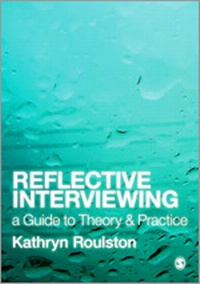
Reflective Interviewing
A Guide to Theory and Practice
1st Edition
Published on 21. January 2010
216 pages
978-1-4462-4814-0 (ISBN)
Description

Qualitative researchers have long made use of many different interview forms. Yet, for novice researchers, making the connections between "theory" and "method" is not always easy. This book provides a theoretically-informed guide for researchers learning how to interview in the social sciences.
In order to undertake quality research using qualitative interviews, a researcher must be able to theorize the application of interviews to investigate research problems in social science research. As part of this process, researchers examine their subject positions in relation to participants, and examine their interview interactions systematically to inform research design. This book provides a practical approach to interviewing, helping researchers to learn about themselves as interviewers in ways that will inform the design, conduct, analysis and representation of interview data.
The author takes the reader through the practicalities of designing and conducting an interview study, and relates various forms of interview to different underlying epistemological assumptions about how knowledge is produced. The book concludes with practical advice and perspectives from experienced researchers who use interviews as a method of data generation.
This book is written for a multidisciplinary audience of students of qualitative research methods.
In order to undertake quality research using qualitative interviews, a researcher must be able to theorize the application of interviews to investigate research problems in social science research. As part of this process, researchers examine their subject positions in relation to participants, and examine their interview interactions systematically to inform research design. This book provides a practical approach to interviewing, helping researchers to learn about themselves as interviewers in ways that will inform the design, conduct, analysis and representation of interview data.
The author takes the reader through the practicalities of designing and conducting an interview study, and relates various forms of interview to different underlying epistemological assumptions about how knowledge is produced. The book concludes with practical advice and perspectives from experienced researchers who use interviews as a method of data generation.
This book is written for a multidisciplinary audience of students of qualitative research methods.
Reviews / Votes
What [Roulston] provides is an excellent blend of the theory and practice of interviewing with a careful analysis of the literature on the theoretical aspects of qualitative research, much of which can be off-putting to a new researcher because of its density. This is carefully synthesized with the more practical aspects of interviewing where different scenarios are examined showing there is no 'one size fits all' approachManagement Learning
'You might expect a book on interviewing in qualitative research to focus solely on the procedures of conducting interviews; however [in this book] Roulston offers this perspective and much more. In particular, her new book addresses ways in which the researcher's theoretical perspective can inform not only the interview but also each stage of the research process...This thoughtful approach to research will benefit novice qualitative researcers, helping them to not only learn some of the procedures involved in research but also to bring critical reflection to their research studies
The Weekly Qualitative Report
I found the narrative well constructed, which resulted in a comprehensive 'journey' through the different thought processes and practicalities of qualitative interviewing...Every chapter is well referenced, contains helpful case examples of the topic and ends with a useful reading list and an exercise which could be used as easily on oneself as in a lecture hall. The book is rounded off with a list of top tips from experienced researchers and a substantial reading list.
Overall I found this comprehensive and accessible
Social Research Association News
All prices
More details
Language
English
Place of publication
London
United Kingdom
Target group
College/higher education
ISBN-13
978-1-4462-4814-0 (9781446248140)
Copyright in bibliographic data and cover images is held by Nielsen Book Services Limited or by the publishers or by their respective licensors: all rights reserved.
Schweitzer Classification
Other editions
Additional editions
Book
01/2010
1st Edition
SAGE Publications Inc
€190.90
Shipment within 10-20 days
Book
01/2010
1st Edition
SAGE Publications Inc
€96.80
Shipment within 10-20 days
Person
Kathryn Roulston is a Professor in the Qualitative Research Program in the Mary Frances Early College of Education at the University of Georgia in Athens, Georgia, where she teaches qualitative research methods. Her research interests include qualitative research methods, qualitative interviewing, and analyses of talk-in-interaction. She is editor of Interactional Studies of Qualitative Interviews (2019), and with Kathleen deMarrais, has co-authored Exploring the Archives: A Beginner's Guide for Qualitative Researchers (forthcoming). She has contributed chapters to The SAGE Handbook of Interview Research (2012, 2nd edition), The SAGE Handbook of Qualitative Data Analysis (2014), The SAGE Handbook of Data Collection (2018), and the forthcoming volume, The SAGE Handbook of Qualitative Research Design. Her articles have been published in Qualitative Research, Qualitative Inquiry, International Journal of Social Research Methodology, International Journal of Qualitative Methods, and International Review of Qualitative Research among other journals.
Content
Introduction
Asking Questions and Individual Interviews
Interviews with Groups
Theorizing the Qualitative Interview
Designing Studies That Use Interviews
Doing Interview Research
Theorizing the Researcher: The Reflective Interviewer
Examining Interview Talk
Analyzing and Representing Interview Data
Final Thoughts: Learning How to Interview
Asking Questions and Individual Interviews
Interviews with Groups
Theorizing the Qualitative Interview
Designing Studies That Use Interviews
Doing Interview Research
Theorizing the Researcher: The Reflective Interviewer
Examining Interview Talk
Analyzing and Representing Interview Data
Final Thoughts: Learning How to Interview
