

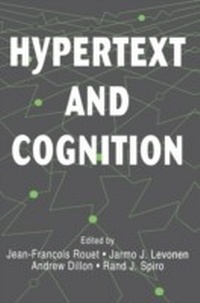
Hypertext and Cognition
1st Edition
Published on 12. November 2012
192 pages
978-1-136-49226-6 (ISBN)
Description

The recent evolution of western societies has been characterized by an increasing emphasis on information and communication. As the amount of available information increases, however, the user -- worker, student, citizen -- faces a new problem: selecting and accessing relevant information. More than ever it is crucial to find efficient ways for users to interact with information systems in a way that prevents them from being overwhelmed or simply missing their targets. As a result, hypertext systems have been developed as a means of facilitating the interactions between readers and text. In hypertext, information is organized as a network in which nodes are text chunks (e.g., lists of items, paragraphs, pages) and links are relationships between the nodes (e.g., semantic associations, expansions, definitions, examples -- virtually any kind of relation that can be imagined between two text passages). Unfortunately, the many ways in which these hypertext interfaces can be designed has caused a complexity that extends far beyond the processing abilities of regular users. Therefore, it has become widely recognized that a more rational approach based on a thorough analysis of information users' needs, capacities, capabilities, and skills is needed. This volume seeks to meet that need.
From a user-centered perspective -- between systems and users -- this volume presents theoretical and empirical research on the cognitive processes involved in using hypertext. In so doing, it illustrates three main approaches to the design of hypertext systems:
*cognitive, which examines how users process multilayered hypertext structures;
*ergonomical, which explores how users interact with the design characteristics of hardware and software; and
*educational, which studies the learning objectives, frequency and duration of hypertext sessions, type of reading activity, and the user's learning characteristics.
This volume also tries to provide answers for the questions that have plagued hypertext research:
*What is hypertext good for?
*Who is hypertext good for?
*If it is useful for learning and instruction, then what type?
*What particular cognitive skills are needed to interact successfully with a hypertext system? Anyone interested in the fields of computer science, linguistics, psychology, education, and graphic design will find this volume intriguing, informative, and a definitive starting point for future research in the field of hypertext.
From a user-centered perspective -- between systems and users -- this volume presents theoretical and empirical research on the cognitive processes involved in using hypertext. In so doing, it illustrates three main approaches to the design of hypertext systems:
*cognitive, which examines how users process multilayered hypertext structures;
*ergonomical, which explores how users interact with the design characteristics of hardware and software; and
*educational, which studies the learning objectives, frequency and duration of hypertext sessions, type of reading activity, and the user's learning characteristics.
This volume also tries to provide answers for the questions that have plagued hypertext research:
*What is hypertext good for?
*Who is hypertext good for?
*If it is useful for learning and instruction, then what type?
*What particular cognitive skills are needed to interact successfully with a hypertext system? Anyone interested in the fields of computer science, linguistics, psychology, education, and graphic design will find this volume intriguing, informative, and a definitive starting point for future research in the field of hypertext.
Reviews / Votes
"This volume represents a highly innovative attempt to lay the conceptual foundations for a rational approach to the design and evaluation of hypertext based on empirical and theoretical research concerned with the abilities, needs, and goals of potential users."-Contemporary Psychology
"Rouet, Levonen, Dillon and Spiro have edited a very interesting volume addressing issues concerning hypertext and cognition. The book is small but comprehensive.
-British Journal of Educational Psychology."
"From this more general perspective, the positons stated in the book will hopefully survive several generations of technological innovations."
-British Journal of Educational Psychology
"Rouet, Levonen, Dillon and Spiro have edited a very interesting volume addressing issues concerning hypertext and cognition. Dillon's chapter on the myths and misconceptions of the implications of hypertext systems is enlightening and very well presented. Individually, the chapters provide eclectic snapshots of hypertextual effects, but taken together in this volume they begin to tell a consistent story..."
-British Journal of Educational Psychology
"Hypertext and Cognition consists in a series of articles that share an empirical, level-headed approach to hypertext and its potential uses. As such the volume makes an interesting and useful addition to the rapidly growing literature on this intriguing information technology."
-Pragmatics & Cognition
More details
Language
English
Place of publication
London
United Kingdom
Publishing group
Taylor & Francis Ltd
Target group
Professional and scholarly
Product notice
Reflowable
File size
5,58 MB
ISBN-13
978-1-136-49226-6 (9781136492266)
Copyright in bibliographic data and cover images is held by Nielsen Book Services Limited or by the publishers or by their respective licensors: all rights reserved.
Schweitzer Classification
Other editions
Additional editions
Jean-Francois Rouet | Jarmo J. Levonen | Andrew Dillon
Hypertext and Cognition
Book
04/1996
Routledge
€207.98
Shipment within 10-20 days
Jean-Francois Rouet | Jarmo J. Levonen | Andrew Dillon
Hypertext and Cognition
Book
04/1996
Routledge
€76.10
Shipment within 10-20 days
Persons
Jean-Francois Rouet, Language and Communication Laboratory, University of Poitiers and CNRS, 95 avenue du Recteur Pineau, 86022 Poitiers Cedex, France.,
Jarmo J. Levonen, Learning Research and Development Center, University of Pittsburgh, 3939 O'Hara Street, Pittsburgh, PA 15260, USA.,
Andrew Dillon, School of Library and Information Science, Indiana University, Bloomington, IN 47405, USA.,
Rand J. Spiro, Center for the Study of Reading, University of Illinois, Urbana-Champaign, 210b Education Building, MC 708, 1310 S. Sixth, Champaign, IL 61820, USA
Jarmo J. Levonen, Learning Research and Development Center, University of Pittsburgh, 3939 O'Hara Street, Pittsburgh, PA 15260, USA.,
Andrew Dillon, School of Library and Information Science, Indiana University, Bloomington, IN 47405, USA.,
Rand J. Spiro, Center for the Study of Reading, University of Illinois, Urbana-Champaign, 210b Education Building, MC 708, 1310 S. Sixth, Champaign, IL 61820, USA
Content
Contents: Preface. C.A. Perfetti, La Maison Hypertext. J-F. Rouet, J.J. Levonen, A. Dillon, R.J. Spiro, An Introduction to Hypertext and Cognition. J-F. Rouet, J.J. Levonen, Studying and Learning with Hypertext: Empirical Studies and Their Implications. A. Dillon, Myths, Misconceptions, and an Alternative Perspective on Information Usage and the Electronic Medium. M.A. Britt, J-F. Rouet, C.A. Perfetti, Using Hypertext to Study and Reason About Historical Evidence. D. Dee-Lucas, Effects of Overview Structure on Study Strategies and Text Representations for Instructional Hypertext. P.W. Foltz, Comprehension, Coherence, and Strategies in Hypertext and Linear Text. H. van Oostendorp, Studying and Annotating Electronic Text. E. Esperet, Notes on Hypertext, Cognition, and Language. C.A. Perfetti, Text and Hypertext.
