

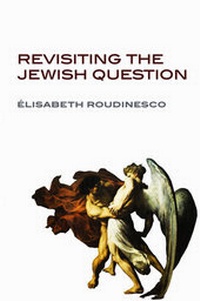
Revisiting the Jewish Question
Description

We need to return to the Jewish question. We need, first, todistinguish between the anti-Judaism of medieval times, whichpersecuted the Jews, and the anti-Judaism of the Enlightenment,which emancipated them while being critical of their religion. Itis a mistake to confuse the two and see everyone from Voltaire toHitler as anti-Semitic in the same way. Then we need to focus onthe development of anti-Semitism in Europe, especially Vienna andParis, where the Zionist idea was born. Finally, we need toinvestigate the reception of Zionism both in the Arab countries andwithin the Diaspora.
Re-examining the Jewish question in the light of these distinctionsand investigations, Roudinesco shows that there is a permanenttension between the figures of the 'universal Jew' andthe 'territorial Jew'. Freud and Jung split partly overthis issue, which gained added intensity after the creation of theState of Israel in 1948 and the Eichmann trial in 1961. Finally,Roudinesco turns to the Holocaust deniers, who started to suggestthat the Jews had invented the genocide that befell their people,and to the increasing number of intellectual and literary figureswho have been accused of anti-Semitism.
This thorough re-examination of the Jewish question will be ofinterest to students and scholars of modern history andcontemporary thought and to a wide readership interested inanti-Semitism and the history of the Jews.
More details
Other editions
Additional editions
Person
Content
Introduction 1
1 Our First Parents 6
2 The Shadow of the Camps and the Smoke of the Ovens 26
3 Promised Land, Conquered Land 49
4 Universal Jew, Territorial Jew 68
5 Genocide between Memory and Negation 93
6 A Great and Destructive Madness 124
7 Inquisitorial Figures 151
Notes 186
Index 232
Introduction
‘Nazis, that's what you are! You drive the Jews out of their homes – you're worse than the Arabs.’1
This accusation was uttered in December 2008 by some young fundamentalist Jews settled in Hebron, in the West Bank, who had never experienced genocide: it was aimed at other Jews, soldiers of the Israeli Army (Tzahal) who had been given orders to evacuate their compatriots, and who had also never experienced genocide.
‘Nazis worse than Arabs’: these words symbolize the passion that has been spreading unstoppably across the planet ever since the Israeli–Palestinian conflict became the main issue in every intellectual and political debate on the international scene.
At the heart of these debates – and against a background of killings, massacres, and insults – we find extremist Jews reviling other Jews by calling them ‘worse than Arabs’. This shows how much they hate the Arabs, and not just the Palestinians, but all Arabs – in other words, the Arab-Islamic world as a whole, and even those who are not Arabs but who claim a stake in Islam in all its varieties:2 Jordanians, Syrians, Pakistanis, Egyptians, Iranians, inhabitants of the Maghreb, etc. So they are racist Jews: in these words, they are comparing what they call Arabs – i.e., both Muslims and Islamists – with Nazis, except that the Arabs are not so bad. But the same Jews identify other Jews with people worse than Arabs, i.e., with the worst assassins in history, those genocidal killers responsible for what, in Hebrew, they call the Shoah, the catastrophe – the extermination of the Jews of Europe – that was such a decisive factor in the foundation of the State of Israel.3
If you cross the walls, the barbed wire, the borders, you will inevitably encounter the same passion, kindled by extremists who, though they may not represent public opinion as a whole, are just as influential. From Lebanon to Iran, and from Algeria to Egypt, the Jews are often, in one place or another, called Nazis, or seen as the exterminators of the Palestinian people. And the more Jews as a whole are here viewed as perpetrators of post-colonial genocide, as followers of American imperialism, or as Islamophobes,4 the more people find inspiration in a literature that has sprung from the tradition of European anti-Semitism: ‘The Jews’, they say, ‘are the descendants of monkeys and pigs.’ And: ‘America has been corrupted by the Jews; the brains of America have been mutilated by those of the Jews. Homosexuality has been spread by the Jew Jean-Paul Sartre. The calamities that befall the world, the bestial tendencies, the lust and the abominable intercourse with animals come from the Jew Freud, just as the propagation of atheism comes from the Jew Marx.’5
In that world, people eagerly read Mein Kampf, The Protocols of the Elders of Zion, or The Mythical Foundations of Israeli Policy;6 they deny the existence of the gas chambers and denounce alleged Jewish plans to take over the world. It's all thrown into the brew: the Jacobins, the supporters of liberal capitalism, communists, freemasons – all are presented as agents of the Jews, witness for example the Twenty-Second Article of the Charter of Hamas, which marks a real step backwards compared with that of the PLO:7
The enemies [the Jews] have been scheming for a long time, and they have consolidated their schemes, in order to achieve what they have achieved. […] [Their] wealth [permitted them to] take over control of the world media such as news agencies, the press, publication houses, broadcasting and the like. […] They stood behind the French and the Communist Revolutions and behind most of the revolutions we hear about here and there. They also used the money to establish clandestine organizations which are spreading around the world, in order to destroy societies and carry out Zionist interests. Such organizations are: the Freemasons, Rotary Clubs, Lions Clubs, B'nai B'rith and the like. […] They also used the money to take over control of the Imperialist states and made them colonize many countries in order to exploit the wealth of those countries and spread their corruption therein.8
If we turn now to the heart of Europe, especially to France, we see that the same insults erupt with equal vehemence. Many essayists, writers, philosophers, sociologists, and journalists support the Israeli cause while heaping insults on the defenders of the Palestinian cause, while the latter insult them back – and both sides endlessly call each other ‘Nazis’, ‘Holocaust deniers’, ‘anti-Semites’, and ‘racists’. On the one side are the sworn opponents of the ‘Shoah business’ or ‘Holocaust industry’, the ‘genocidal Zionist state’, ‘national-secularism’, ‘collaborators’ ‘Judaeolaters’ and ‘Ziojews’ (Zionist Jews). On the other, we have the fierce critics of ‘collabo-leftist-Islamo-fascist-Nazis’.9
In short, the Israeli–Palestinian conflict – experienced as a structural split tearing the Jews and the Arab-Islamic world apart, but also as a rift within the Jewishness of the Jews or as a break between the Western world and the world of its former colonies – now lies at the centre of all debates between intellectuals, whether they are aware of it or not.
And it is easy to understand why. Ever since the extermination of the Jews by the Nazis – a tragic event underlying a new organization of the world from which sprang the Universal Declaration of Human Rights and the State of Israel in Palestine – the notions of genocide and crime against humanity have become applicable to every country in the world. As a consequence, and gradually, the so-called Western discourse of universalism has been seriously undermined. Since the most civilized nations in Europe had given birth to the greatest of barbarities – to Auschwitz – it was now possible for all the peoples humiliated by colonialism or the various forms of capitalist exploitation, as well as for all minorities oppressed on grounds of their sex, the colour of their skin, or their identity, to criticize so-called universal values of freedom and equality. After all, in the name of these values, Western states had committed the worst crimes and continued to rule the world while perpetrating crimes and misdemeanours that went completely against the principles of the Declaration of Rights that they themselves had enacted.
What we are thus witnessing is a new quarrel over universals. Whether we take an interest in anti-globalization, in the history of colonialism and post-colonialism, of so-called ethnic minorities and minorities of ‘identity’; whether we focus on the construction or deconstruction of definitions of gender or sex (homosexuality, heterosexuality); whether we highlight the need to study the phenomenon of religion or the desacralization of the world; or whether we take the side of history as memory or ‘memorial history’ [l'histoire mémorielle] versus scholarly history [l'histoire savante], we always start with reference to the question of the extermination of the Jews, insofar as it is a foundational moment in all possible thinking about conflicts over identity. Hence the exacerbation of anti-Semitism and racism we are witnessing, accompanied by a new type of thinking about being Jewish.
As a result of the secular structures of its institutions, France for a long time seemed to be exempt from this type of conflict, to such an extent that Ashkenazi Jews living in Germany, Russia, or Eastern Europe used to dream of it: happy as God in France, they said. If God did actually live there, he would not be disturbed by prayers, rituals, blessings, and requests to interpret delicate questions of diet. Surrounded by unbelievers, God too would be able to relax when evening fell, just like thousands of Parisians in their favourite cafés. There are few things more agreeable, more civilized, than a tranquil café table outside at dusk.
But times have changed: the French model of secularism has been questioned, the Israeli–Palestinian conflict has become a major issue in civil society, and – with the appearance of claims relating to identity and religion – the French Republic has encountered new difficulties in assimilating immigrants from its former colonies. It even seems to have fallen prey, recently, to the mania for evaluating things by their origins – a mania which, in spite of politics, encourages human beings to be categorized in accordance with so-called ethnic and sexual criteria, or on the basis of the ‘community’ to which they ‘belong’. This mania for gauging people is, in the last analysis, perhaps just a return of the repressed, since the country in which human rights were born, and the first country to have emancipated the Jews (in 1791), was also the origin, around 1850, of the first anti-Semitic theories and, in 1940, betrayed its own ideal with the establishment of the Vichy regime.
Revisiting the Jewish question, then, means reviewing the different ways of being Jewish in the modern world ever since, at the end of the nineteenth century, anti-Semitism triggered a revolution in Jewish consciousness. But this will be a historical, critical, dispassionate review, in the spirit of the Enlightenment. It will aim at...
