

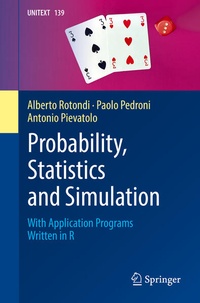
Probability, Statistics and Simulation
Description

This book presents in a compact form the program carried out in introductory statistics courses and discusses some essential topics for research activity, such as Monte Carlo simulation techniques, methods of statistical inference, best fit and analysis of laboratory data. All themes are developed starting from fundamentals, highlighting their applicative aspects, up to the detailed description of several cases particularly relevant for technical and scientific research. The text is dedicated to university students in scientific fields and to all researchers who have to solve practical problems by applying data analysis and simulation procedures. The R software is adopted throughout the book, with a rich library of original programs accessible to the readers through a website.
More details
Other editions
Additional editions
Persons
Alberto Rotondi is formerly full professor of nuclear physics at the University of Pavia (Italy), where he is now adjunct professor of Data Analysis at the Physics Department of Pavia. He is the author of several hundred publications in the field of experimental nuclear physics. During the research activity, carried out mainly at the CERN laboratories of Geneva, he applied many statistical and simulation methods to the project of new experiments and to the analysis of experimental results.
Paolo Pedroni is a senior researcher at the INFN (Italian National Institute of Nuclear Physics), Section of Pavia, and an adjunct professor at the Physics Department of the University of Pavia (Italy), where he teaches the course of Statistical Methods in Physics. He has been carrying out experimental research on the interactions of quarks within protons and neutrons in the framework of several international collaborations.
Antonio Pievatolo is Director of Research at CNR IMATI in Milan, Italy, where he works at applications of Statistics in industry and technology. He has led his local unit in applied research projects commissioned by national and regional public bodies and companies. He has been president of ENBIS, the European Network for Business and Industrial Statistics, from 2017 to 2019, and contract professor of Statistics at the University.
Content
1 Probability.- 2 Representation of random phenomena.- 3 Basic probability theory.- 4 Multivariate Probability Theory.- 5 Functions of random variables.- 6 Basic statistics: parameter estimation.- 7 Basic statistics: hypothesis testing.- 8 Monte Carlo methods.- 9 Applications of Monte Carlo methods.- 10 Statistical inference and likelihood.- 11 Least squares.- 12 Experimental data analysis.- Appendix A: Table of symbols 533.- Appendix B: R software 535.- Appendix C: Moment-generating functions 539.- Appendix D: Solutions of problems 543.- Appendix E: Tables.
