

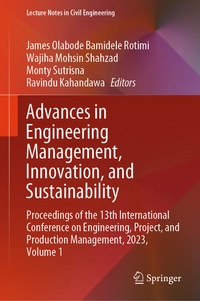
Advances in Engineering Management, Innovation, and Sustainability
Description

This book contains a selection of papers from the 13th International Conference on Engineering, Project, and Production Management (EPPM) held in Auckland, New Zealand from 29 November to 1 December 2023. The conference was organized by the School of Built Environment, Massey University in collaboration with the EPPM Association. The book comprises of quality-assured theoretical discussions, data analysis, case studies, and industry practices, presented by global researchers and practitioners. The conference theme was "Creating capacity and capability: re-energizing supply chain for sustainable management of projects and productions in engineering," and this volume focuses on papers related to engineering management, innovation, and sustainability. The papers are comprehensive, multidisciplinary, and advanced, and will be of interest to researchers and practitioners from various industries seeking the latest updates on the fields of engineering, project, and production management.
More details
Other editions
Additional editions
Persons
Prof James Rotimi is a Professor of Construction Economics and Management at the School of Built Environment, Massey University, New Zealand. He is also a visiting Professor in the School of Construction Economics and Management, University of the Witwatersrand, Johannesburg, South Africa. James has qualifications in building construction management, civil engineering, commerce, and education. He is a Fellow of the Chartered Institute of Building UK and holds professional membership of the Royal Institution of Chartered Surveyors, UK, New Zealand Institute of Building, Facilities Management Association of New Zealand, and the Nigerian Institute of Building (NIOB). James' research has focused on improving performance within the construction industry, integrating its supply chain, and optimizing the achievement of construction and project deliverables. He has over 30 years of tertiary teaching and research experience in academic institutions in Nigeria, UK, South Africa, and New Zealand. He also has various building construction industry experiences, including a senior associate role in a quantity surveying consultancy in Nigeria. James publishes extensively within peer-reviewed journals and conference proceedings and in edited books. He is the Founding Editor of the International Journal of Construction Supply Chain Management IJCSCM, established in 2011.
Dr Wajiha Shahzad is a highly experienced academic with over 15 years of academic and construction industry experience. Currently, a Senior Lecturer in Construction Management and Postgraduate Lead at the School of Built Environment, Massey University in New Zealand, her expertise includes construction management, productivity, and modern methods of construction, with a specific focus on offsite construction. She leads a research group on 'Future Material Technologies in Built Environment'. Her research has been recognised for its impact and novel contributions to the field of offsiteconstruction. She has published various quality-assured journal papers, conference papers, book chapters, and industry reports. Her work has played a significant role in shaping policies surrounding the advancement of the construction industry in New Zealand.
Prof Monty Sutrisna is Professor of Construction and Project Management and is the Head of the School of the School of Built Environment at Massey University, New Zealand. He is the current President of the Australasian Universities Building Education Association (AUBEA) and a current member of the Board of the International Council for Research and Innovation in Building and Construction (CIB). His research expertise includes Construction and Engineering Management, Construction Productivity, Construction Procurement and Contracts, Construction IT and other Advanced Technologies applied in Construction including Offsite Construction, Decision Making Modelling/Support, Knowledge Based Systems and Artificial Intelligence. Prior to joining Massey University, he was the Head of Construction Management Department at Curtin University in Western Australia and he was the Director of PG Research Training & Outreach as well as the Programme Director for Construction Management Programme at the University of Salford, UK.
Dr Ravindu Kahandawa is a Lecturer in Quantity Surveying at The School of Built Environment at Massey University with 8 years of experience in the construction industry and academia. Ravindu graduated with a BSc (Hons) In Quantity Surveying from the University of Moratuwa, Sri Lanka, and Completed my Ph.D. at Massey University, New Zealand In the area of "Cost Estimation model for Earthquake Damage Repair Work". Ravindu is also the lead researcher in a NZD 200,000, BRANZ (Building Research Association of New Zealand)-funded project titled, "Construction cost blowouts - can a standardized opensource cost estimation process help?", and a key researcher in another BRANZ-funded project on Zeron carbon. Ravindu's research areas include construction waste, circular economy, and construction company insolvencies.
Content
- Intro
- Preface
- Contents
- About the Editors
- Theme: Management
- Managing Construction Supply Chains: Application of the Agile Ways of Working
- 1 Introduction
- 2 Methodology
- 3 Literature Review
- 3.1 Supply Chain Management in the Construction Industry
- 3.2 The Agile Ways of Working
- 3.3 Common Issues in Construction Supply Chain and the Software Industry
- 4 Results and Discussion
- 4.1 Agile Mindset
- 4.2 Agile Values
- 4.3 Agile Principles
- 4.4 Agile Tools and Processes
- 4.5 Implementation of the Agile Ways of Working
- 4.6 Enablers of the Agile Ways of Working
- 5 Limitations and Future Work
- 6 Conclusion
- 7 Ethics Statement
- References
- Revisiting Construction Delays in GCC: Oman Versus UAE
- 1 Introduction
- 2 Construction Delays in the GCC
- 3 Method
- 4 Results and Discussions
- 5 Conclusions
- References
- Team Dynamics and Its Effect on the Design Process Within the Construction Industry
- 1 Introduction
- 1.1 Literature Review
- 1.2 Theoretical Review
- 2 Method
- 2.1 Research Philosophy and Approach
- 2.2 Methodology
- 2.3 Research Methods
- 2.4 Population and Sampling
- 2.5 Development of the Research Instrument
- 2.6 Data Collection Protocol
- 3 Results
- 3.1 Design Management
- 3.2 Interpersonal Relationships
- 3.3 Task Orientation
- 3.4 Working Style
- 3.5 Variations
- 3.6 Conflict
- 3.7 Development Sequence
- 3.8 Performance
- 4 Discussion
- 4.1 Team Dynamics: Social Domain
- 4.2 Team Dynamics: Technical Domain
- 5 Conclusion
- References
- Building Organizational Resilience Capacities and Capabilities in Construction Firms
- 1 Introduction
- 2 Overview of Organizational Resilience Capabilities
- 3 Methodology
- 3.1 Search of Relevant Articles
- 3.2 Classification of Selected Articles
- 4 Presentation and Analysis of Results
- 4.1 National Context
- 4.2 Theoretical Focus
- 4.3 Research Methodology
- 4.4 Results' Area
- 4.5 Organizational Resilience Capabilities and Capacities
- 5 Conclusions
- References
- Communication Strategies and Construction Projects' Outcomes in Nigeria
- 1 Introduction
- 2 Research Method
- 3 Findings and Discussions
- 3.1 Demographic Information
- 3.2 Application of Communication Strategies (CS) in Construction Projects
- 3.3 Impact of CS on Construction Project Outcomes
- 4 Conclusions and Recommendations
- References
- Intervening Qualities of Building Information Modeling (BIM) on the Adoption of Prevention Through Design (PTD)
- 1 Introduction
- 2 Theoretical Background
- 2.1 The Perceived Usefulness of BIM for PTD
- 2.2 The Perceived Ease of Use of BIM for PTD
- 2.3 The Relative Advantage of BIM for PTD
- 2.4 The Perceived Benefits of Using BIM for PTD
- 3 Proposed Model
- 4 Methodology
- 4.1 Analysis Approach
- 4.2 Questionnaire Survey
- 4.3 Research Sampling
- 5 Preliminary Results
- 5.1 Respondents Demographics
- 5.2 Data Screening
- 5.3 Confirmatory Factor Analysis
- 6 Conclusion and Further Study
- References
- Barriers to the Adoption of Robot-Assisted Construction Approach in the South African Built Environment
- 1 Introduction
- 2 Adoption of Robots in the Construction Industry
- 2.1 Barriers to the Adoption of Robot-Assisted Construction Operation in the Construction Industry
- 3 Research Methodology
- 4 Findings and Discussion
- 4.1 Respondents' Background Information
- 4.2 Descriptive Analysis Result
- 5 Conclusion and Recommendation
- References
- Accessibility to the Built Environment for Mobility-Impaired Persons: A Review
- 1 Introduction
- 1.1 A Short History of Disability in New Zealand and Internationally
- 1.2 The Progress Made Internationally
- 1.3 The Focus of the Study
- 2 Method
- 3 Results and Discussion
- 3.1 The Law on Accessibility in the Built Environment, New Zealand
- 3.2 An Insight into International Laws on Accessibility in the Built Environment
- 3.3 The Compassionate View
- 3.4 Additional Gaps in Legislation
- 4 Conclusions
- 5 Ethics Statement
- References
- Covid-19 Lockdowns-Effect on Female Worker Well-Being in New Zealand Construction Professions
- 1 Introduction
- 2 Literature Review
- 2.1 Women in Construction
- 2.2 Mental Health in Construction
- 3 Research Methodology
- 4 Data Analysis and Discussion
- 4.1 Population Sample
- 5 Discussion
- 6 Conclusions
- 7 Ethics Statement
- References
- Towards the Adoption of Data Management Systems by Quantity Surveyors
- 1 Introduction
- 2 Literature Review Framework
- 2.1 Importance of Data
- 2.2 Data Management
- 2.3 Factors Influencing Data Management Adoption
- 3 Methodology
- 4 Results and Discussion
- 4.1 Personal Characteristics Information
- 4.2 Practice of Data Management Utilized by Organizations
- 4.3 Factors Towards Adoption of Data Management by Quantity Surveyors
- 5 Conclusion
- 6 Ethics Statement
- References
- Investigation of the Effects of Supply Chain Disruptions on Offsite Construction Projects
- 1 Introduction
- 2 Methodology
- 2.1 Framework
- 2.2 Screening
- 3 Finding
- 3.1 Co-occurrence Analysis
- 3.2 Countries Studying Risks
- 4 Discussion
- 5 Conclusion
- References
- Examining Infrastructure Pipelines Information for Their Relevance in Construction Organizations' Strategic Decision-Making
- 1 Introduction
- 2 Methodology
- 2.1 Search Strategy and the Selection of Studies
- 3 Literature Review
- 3.1 Overview of Infrastructure Pipeline Projects in New Zealand
- 3.2 Sources of Infrastructure Pipelines Project Information in New Zealand
- 3.3 Strategy Management in Construction Industry
- 3.4 Levels of Strategy
- 3.5 Infrastructure Pipelines Information as a Factor in Strategic Decision-Making
- 3.6 Data/Information Needs and Strategic Decision-Making in the Construction Industry
- 3.7 Strategic Decision-Making Under Quality of Information
- 3.8 Challenges in Quality of Information for Strategic Decision-Making
- 4 Discussion
- 5 Conclusion
- 6 Institutional Review Board Statement
- References
- New Zealand Construction Nga Roopu and Preferred Nga Tangata: Towards More Purpose-Fit Selection
- 1 Introduction
- 1.1 Teams (Nga Roopu) Within the Construction Industry
- 1.2 Personalities (Nga Tangata)
- 2 Method
- 3 Results and Discussion
- 3.1 Demographic Information
- 3.2 Exploring the South African Personality Inventory (SAPI) Items
- 3.3 Current Profession Grouping
- 4 Conclusion
- 5 Ethics Statement
- References
- Quantity Surveyors' Perspective on Knowledge Areas for Sustainable Construction
- 1 Introduction
- 2 Literature Review
- 2.1 Sustainability
- 2.2 Quantity Surveyors' Role in Construction Industry
- 2.3 Changing Demand on Quantity Surveying Profession
- 3 Research Design
- 4 Data Analysis
- 4.1 Reliability Test
- 4.2 Relative Importance Index (RII)
- 5 Discussion
- 6 Conclusion
- 7 Ethics Statement
- References
- Scientometric Review of Research Trends on Construction Project Variations
- 1 Introduction
- 2 Research Methodology
- 2.1 Software Tools Selection
- 2.2 Database Selection
- 2.3 Bibliometric Data Extraction and Journals Selection
- 3 Results and Discussion
- 3.1 Annual Publication Trends of Variations Management
- 3.2 Prominent Research Outlets of Variations Management
- 3.3 Co-occurrence Network of Keywords
- 3.4 Co-authorship Network Analysis
- 3.5 Article Citation Analysis (High-Impact Articles)
- 4 Major Variations Management Research Areas
- 4.1 Causes of Variations
- 4.2 Management of Variations
- 4.3 Emerging Technologies in Variations Management
- 5 Knowledge Gaps and Future Research Consideration
- 6 Conclusion
- References
- COVID-19 and the Changes It Made to Construction Demand in New Zealand
- 1 Introduction
- 2 Method
- 3 Results
- 4 Discussion
- 5 Conclusion
- 6 Ethics Statement
- References
- Health & Safety and Wellbeing Issues Confronting New Zealand Building Council Staff Involved in Compliance Issues
- 1 Introduction
- 2 Method
- 3 Results
- 3.1 Demographic Information
- 3.2 Health & Safety and Wellbeing Issues
- 3.3 Health & Safety and Wellbeing Support
- 4 Discussion
- 5 Conclusion
- References
- Assessing Health and Safety Practices in the Nigerian Construction Industry in the Era of the Fourth Industrial Revolution: Issues and Challenges
- 1 Introduction
- 2 Methodology
- 3 Results
- 4 Discussion of Findings
- 5 Conclusion and Recommendation
- References
- Assessing Benefits of Monitoring and Evaluation Practices: The Construction Industry Perspective
- 1 Introduction
- 2 Methodology
- 3 Results
- 4 Discussion of Findings
- 5 Conclusion and Recommendation
- References
- Minimizing Patent Defects in Low-Cost Housing
- 1 Introduction
- 2 Literature Review
- 2.1 Risks and Health Concerns Posed by Patent Defects
- 3 Research Methodology
- 4 Findings and Discussion
- 5 Conclusion
- 6 Ethics Statement
- References
- Impacts of Artificial Lighting on Human Behaviour In-Office Buildings-A Systematic Literature Review
- 1 Introduction
- 2 Method
- 2.1 Criteria of Inclusion
- 2.2 Criteria of Exclusion
- 2.3 Selection of Studies
- 2.4 Data Extraction and Data Analysis
- 3 Results
- 3.1 Different Types of Artificial Lighting and Their Effects on Workers at the Workplace
- 3.2 Impact of Lighting on Workplace Behaviour
- 4 Discussion
- 5 Conclusion
- References
- Suitability of FIDIC Contracts for Post-disaster Reconstruction of Infrastructure Projects
- 1 Introduction
- 2 Research Methods
- 2.1 Content Analysis
- 3 Literature Review
- 3.1 Standard Forms of Construction Contracts (SFCCs)
- 3.2 Challenges and Limitations of Current SFCCs
- 3.3 Uniqueness of Post-disaster Reconstruction
- 3.4 Limited Studies on Contracts for Disasters
- 3.5 Applicability of Available Standard Forms in Disasters
- 3.6 Applicability of FIDIC Forms in Reconstruction Projects
- 4 Discussion
- 5 Conclusion
- 6 Limitations and Future Research
- References
- Managing BIM Implementation in the AEC Sector: Identifying Key Aspects and Developing a Framework
- 1 Introduction
- 2 BIM Implementation
- 3 BIM Implementation Management Aspects
- 3.1 BIM Implementation Strategy
- 3.2 Information Exchange Requirement
- 3.3 Technology and Infrastructure
- 3.4 Common Data Environment
- 3.5 Collaborative Workflows and Process (Including Communication, Coordination)
- 3.6 Project Leadership
- 3.7 Resource Management
- 3.8 Training and Education (Skills Development)
- 3.9 Change Management
- 3.10 Stakeholder Engagement
- 3.11 Quality Assurance and Control-BIM Performance
- 3.12 Contractual and Legal Considerations/Standard Conventions, Protocols
- 4 Proposed Research Design and Discussion
- 5 Conclusion
- References
- Ethics Provisions Within New Zealand Professional Codes of Conduct, Towards a Construction-Wide Code of Ethics
- 1 Introduction
- 2 Research Methodology
- 3 Literature Review
- 3.1 Enforcement and Reporting of Ethical Breaches
- 3.2 Types of Ethical Breaches
- 3.3 Extent of Ethical Breaches
- 4 Data Analysis and Discussion
- 5 Conclusions
- 6 Ethics Statement
- References
- Mitigating Delay in Construction Contract Payment: A South African Case Study
- 1 Introduction
- 2 Literature Review
- 2.1 Bond and Guarantees
- 2.2 Prequalification of Construction Parties
- 2.3 Payment Default Insurance
- 2.4 Bankruptcy Notice and Liquidation Proceedings
- 2.5 Remedies for Securing Payment Debt
- 2.6 Payment of Stipulated Interest
- 2.7 Suspension of Work
- 2.8 Right to Slow Down Work by the Contractor
- 2.9 Eradication of "Pay When Paid" Clause
- 2.10 The Creation of a Right to a Lien
- 3 Methodology
- 4 Discussion of Findings
- 5 Conclusion
- References
- Mental Health Interventions and the Productivity of Construction Workforce
- 1 Introduction
- 2 Literature Review
- 2.1 Factors Affecting the Mental Health of Construction Workers
- 2.2 Barriers to Access to Mental Health
- 2.3 Addressing Mental Health Challenges in the Construction Industry: Initiatives and Interventions
- 2.4 Common Mental Health Interventions in New Zealand [27]
- 3 Research Method
- 4 Data Analysis
- 4.1 Thoughts on Mental Health Intervention
- 4.2 Availability of the Types of Mental Health Intervention
- 4.3 Effectiveness of Mental Health Intervention
- 4.4 Barriers to Having Good Mental Health Intervention
- 4.5 Improvement of Mental Health Intervention
- 5 Discussion
- 6 Conclusion
- References
- Traditional Architecture: A Natural Disaster Resilient Alternative
- 1 Introduction
- 2 Traditional Building Methods
- 3 Research Method
- 4 Findings and Discussion
- 4.1 Dhajji-Dewari, Kashmir
- 4.2 Ghumauro Dhi, Nepal
- 4.3 Rajbanshi House, Nepal
- 4.4 Himis, Turkey
- 4.5 Bure Houses, Fiji
- 4.6 Gaiola Pombalina, Lisbon Portugal
- 4.7 Taquezal and Bahareque, South America
- 4.8 Quincha Houses, Peru
- 4.9 Bhunga Houses, Gujrat
- 5 Discussion
- 6 Conclusion and Further Research
- References
- A Bibliometric Analysis of Early Contractor Involvement (ECI) Research in the Construction Industry
- 1 Introduction
- 2 Method
- 3 Result
- 3.1 Keywords Co-Occurrence Analysis
- 3.2 Country Analysis
- 3.3 Time Series Analysis
- 3.4 Journal Analysis
- 3.5 ECI Approaches
- 4 Discussion
- 4.1 Usage of ECI
- 4.2 Benefits of ECI
- 4.3 Challenges of ECI
- 5 Conclusion
- References
- A Review of Barriers to Safety Incentives Design and Implementation in the Construction Industry
- 1 Introduction
- 2 Material and Methods
- 2.1 Safety Incentives Concept in the Construction Industry
- 2.2 Barriers to Designing and Implementing Safety Incentives in the Construction Industry
- 3 Implication of the Study
- 4 Conclusion and Recommendation
- 5 Ethics Statement
- References
- Eliminating Building Quality Issues: A Theoretical Framework Using the Theory of Planned Behaviour
- 1 Introduction
- 2 Quality Issues in the Construction Industry
- 2.1 Causes of Quality Defects
- 3 The Theory of Planned Behaviour (TPB)
- 4 Research Method
- 5 Theory of Planned Behaviour and Proactive Quality Management
- 6 Conclusions and Further Research
- 7 Ethics Statement
- References
- Organisational Leadership as a Driver for the Delivery of Sustainable Construction in South Africa
- 1 Introduction
- 2 Literature Review
- 2.1 Contextualising Sustainable Development in South Africa
- 2.2 Organisational Leadership and Sustainable Construction
- 3 Methodology
- 4 Results
- 4.1 Demographic Information of Respondents
- 4.2 Roles of Organisational Leadership in the Delivery of Sustainable Construction
- 4.3 Internal Factors Affecting Organisational Leadership in the Delivery of Sustainable Construction
- 4.4 External Factors Affecting Organisational Leadership in the Delivery of Sustainable Construction
- 5 Discussion
- 6 Conclusion
- References
- Post-disaster Recovery: A Critical Assessment of Housing Reconstruction Types and Features in Fiji
- 1 Introduction
- 2 Literature Review
- 2.1 Tropical Cyclones in Fiji
- 2.2 Post-disaster Housing in Fiji
- 2.3 Damages to Housing Resulting from TC Winston
- 2.4 Village Damage After Tropical Cyclone Winston
- 2.5 The HFH Scheme in Post-TC Winston
- 3 Research Method
- 3.1 Overview
- 3.2 Data Collection Process
- 3.3 Study Area and Demographics
- 4 Study Findings
- 4.1 Village Damage After Tropical Cyclone Winston
- 4.2 The HFH Scheme and Technical Support
- 4.3 Houses in Namuaimada After Tropical Cyclone Winston
- 4.4 Types of the Reconstructed Houses
- 4.5 Physical Features of the Houses
- 5 Discussion
- 6 Conclusion
- 7 Ethics Statement
- References
- Theme: Innovation
- A New Approach Toward Hazard Mitigation by Designing Moveable Architectural Space
- 1 Introduction
- 2 Proposed Methods and Current Findings
- 2.1 The Flexibility of Space is Facilitated by the Ability of Kinetic Structures to Move
- 2.2 The Architects' Perspective of a Valuable Construction Has to Modify
- 2.3 For a Single Volume, Kinetic Structures Are More Appropriate
- 2.4 There is a Need to Investigate Materials Specifications to Identify the Most Compatible Ones to the Characteristics of the Kinematic Structures
- 2.5 New Construction Strategies and Mechanical Equipment Are Required to Be Devised
- 2.6 Modern Technology Makes Intelligent Kinetic Structures Almost Feasible Today
- 3 Expected Results
- 4 Discussion
- 5 Conclusion
- References
- Introducing an Integrated Agent-Based and Reinforcement Learning Model of Contracting and Subcontracting in Construction Sector
- 1 Introduction
- 2 Literature Review
- 2.1 Construction Projects Contracting
- 2.2 Construction Resource Allocation Models
- 3 Research Methodology
- 3.1 Data Evaluation
- 3.2 Model Development
- 4 Results: Model Feasibility Check
- 4.1 Level 0 Project Sample
- 4.2 Level 1 Project Sample
- 4.3 Level 2 Project Sample
- 4.4 Level 3 Project Sample
- 5 Discussion and Future Developments
- 6 Conclusion
- Appendix
- References
- Systematic Review of the Adoption Level of Building Information Modelling in Construction Small and Medium-Sized Enterprises in Nigeria
- 1 Introduction
- 2 Research Methodology
- 3 Building Information Modelling
- 4 Construction Small and Medium-Sized Enterprises in Developing Countries
- 5 Adoption of Building Information Modelling in Developing Countries
- 6 Level of Adoption of Building Information Modelling in Construction Small and Medium-Sized Enterprises
- 7 Importance of Building Information Modelling Adoption in the Nigeria Construction SMEs
- 8 Implication of the Study
- 9 Conclusion and Further Research
- References
- Conceptualizing Hard and Soft Benefits of Adopting BIM in Construction Projects: A Systematic Review
- 1 Introduction
- 2 Research Background
- 2.1 Definition of BIM
- 2.2 Development of BIM
- 2.3 BIM Levels
- 2.4 Definition and Categories of Benefits
- 2.5 Knowledge Gap
- 3 Methodology
- 4 Results
- 5 Discussion
- 5.1 Hard Benefits of Adopting BIM
- 5.2 Soft Benefits of Adopting BIM
- 6 Conclusion
- References
- Trust in Robotics and Automation in the Construction Industry: The Case of Malaysia
- 1 Introduction
- 2 Literature Review
- 2.1 Issues on Building Trust in Robotics and Automation in the Construction Industry
- 2.2 Strategies on Building Trust in Robotics and Automation in the Construction Industry
- 2.3 Knowledge Gap
- 3 Methodology
- 3.1 Developing Interview Protocol
- 3.2 Collecting Interview Data
- 3.3 Analyzing Interview Data
- 4 Results and Discussion
- 4.1 Issues in Building Trust to Implement Robotic and Automation in Malaysia's Construction Industry
- 4.2 Strategies in Building Trust to Implement Robotic and Automation in Malaysia's Construction Industry
- 4.3 Study Implications
- 4.4 Limitations and Future Directions
- 5 Conclusion
- References
- Applicability of Building Information Modelling (BIM) to Structural Design Workflow
- 1 Introduction
- 2 Literature Review
- 3 Method
- 4 Results and Discussion
- 4.1 BIM Knowledge and Awareness
- 4.2 Use of BIM for Structural Design Workflow
- 5 Conclusions
- References
- Effective Digital Leadership Among Construction Industry Professionals: Analysis of Core Competencies
- 1 Introduction
- 2 Background
- 2.1 Digital Leadership Concept
- 2.2 Digital Leadership in Construction
- 2.3 Study Positioning
- 3 Methodology
- 3.1 Data Collection
- 3.2 Data Analysis
- 4 Result
- 4.1 Hard Skills
- 4.2 Soft Skills
- 5 Discussion
- 5.1 Hard Competencies
- 5.2 Soft Competencies
- 6 Implications and Limitations
- 7 Conclusion
- References
- Theme: Sustainability
- Assessment of Energy Consumption in Building Construction Phase: A Case of Sri Lanka
- 1 Introduction
- 2 Literature Review
- 2.1 Energy for On-Site Construction
- 2.2 Impact of Site Energy on the Total Cost
- 2.3 Optimizing Energy Consumption
- 3 Research Methodology
- 4 Analysis and Findings
- 4.1 Energy Consumption
- 4.2 Energy-Saving Measures
- 5 Conclusions
- Appendix 1
- References
- Embracing Circular Economy in Australian Universities: Learning from Global Perspectives Using State-of-the-Art Review
- 1 Background of the Study: Imperatives of Circular Economy in Universities
- 2 Methods, Materials, and Data Sources
- 2.1 Data Sources
- 3 State-of-the-Art (SOTA) Review and Analysis
- 3.1 The United Kingdom
- 3.2 Germany
- 3.3 The USA
- 3.4 South Africa
- 3.5 China
- 3.6 Brazil
- 3.7 Overview of Strategic Principles of CE for Universities
- 4 SOTA Review Findings
- 4.1 Waste Prevention and Resource Optimisation Strategies
- 4.2 Circular Infrastructure
- 4.3 Smarter Campuses
- 4.4 Local Partnerships
- 4.5 CE Teaching and Development Practices
- 5 Contribution to Knowledge: Proposed CE Framework for Australian Universities
- 6 Conclusion and Future Directions
- References
- Circular Economy Strategies for Enhancing the Sustainable Performance of Building Sector: A Systematic Review
- 1 Introduction
- 2 Research Methodology
- 3 Results and Discussion
- 3.1 Descriptive Analysis
- 3.2 Strategies of Circular Economy for Building Sector
- 4 Conclusions
- References
- Factors Influencing Circular Economy Adoption in the South African Construction Sector
- 1 Introduction
- 2 Method
- 3 Results
- 4 Discussion
- 5 Conclusion
- References
- Perceived Benefits of Circular Economy Adoption in the South African Construction Sector
- 1 Introduction
- 2 Method
- 3 Result
- 4 Discussion
- 5 Conclusion
- References
- Evaluating How Energy Performance Certificates Could Influence the Supply of Net Zero Carbon Buildings
- 1 Introduction
- 2 Literature Review
- 2.1 Introduction to the Literature Review
- 2.2 Findings from Literature Review
- 3 Method
- 3.1 Research Approach
- 3.2 Methodology
- 3.3 Research Methods
- 3.4 Population and Sampling Criteria
- 3.5 Limitations
- 3.6 Selection of Participants
- 4 Analysis of Data
- 4.1 Population Sample
- 4.2 New Buildings and Decision-Making
- 4.3 Reporting of Existing Green Building Practices
- 5 Discussion on Findings
- 5.1 Barriers to the Green Building Practices and Supply of Net Zero Carbon Buildings
- 5.2 Impact of ESG and Environment and Climate Disclosure as a Driver
- 5.3 Conclusion to Analysis
- 6 Discussion on Findings
- 7 Conclusions
- 7.1 Barriers to Green Building Practices Are Reducing
- 7.2 Net Zero Carbon Buildings not yet Pervasive
- 7.3 Affordable Rental Housing/Build to Rent is an Under-Valued Asset Class
- 7.4 EPC's Could Help Align Projects and Financial Reporting
- 7.5 Overall Conclusion
- References
- Embodied Carbon Emissions for Net-Zero Carbon Buildings: A Comprehensive Study of New Zealand
- 1 Introduction
- 2 Literature Review
- 2.1 Materials
- 2.2 Carbon Storage
- 2.3 Construction Strategies
- 2.4 Other Studies
- 3 Embodied Carbon Emissions for Non-Residential Buildings in New Zealand
- 3.1 Background
- 3.2 Available Tools and Data
- 3.3 Frameworks and Certification Schemes
- 4 Discussion and Conclusions
- References
- Performance of Sustainable Reinforced Concrete Beams Containing Fine Plastic Waste Aggregate and Their Life-Cycle Costing
- 1 Introduction
- 2 Experimental Work
- 2.1 Concrete Materials
- 2.2 Fine Plastic Waste Aggregate
- 2.3 Specimens' Design
- 2.4 Test Methods
- 3 Results and Discussion
- 3.1 Fresh Concrete Workability
- 3.2 Compressive Strength
- 3.3 Split Tensile Strength
- 3.4 Flexural Strength
- 3.5 The Digital Image Technique and Cracking Patterns
- 3.6 Life-Cycle Cost Analysis of Reinforced Beams Containing Plastic Waste Aggregate
- 4 Conclusion
- References
- Review of the Critical Success Factors for Stakeholders' Management in Sustainable Building Projects
- 1 Introduction
- 2 Literature Review
- 2.1 Stakeholder Management and Sustainable Building Projects
- 2.2 Critical Success Factors (CSFs) of Stakeholder Management to Achieve Sustainable Building Projects
- 3 Presentation of Results
- 3.1 Stakeholders Characteristics and Project Characteristics (SCPC)
- 3.2 Stakeholder Analysis (SA)
- 3.3 Stakeholders' Dynamics
- 3.4 Stakeholders' Engagement (SE)
- 4 Discussion
- 5 Conclusion
- References
- Key Indoor Environmental Quality Indicators for Students' Satisfaction in Residences Built from ISBU
- 1 Introduction
- 2 Related Literature
- 3 Methodology
- 4 Results
- 5 Discussion of Findings
- 6 Conclusion
- References
- A Review of Indoor Air Quality and Thermal Comfort Guidelines for New Zealand Primary School Classrooms: A Comparison of DQLS Document (Old Versus New)
- 1 Introduction
- 2 Literature Review
- 2.1 Indoor Air Quality (IAQ) and School Children's Performance
- 2.2 New Zealand School Buildings' Design and Maintenance and the Designing Quality Learning Spaces (DQLS) Documents
- 3 Methodology
- 4 Findings and Discussion
- 4.1 Carbon Dioxide (CO2) Concentration
- 4.2 Ventilation Rates
- 4.3 Indoor Temperature
- 4.4 Relative Humidity
- 4.5 Window-Wall Ratio
- 5 Conclusion
- References
- Sustainability of Post-disaster Temporary Houses: A Review of Principles and Assessment Methods
- 1 Introduction
- 1.1 Research Method
- 2 Post-disaster Construction
- 2.1 Temporary Housing
- 3 Sustainability
- 3.1 Sustainable Housing
- 3.2 Sustainable Reconstruction
- 3.3 Temporary Housing Sustainability
- 4 Assessment Systems and Methods
- 4.1 Reconstruction Sustainability Assessment
- 4.2 Sustainability Assessment of Temporary Houses
- 5 Discussion and Conclusion
- References
- Construction and Demolition Waste Management in Affluent Economies in Transition: Implementing the 3R Strategy
- 1 Introduction
- 1.1 The UAE Context
- 2 Methodology
- 3 Existing Conditions: CDW Policies, Legislative and Treatment Modes in the UAE
- 3.1 National and Regional Policies and Legislation
- 3.2 CWD Treatment and Recycling Centers in the UAE
- 4 Challenges and Enablers Based on the 3R Principles
- 4.1 Reduce
- 4.2 Reuse
- 4.3 Recycling
- 5 Conclusion
- References
