

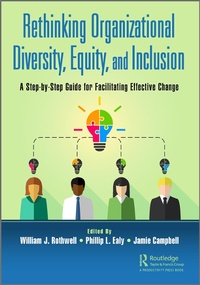
Rethinking Organizational Diversity, Equity, and Inclusion
A Step-by-Step Guide for Facilitating Effective Change
1st Edition
Published on 3. May 2022
276 pages
978-1-000-57550-7 (ISBN)
Description

Research has shown that having a diverse organization only improves and enhances businesses. Forbes and Time report that diversity is an $8 Billion a year investment. However, poorly implementing diversity programs have damaging effects on the organization and the very individuals these programs attempt to help. Poorly implemented programs can cause peers and subordinates to question decisions and lose faith in leadership. In addition, it can cause even the most confident individuals to doubt their own skillset and qualifications. Many organizations have turned to training to solve this complex issue.
Yet still, other organizations have created and filled diversity and inclusion positions to tackle the issue. The effects of these poorly implemented programs are highlighted during strenuous times such as the latest COVID-19 pandemic. Marginalized people are more marginalized, and resources and support do not reach everyone. Tasks such as providing technical support, conducting large group meetings, or distributing work obligations without seeing employees on a daily basis becomes more challenging.
Complex problems cannot be solved with simple solutions. Using organization development (OD) to develop a comprehensive change initiative can help. This book outlines how properly conducting an OD change initiative can effectively increase an organization's diversity and inclusion -- it is grounded in research-based literature on diversity and OD principles.
Many organizational leaders realize the key importance of diversity, equity, inclusion and multiculturalism in modern organizations. It is only through such efforts can organizations thrive in a networked world where much work is done virtually-and often across borders.
But a common scenario is that leaders, recognizing the need for a diversity program, will pick someone from the organization to launch it. Perhaps the person identified for this challenge is in the HR department but has had no experience in launching diversity efforts-or even in managing large-scale, long-term, organization wide change efforts. But these are the challenges to be faced.
This book quickly identifies some reasons why diversity programs fail and how to avoid those failures. The majority of the book highlights how to use OD to improve organization culture and processes to not only increase diversity and inclusion but develop overall organization talent and prevent personal preferences and biases from hindering the selection of the best talent for positions.
Yet still, other organizations have created and filled diversity and inclusion positions to tackle the issue. The effects of these poorly implemented programs are highlighted during strenuous times such as the latest COVID-19 pandemic. Marginalized people are more marginalized, and resources and support do not reach everyone. Tasks such as providing technical support, conducting large group meetings, or distributing work obligations without seeing employees on a daily basis becomes more challenging.
Complex problems cannot be solved with simple solutions. Using organization development (OD) to develop a comprehensive change initiative can help. This book outlines how properly conducting an OD change initiative can effectively increase an organization's diversity and inclusion -- it is grounded in research-based literature on diversity and OD principles.
Many organizational leaders realize the key importance of diversity, equity, inclusion and multiculturalism in modern organizations. It is only through such efforts can organizations thrive in a networked world where much work is done virtually-and often across borders.
But a common scenario is that leaders, recognizing the need for a diversity program, will pick someone from the organization to launch it. Perhaps the person identified for this challenge is in the HR department but has had no experience in launching diversity efforts-or even in managing large-scale, long-term, organization wide change efforts. But these are the challenges to be faced.
This book quickly identifies some reasons why diversity programs fail and how to avoid those failures. The majority of the book highlights how to use OD to improve organization culture and processes to not only increase diversity and inclusion but develop overall organization talent and prevent personal preferences and biases from hindering the selection of the best talent for positions.
More details
Edition
1. Auflage
Language
English
Place of publication
London
United Kingdom
Publishing group
Taylor & Francis Ltd
Target group
Professional and scholarly
Product notice
Reflowable
Illustrations
8 Tables, black and white; 33 Line drawings, black and white; 33 Illustrations, black and white
ISBN-13
978-1-000-57550-7 (9781000575507)
Copyright in bibliographic data and cover images is held by Nielsen Book Services Limited or by the publishers or by their respective licensors: all rights reserved.
Schweitzer Classification
Other editions
Additional editions
William J. Rothwell | Phillip L. Ealy | Jamie Campbell
Rethinking Organizational Diversity, Equity, and Inclusion
A Step-by-Step Guide for Facilitating Effective Change
Book
05/2022
1st Edition
Productivity Press
€58.40
Shipment within 10-20 days
William J. Rothwell | Phillip L. Ealy | Jamie Campbell
Rethinking Organizational Diversity, Equity, and Inclusion
A Step-by-Step Guide for Facilitating Effective Change
Book
05/2022
1st Edition
Productivity Press
€194.90
Shipment within 10-20 days
Persons
William J. Rothwell, PhD, SPHR, SHRM-SCP, RODC, CPTD Fellow, is Distinguished Professor in the Master of Professional Studies in Organization Development and Change program and also in the PhD program of Workforce Education and Development at the Pennsylvania State University. He has authored, coauthored, edited, and coedited 127 books since 1987. His recent books since 2017 include Organization Development (OD) Interventions: Executing Effective Organizational Change (Routledge, 2021); Virtual Coaching to Improve Group Relationships: Process Consultation Reimagined (Routledge, 2021); The Essential HR Guide for Small Business and Start Ups (Society for Human Resource Management, 2020); Increasing Learning and Development's Impact through Accreditation (Palgrave, 2020); Adult Learning Basics, 2nd ed. (Association for Talent Development, 2020) Workforce Development: Guidelines for Community College Professionals, 2nd ed. (Rowman-Littlefield, 2020); Human Performance Improvement: Building Practitioner Performance, 3rd ed. (Routledge, 2018); Innovation Leadership (Routledge, 2018), Evaluating Organization Development: How to Ensure and Sustain the Successful Transformation (CRC Press, 2017), Marketing Organization Development Consulting: A How-To Guide for OD Consultants (CRC Press, 2017), and Assessment and Diagnosis for Organization Development: Powerful Tools and Perspectives for the OD Practitioner (CRC Press, 2017).
Phillip L. Ealy, MPS, is a retired U.S. Army Officer where he spent time integrating women into previously restricted combat arms roles. He also developed U.S. and foreign militaries, building international coalitions. He works as the coaching coordinator for the Children, Youth, and Families at Risk (CYFAR) grant program. In this role, Ealy trains and develops coaches that work with land-grant universities on implementing government-funded programs for local communities. Ealy holds a Master of Professional Studies in Organization Development and Change and is finishing a PhD in Workforce Education and Development with an emphasis in human resource development and organization development from the Pennsylvania State University. He holds an undergraduate degree in communications from West Virginia State University.
Jamie Campbell, MEd, serves as the Assistant Dean for Diversity Enhancement Programs at the Smeal College of Business. He has served as a panelist on topics ranging from social justice to students' issues, and has been a keynote speaker for various leadership programs. He also serves as an advisor to several student organizations within the Smeal College of Business and continues to mentor graduates working in Fortune 500 companies. Campbell is a 1995 graduate of Morehouse College where he obtained his BA in sociology. He obtained his MEd with concentrations in adult education and instruction education from Central Michigan University in 2003. He is a PhD student in the Workforce Education and Development program with concentrations in organization design and human resource development at the Pennsylvania State University. His research focuses on successionplanning as a form of crisis management.
Phillip L. Ealy, MPS, is a retired U.S. Army Officer where he spent time integrating women into previously restricted combat arms roles. He also developed U.S. and foreign militaries, building international coalitions. He works as the coaching coordinator for the Children, Youth, and Families at Risk (CYFAR) grant program. In this role, Ealy trains and develops coaches that work with land-grant universities on implementing government-funded programs for local communities. Ealy holds a Master of Professional Studies in Organization Development and Change and is finishing a PhD in Workforce Education and Development with an emphasis in human resource development and organization development from the Pennsylvania State University. He holds an undergraduate degree in communications from West Virginia State University.
Jamie Campbell, MEd, serves as the Assistant Dean for Diversity Enhancement Programs at the Smeal College of Business. He has served as a panelist on topics ranging from social justice to students' issues, and has been a keynote speaker for various leadership programs. He also serves as an advisor to several student organizations within the Smeal College of Business and continues to mentor graduates working in Fortune 500 companies. Campbell is a 1995 graduate of Morehouse College where he obtained his BA in sociology. He obtained his MEd with concentrations in adult education and instruction education from Central Michigan University in 2003. He is a PhD student in the Workforce Education and Development program with concentrations in organization design and human resource development at the Pennsylvania State University. His research focuses on successionplanning as a form of crisis management.
Content
Preface....................................................................................................ix
Acknowledgments....................................................................................xv
About the Editors and Contributing Authors...............................................xvii
Advance Organizer....................................................................................xxv
PART I ESTABLISHING THE FOUNDATION FOR DE&I
Overview: What's in a Name?...................................................................... 3
WILLIAM BRENDEL
PART II A STEP-BY-STEP APPROACH TO IMPLEMENTING A DE&I EFFORT
1 Facilitating Transformative Learning.........................................13
WILLIAM BRENDEL
2 Step 1: Defining Your Organization's Culture............................35
PHILLIP L. EALY
3 Step 2: Clarifying the Role of Diversity, Equity, and
Inclusion in Shaping Culture......................................................45
NORM J. JONES
4 Step 3: Clarifying Who Has the Authority to Change Culture..... 57
S. RON BANERJEE
5 Step 4: Identifying and Defining the Pipeline...........................73
CATHERINE HAYNES
6 Step 5: Developing Talent...........................................................87
MICHELE MCBRIDE
7 Step 6: Navigating Emotions and Other Relational
Dynamics..................................................................................107
MARIE CARASCO
8 Step 7: Showcasing Your Organization's Talent........................123
MARIE CARASCO
9 Step 8: Promoting Your Organization's Talent.........................141
BARBARA R. HOPKINS
10 Step 9: Developing Employee Resource Groups....................... 151
WAYNE GERSIE
11 Step 10: Evaluating Your Processes.......................................... 171
CHRISTINA PETTEY
PART III FUTURE TRENDS IN DE&I
12 Trends in Diversity, Equity, and Inclusion...............................193
JAMIE CAMPBELL
PART IV RESOURCES TO SUPPORT
IMPLEMENTATION OF A DE&I EFFORT
Appendix A: Glossary......................................................................209
Appendix B: Diversity, Equity, and Inclusion (DE&I) Audit...........211
WILLIAM J. ROTHWELL
Appendix C: Resources for Diversity, Equity and Inclusion
(DE&I)............................................................................................. 215
Appendix D: Frequently Asked Questions (FAQs) about
Diversity, Equity, and Inclusion......................................................223
JAMIE CAMPBELL, PHILLIP L. EALY, AND WILLIAM J. ROTHWELL
Appendix E: Tools to Guide Implementation..................................229
PHILIP L. EALY AND WILLIAM J. ROTHWELL
Index...............................................................................................243
Acknowledgments....................................................................................xv
About the Editors and Contributing Authors...............................................xvii
Advance Organizer....................................................................................xxv
PART I ESTABLISHING THE FOUNDATION FOR DE&I
Overview: What's in a Name?...................................................................... 3
WILLIAM BRENDEL
PART II A STEP-BY-STEP APPROACH TO IMPLEMENTING A DE&I EFFORT
1 Facilitating Transformative Learning.........................................13
WILLIAM BRENDEL
2 Step 1: Defining Your Organization's Culture............................35
PHILLIP L. EALY
3 Step 2: Clarifying the Role of Diversity, Equity, and
Inclusion in Shaping Culture......................................................45
NORM J. JONES
4 Step 3: Clarifying Who Has the Authority to Change Culture..... 57
S. RON BANERJEE
5 Step 4: Identifying and Defining the Pipeline...........................73
CATHERINE HAYNES
6 Step 5: Developing Talent...........................................................87
MICHELE MCBRIDE
7 Step 6: Navigating Emotions and Other Relational
Dynamics..................................................................................107
MARIE CARASCO
8 Step 7: Showcasing Your Organization's Talent........................123
MARIE CARASCO
9 Step 8: Promoting Your Organization's Talent.........................141
BARBARA R. HOPKINS
10 Step 9: Developing Employee Resource Groups....................... 151
WAYNE GERSIE
11 Step 10: Evaluating Your Processes.......................................... 171
CHRISTINA PETTEY
PART III FUTURE TRENDS IN DE&I
12 Trends in Diversity, Equity, and Inclusion...............................193
JAMIE CAMPBELL
PART IV RESOURCES TO SUPPORT
IMPLEMENTATION OF A DE&I EFFORT
Appendix A: Glossary......................................................................209
Appendix B: Diversity, Equity, and Inclusion (DE&I) Audit...........211
WILLIAM J. ROTHWELL
Appendix C: Resources for Diversity, Equity and Inclusion
(DE&I)............................................................................................. 215
Appendix D: Frequently Asked Questions (FAQs) about
Diversity, Equity, and Inclusion......................................................223
JAMIE CAMPBELL, PHILLIP L. EALY, AND WILLIAM J. ROTHWELL
Appendix E: Tools to Guide Implementation..................................229
PHILIP L. EALY AND WILLIAM J. ROTHWELL
Index...............................................................................................243
