

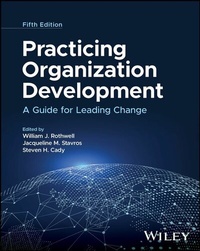
Practicing Organization Development
Description

Explore contemporary organization development theory to advance your research agenda or implement transformational change at your organization.
In the newly revised fifth edition of Practicing Organization Development: A Guide for Leading Change, a team of renowned experts in the field of organization development (OD) delivers an invaluable new look at how OD theories, models, frameworks, and whole systems interventions can effect positive transformation and change. The book covers classical and newer theories, process, and practices for transformational change, closely examines system dynamics, and identifies contemporary themes in OD, transformation, and change.
Readers will find:
- Strategies for implementing OD approaches into leading, managing, consulting, and coaching
- Ways to elevate and extend their research agendas into new theories and models for impacting positive change
- Techniques for expanding OD from human resources and talent management silos into the areas of management and leadership
Perfect for managers, executives, directors, and other business leaders interested in implementing transformational change, Practicing Organization Development is also an essential read for organization development theorists and researchers and other business academics seeking modern insights into an exciting and dynamic field of study.
More details
Other editions
Additional editions
Persons
William J. Rothwell is a Distinguished Professor Emeritus in the Workforce Education and Development program in the Department of Learning and Performance Systems, College of Education at The Pennsylvania State University. He is also Academy Professor at Penn State University.
Jacqueline M. Stavros is Professor of Management for the College of Business and IT at Lawrence Technological University and a management consultant. She is founder of SOAR Institute and co-founder of CWH Institute.
Steven H. Cady is a Professor of Management and the founding Director of the Doctoral Program in Organization Development & Change at the Schmidthorst College of Business at Bowling Green State University. He is also founder of NEXUS4change, a global community and consultancy.
Content
List of Figures, Tables, and Exhibits xi
Introduction: Getting the Most from This Book 1
William J. Rothwell, Jacqueline M. Stavros, and Steven H. Cady
Part One: Foundations: Theory and Practice of Organization Development, Transformation, and Change Management 9
1. Organization Development and Change 11
William J. Rothwell, Jacqueline M. Stavros, and Steven H. Cady
2. The Origins of Organization Development 31
John J. Scherer, Billie Alban, and Marvin Weisbord
3. Change Process and Models 47
William J. Rothwell, Jong Gyu Park, and Wesley E. Donahue Copyrighted Material
4. Being an Effective Leader Starts with Knowing Thyself 63
Jacqueline M. Stavros and Donald R. James
5. Appreciative Inquiry: The Design of Net-Positive Organizations 77
Lindsey N. Godwin, Jacqueline M. Stavros, and David L. Cooperrider
6. Human-Centric Competencies: A Unified Framework for Organization Development & Change Professionals 91
Steven H. Cady, Zachary D. Shoup, David S. Bright, and Shawn Otto
Part Two: Od Process to Guide Transformation And Change 109
7. The Marketing of Organization Development and Change (ODC): Using the 7Ps to Advance Your Brand 111
Steven H. Cady and David R. Perry
8. Front-End Work: Engaging the Client System 127
David W. Jamieson and Rachael L. Narel
9. Launch: Assessment, Action Planning, and Implementation 141
D. D. Warrick
10. Post Launch: Evaluating Transformation and Change 159
Steven H. Cady and Jennifer R. Steele Viti
11. Measurement to Determine the Return on Change Management 173
Tim Creasey
12. Closure: Unleashing Energy for Learning and Agility 189
Ann M. Van Eron and W. Warner Burke
13. Culture Matters in Organization Development 201
Peter A. Schein
Part Three: Levels and Types of Transformational Change Interventions 211
14. Coaching in OD 213
Behnam Bakhshandeh
15. SOAR to Success: Building Strategic Capacity to Create High-Performing Teams 227
Jacqueline M. Stavros and Patrica Malone
16. Large Systems Transformation and Change 241
Ann Feyerherm
17. Dialogic Organization Development: Emerging Directions 253
Gervase R. Bushe
18. Intervention Selection and Design: Using OD&C Principles to PLAN Intentional Change 263
Steven H. Cady and C. Theodor Forde-Stiegler
Part Four: Special Topics in Od and Change 281
19. Bibliometric Analysis for Organization Development and Change Management (2010-2023) 283
Farhan Sadique, Aileen G. Zaballero, and Azza Al Hajri
20. Sustainability and Transformation 293
Chris Laszlo
21. Managing Mergers and Acquisitions: Best Practices and New Challenges for OD 299
Philip H. Mirvis and Mitchell Lee Marks
22. Organization Design that Transforms 307
Amy Kates and Julian Chender
23. Leveraging Positive Organizational Scholarship to Enhance OD and Change 315
JonMcNaughtanandKimCameron
24. The T-Group: Powerful Portal to Self-Knowledge 323
Matt Minahan
25. The Power of Agency: A Transformational Organization Change Intervention 333
Frederick A. Miller and Judith H. Katz
26. Technology-Leveraged OD for Collective Decision-Making 341
Hyung Joon Yoon, Matt Raup, Yu-Ling Chang, and I-Pang Fu
27. Comparing Organization Development to Related Fields of Practice 351
David W. Jamieson and William J. Rothwell
28. Organization Development & Change in the Age of Artificial Intelligence 359
Steven H. Cady and William A. Pasmore
29. Regenerative System Change 367
Arielle Threlkeld-Sullivan
30. Beyond Hierarchy: Heterarchy in the 21st Century 375
Karen Stephenson
31. Strategies for OD to Win at Organizational Politics 381
William J. Rothwell
Part Five: the Future of Od: Embracing New Directions for Change 389
32. Social Dynamics in Virtual Settings 391
Cho Hyun Park
33. Perspectives on Practicing OD: Survey of the Authors 397
D. D. Warrick
34. Afterword: The Future of Organization Development: Opportunities and Challenges 405
William J. Rothwell, Jacqueline M. Stavros, and Steven H. Cady
Acknowledgments 413
About the Editors 415
About the Contributors 419
Index 433
Introduction: Getting the Most from This Edited Volume
William J. Rothwell, Jacqueline M. Stavros, and Steven H. Cady
The fourth edition of Practicing Organization Development, subtitled Leading Transformation and Change, was about facilitating transformational and incremental changes. The edition recognized that organization development (OD) is both a field and a profession and that there are diverse frameworks, models, and approaches to handling organizational issues. The book was about the power and possibilities of OD, which place human conversation and behaviors at the heart of change, leading to enhanced performance.
There are many popular definitions of OD. However, it is best understood as facilitating system-wide growth and human systems' evolution. Change is messy and complicated because our organizations are living systems. For this reason, it is best managed by applying complexity theory and tapping complex adaptive systems (Church et al. 2018). OD must adopt an open systems perspective (Gopinath and Kendall 2021).
The fifth edition of Practicing Organization Development is subtitled A Guide for Leading Change. The word transformation has been dropped. It has grown to be a controversial word. Some people think it implies ordinary change. For other people, the word transformation suggests an abrupt change that is neither well-planned nor well-accepted by those affected by the change. Neither way of understanding that word is helpful. For that reason, it has been removed from the subtitles of this new edition.
AUDIENCE FOR THE BOOK
Practicing Organization Development: A Guide for Leading Change (fifth edition) is written for established internal or external OD practitioners and those new to the field. It is also written for scholars and line managers who wish to grow more familiar with OD. Those new to the field will find the book foundational, a place to begin building their knowledge and skills about OD. Experienced practitioners, scholars, and operating managers will find this book a compendium of useful information about how to formulate, implement, and evaluate change using a humanistic approach that places people first rather than placing primary emphasis on change project goals or budgets while ignoring or de-emphasizing human involvement in change (Anderson 2021).
The primary audience is OD professionals, and this book provides helpful information to lead change efforts. Undergraduate students can use it in multiple courses, and more advanced students will find it valuable as a repository of the latest thinking on OD.
Our secondary audience consists of human resource (HR) generalists and talent development practitioners, previously called training and development (T&D) or human resource development (HRD) practitioners. Some talent development practitioners train employees. They equip workers with the knowledge, skills, and attitudes needed to qualify for their jobs, maintain their skills as times change, and prepare for future advancement opportunities. However, many talent development practitioners go beyond individually focused change efforts like training to ensure that identified individuals are supported in their work settings by a corporate culture that supports the application of new knowledge, skills, and attitudes. Individual performance improvement can only occur when the surrounding work environment supports it (Rothwell et al. 2024). The theory and practice of changing organization and work-group cultures are OD topics. To do their jobs and achieve results, talent development practitioners often demonstrate competencies associated with OD.
Our third audience consists of others looking for ways to transform whole organizations and communities to thrive in the 21st century. Today's leaders must know how to introduce and consolidate change successfully to bring visions into reality or leverage organizational strengths to their advantage. Executives or managers often lack training in OD methods, and that may be one reason why so few organizational change efforts are entirely successful and meet the expectations established for them. We hope senior managers (such as those in the C-Suite) are also reading this book.
PURPOSE AND OBJECTIVES OF THE BOOK
The purpose of Practicing Organization Development: A Guide for Leading Change (fifth edition) is to build the reader's competencies to assess the need for change, manage change, and facilitate the implementation of change in organization settings while also remaining in alignment with the values of OD as a field and the values of organizations in which OD is practiced.
After completing this book, the reader should be able to:
- Define OD and change and how these relate to each other.
- Describe various change models.
- Understand the importance of effective leadership in leading self and then others.
- Describe and apply the competencies and values needed to conduct planned change.
- Understand the phases of OD work and levels of change.
- Work through each step of an OD project and collaborate successfully with key stakeholders to plan and implement facilitated change.
- List and summarize various OD interventions used in the OD field.
- Explain the importance of strengthening and shaping the organization's culture and design.
- Understand the impact of special issues on OD.
This guide supports the ongoing development of leaders, managers, practitioners, and consultants in leading change. It provides basic concepts and foundational models and then goes beyond that to review the state-of-the-art and best practices in OD. The book has been designed so that each chapter can stand alone and be used to build OD competencies in alignment with OD values. The contributors are leaders in the areas they wrote about.
WHAT'S NEW IN THE FIFTH EDITION
The convergence of OD with transformation, change management, organizational behavior, ethics, and human resource management is more prevalent today than ever, given the changes in our global business environment. Practicing Organization Development: A Guide for Leading Change (fifth edition) expands and updates the fourth edition to reflect current best practices in OD. The fifth edition, like its predecessors, is comprehensive and provides the essentials: foundations and principles, OD phases, present state, and future challenges, and implications of the OD field with the latest and most widely used models, frameworks, strategies, and methods to improve human and organizational well-being and performance. However, this edition reflects the growing importance and emphasis of a dialogic approach in OD (Marshak and Bushe 2020).
Readers will note unique similarities and differences between the fourth and fifth editions of this book. The editions are similar in that both share the foundations and phases of planned change in OD. That is perennial and does not change, though the chapters describing them have been updated. The fifth edition is different because it has been rewritten and updated by the previous contributors from the fourth edition. It also includes many new contributors who bring OD frameworks and approaches into leading, managing, consulting, and coaching while also increasing the sensitivity to transformation and positive change, as well as their aptitudes in facilitating generative dialogues and learning exchanges.
The fifth edition includes new chapters and many new contributors. They are drawn from various leading OD scholars and practitioners who share the theory and practice of OD as it relates to the whole system, strengths-based, and positive change methods, transformation, and the importance of practicing OD at the five levels of individual, organizational, inter-organizational, trans organizational, and global. Each chapter has discussion questions and additional online resources for you to review. This new edition of Practicing Organization Development will help any organization build its capabilities to operate efficiently and effectively and improve its whole system while operating in its current environment.
Based on the contributions in this fifth edition, we realize that OD has been transitioning from primarily focusing on "organizations" to being more inclusive of how the "human systems" transform the organization and its environment. OD is also uniquely positioned to help humans deal with the change wrought by technological change-such as artificial intelligence.
All chapter contributions in the fifth edition will feature 21st-century challenges for individuals, groups, organizations, and regions of the world for those who seek to understand what OD is and how to apply it to do developmental, transitional, and transformational change.
The fifth edition will illuminate how appreciative, strengths-based OD theories, models, frameworks, and whole systems interventions can facilitate more profound understanding and influence positive transformation and change. This edition generates relevant insights for OD scholars (theories) and practitioners (practice), including those who seek to:
- Understand classic and new theories and practices for change.
- Examine diversity and inclusive whole system dynamics in greater depth.
- Identify contemporary themes in OD and change, such as examining current issues through a positive organizational scholarship (POS) lens, understanding sustainability, and leveraging technology,...
