

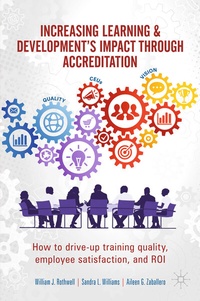
Increasing Learning & Development's Impact through Accreditation
Description

Workplace and executive training is a multi-billion dollar industry and yet an enormous percentage of that budget is spent on programs that have never been rigorously examined to ensure that they are fit for purpose and deliver value for the money.
If you're signing off on that budget, or asking your people to spend time on training programs, shouldn't that concern you?
Training accreditation offers vital quality assurance, ensures global consistency of results and delivers accountability for learning and performance outcomes.
Apart from delivering better results and greater ROI, organizations can differentiate themselves fromtheir competitors in the employment marketplace by offering accredited proprietary training. After all, digital natives, and indeed all of today's most talented potential employees, expect (and increasingly demand) the high quality, engaging and transferable employee development that only accredited programs can deliver.
Aligning with the standards set by the International Association of Continuing Education and Training (IACET) - today's premier accreditation body for training programs - the authors offer principles for quality program structure, delivery, and improvement needed to achieve accreditation.
They share practices used by high quality training program managers today, covering business alignment and program administration along with the planning, design, delivery and evaluation of learning systems.
More details
Other editions
Additional editions
Persons
William J. Rothwell is President of Rothwell & Associates. He is also a Professor of the Workforce Education and Development program, Department of Learning and Performance Systems, at The Pennsylvania State University, University Park campus. He has authored, co-authored, edited, or co-edited 300 books, book chapters, and articles-including 111 books.
Sandra L. Williams is Associate Professor and Program Coordinator of the Human Resource Development Program, Department of Literacy, Leadership and Development, at Northeastern Illinois University, Chicago, where she also serves as the Graduate Student Advisor in Human Resource Development. Her work is a unique blend of business consulting, training program development and current research in the human resource development field.
Aileen G. Zaballero is a senior partner of Rothwell & Associates and a dual-title Ph.D. in Workforce Education and Comparative International Education at The Pennsylvania State University. She is a Certified Professional in Learning and Performance (CPLP) with more than twenty years of experience in the learning and development field.
Content
Chapter 1: Introduction.- Chapter 2: Align Learning with Organization Mission Values.- Chapter 3: Structuring for Accountability.- Chapter 4: Management of Training.- Chapter 5: Planning for Learning.- Chapter 6: Is Training the Answer? Assessing Needs.- Chapter 7: Intended Learning Outcomes.- Chapter 8: Who Should Be Involved in Instruction?.- Chapter 9: Conducting Learning Events Professionally.- Chapter 10: Deciding What to Include.- Chapter 11: Methods to Achieve Consistency.- Chapter 12: Feedback and Job Application.- Chapter 13: Records and Program Evaluation.- Chapter 14: Accreditation Sources.
