

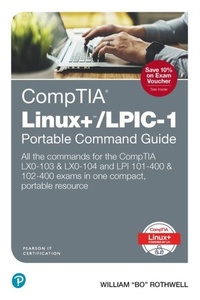
CompTIA Linux+/LPIC-1 Portable Command Guide
All the commands for the CompTIA LX0-103 & LX0-104 and LPI 101-400 & 102-400 exams in one compact, portable resource
1st Edition
Published on 17. August 2017
336 pages
978-0-13-469237-1 (ISBN)
Description

Here are all the CompTIA Linux+/LPIC-1 Linux commands you need in one condensed, portable resource. The CompTIA Linux+/LPIC-1 Portable Command Guide is filled with valuable, easy-to-access information and is portable enough to use wherever your work takes you.
The guide summarizes all Linux+/LPIC-1 certification-level Linux commands, keywords, command arguments, and associated prompts, and provides tips and examples of how to apply them to real-world scenarios. Configuration examples throughout the book provide you with a better understanding of how these commands are used in real-world environments.
This book reflects topics in today's CompTIA LX0-103 & LX0-104 and LPI 101-400 & 102-400 exams. Use this quick reference resource to help you memorize commands and concepts as you work to pass any of these CompTIA or LPI certification exams.
The book is organized into these parts:
Exam LX0-103/LPI 101-400
Part I: System Architecture
Part II: Linux Installation and Package Management
Part III: GNU and Unix Commands
Part IV: Devices, Linux Filesystems, Filesystem Hierarchy Standard
Exam LX0-104/LPI 102-400
Part V: Shells, Scripting, and Data Management
Part VI: User Interfaces and Desktops
Part VII: Administrative Tasks
Part VIII: Essential System Services
Part IX: Networking Fundamentals
Part X: Securityuick, offline access to all CompTIA
Linux+/LPI LPIC-1 commands for research and solutions
Logical how-to topic groupings for a one-stop resource
Great for review before your Linux+ or LPIC-1 certification exams
Compact size makes it easy to carry with you, wherever you go
"Create Your Own Journal" appendix with blank, lined pages allows you to personalize the book for your needs
"What Do You Want to Do?" chart inside front cover helps you to quickly reference specific tasks
The guide summarizes all Linux+/LPIC-1 certification-level Linux commands, keywords, command arguments, and associated prompts, and provides tips and examples of how to apply them to real-world scenarios. Configuration examples throughout the book provide you with a better understanding of how these commands are used in real-world environments.
This book reflects topics in today's CompTIA LX0-103 & LX0-104 and LPI 101-400 & 102-400 exams. Use this quick reference resource to help you memorize commands and concepts as you work to pass any of these CompTIA or LPI certification exams.
The book is organized into these parts:
Exam LX0-103/LPI 101-400
Part I: System Architecture
Part II: Linux Installation and Package Management
Part III: GNU and Unix Commands
Part IV: Devices, Linux Filesystems, Filesystem Hierarchy Standard
Exam LX0-104/LPI 102-400
Part V: Shells, Scripting, and Data Management
Part VI: User Interfaces and Desktops
Part VII: Administrative Tasks
Part VIII: Essential System Services
Part IX: Networking Fundamentals
Part X: Securityuick, offline access to all CompTIA
Linux+/LPI LPIC-1 commands for research and solutions
Logical how-to topic groupings for a one-stop resource
Great for review before your Linux+ or LPIC-1 certification exams
Compact size makes it easy to carry with you, wherever you go
"Create Your Own Journal" appendix with blank, lined pages allows you to personalize the book for your needs
"What Do You Want to Do?" chart inside front cover helps you to quickly reference specific tasks
All prices
More details
Series
Edition
1. Auflage
Language
English
Place of publication
Upper Saddle River
United States
Publishing group
Pearson Education (US)
Target group
College/higher education
File size
11,68 MB
ISBN-13
978-0-13-469237-1 (9780134692371)
Copyright in bibliographic data and cover images is held by Nielsen Book Services Limited or by the publishers or by their respective licensors: all rights reserved.
Schweitzer Classification
Other editions
Additional editions
William Rothwell
CompTIA Linux+/LPIC-1 Portable Command Guide
All the commands for the CompTIA LX0-103 & LX0-104 and LPI 101-400 & 102-400 exams in one compact, portable resource
Book
07/2018
Pearson It Certification
€52.18
Article exhausted; check for reprint
Person
At the impressionable age of 14, William "Bo" Rothwell crossed paths with a TRS-80 Micro Computer System (affectionately known as a "Trash 80"). Soon thereafter, the adults responsible for Bo made the mistake of leaving him alone with the TRS-80. He immediately dismantled it and held his first computer class, showing his friends what made this "computer thing" work.
Since this experience, Bo's passion for understanding how computers work and sharing this knowledge with others has resulted in a rewarding career in IT training. His experience includes Linux, Unix, IT security, Devops, and programming languages such as Perl, Python, Tcl, and BASH. He is the founder and lead instructor of One Course Source, an IT training organization.
Since this experience, Bo's passion for understanding how computers work and sharing this knowledge with others has resulted in a rewarding career in IT training. His experience includes Linux, Unix, IT security, Devops, and programming languages such as Perl, Python, Tcl, and BASH. He is the founder and lead instructor of One Course Source, an IT training organization.
Content
Exam LX0-103/LPI-101
Topic 101: System Architecture
1. Determine and Configure Hardware Settings
2. Boot the System
3. Change Runlevels / Boot Targets and Shutdown or Reboot System
Topic 102: Linux Installation and Package Management
4. Design Hard Disk Layout
5. Install a Boot Manager
6. Manage Shared Libraries
7. Use Debian Package Management
8. Use RPM and Yum Package Management
Topic 103: Gnu and Unix Commands
9. Work on the Command Line
10. Process Text Streams Using Filters
11. Perform Basic File Management
12. Use Streams, Pipes and Redirects
13. Create, Monitor and Kill Processes
14. Modify Process Execution Priorities
15. Search Text Files Using Regular Expressions
16. Perform Basic File Editing Operations Using Vi
Topic 104: Devices, Linux Filesystems, Filesystem Hierarchy Standard
17. Create Partitions and Filesystems
18. Maintain the Integrity of Filesystems
19. Control Mounting and Unmounting of Filesystems
20. Manage Disk Quotas
21. Manage File Permissions and Ownership
22. Create and Change Hard and Symbolic Links
23. Find System Files and Place Files in the Correct Location
Exam LX0-104/LPI-102
Topic 105: Shells, Scripting and Data Management
24. Customize and Use the Shell Environment
25. Customize or Write Simple Scripts
26. SQL Data Management
Topic 106: User Interfaces and Desktops
27. Install and Configure X11
28. Set up a Display Manager
29. Accessibility
Topic 107: Administrative Tasks
30. Manage User and Group Accounts and Related System Files
31. Automate System Administration Tasks by Scheduling Jobs
32. Localization and Internationalization
Topic 101: System Architecture
1. Determine and Configure Hardware Settings
2. Boot the System
3. Change Runlevels / Boot Targets and Shutdown or Reboot System
Topic 102: Linux Installation and Package Management
4. Design Hard Disk Layout
5. Install a Boot Manager
6. Manage Shared Libraries
7. Use Debian Package Management
8. Use RPM and Yum Package Management
Topic 103: Gnu and Unix Commands
9. Work on the Command Line
10. Process Text Streams Using Filters
11. Perform Basic File Management
12. Use Streams, Pipes and Redirects
13. Create, Monitor and Kill Processes
14. Modify Process Execution Priorities
15. Search Text Files Using Regular Expressions
16. Perform Basic File Editing Operations Using Vi
Topic 104: Devices, Linux Filesystems, Filesystem Hierarchy Standard
17. Create Partitions and Filesystems
18. Maintain the Integrity of Filesystems
19. Control Mounting and Unmounting of Filesystems
20. Manage Disk Quotas
21. Manage File Permissions and Ownership
22. Create and Change Hard and Symbolic Links
23. Find System Files and Place Files in the Correct Location
Exam LX0-104/LPI-102
Topic 105: Shells, Scripting and Data Management
24. Customize and Use the Shell Environment
25. Customize or Write Simple Scripts
26. SQL Data Management
Topic 106: User Interfaces and Desktops
27. Install and Configure X11
28. Set up a Display Manager
29. Accessibility
Topic 107: Administrative Tasks
30. Manage User and Group Accounts and Related System Files
31. Automate System Administration Tasks by Scheduling Jobs
32. Localization and Internationalization
