

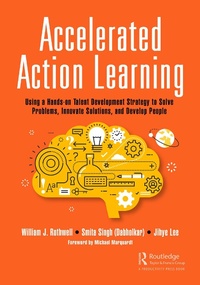
Accelerated Action Learning
Using a Hands-on Talent Development Strategy to Solve Problems, Innovate Solutions, and Develop People
1st Edition
Published on 31. January 2024
260 pages
978-1-003-83499-1 (ISBN)
Description

In a knowledge-based society, people should not simply collect knowledge but should utilize and apply it to solve a problem. Action learning makes organizational members learn while solving real problems in the workplace. However, traditional action learning might not be effective for rapidly changing environments, because it is typically a process that requires substantial time. Therefore, this book provides a guideline on how to apply action learning quickly in workplaces-especially in virtual settings.
Action learning allows the organization to develop people while, at the same time, getting work done. It is an alternative to classroom-based and online learning programs. In addition, it can also be an alternative to the instructional systems design (ISD) model or the successive approximation model (SAM) as a means of developing planned instruction if used for that purpose. Action learning can be an effective tool for Web 2.0 learning. Many organizations are now using self-directed teams and other team formats for work. It makes sense to revisit planned on-the-job training and learning with an emphasis on teams. Action learning is a process involving a small group with facilitators and action-learning process managers, so it is one of the best options for team-based problem-solving.
This book provides real action learning cases. There are needs that have emerged in these post-pandemic times. There is a need to explain how action learning can be applied to various settings, issues, and challenges. Since COVID-19 occurred, many people must work in virtual or hybrid settings. This book gives trainers-who could be HR managers, operating managers, or learning and development professionals-guidelines that can be used in virtual settings to meet the new needs.
Essentially, this book is written for team facilitators, supervisors, managers, or team members who wish to plan action-oriented, problem-based, and work-related learning experiences in real time. Because many action-learning books are written for an academic audience, it is not easy to put action learning into practice. Therefore, the goal of this book is to provide guidelines on how action learning starts, what basic principles should be considered, and what tools and techniques are needed for rapid action learning. The book is intended to be a primer on how to facilitate a planned learning project in a team or workgroup.
Action learning allows the organization to develop people while, at the same time, getting work done. It is an alternative to classroom-based and online learning programs. In addition, it can also be an alternative to the instructional systems design (ISD) model or the successive approximation model (SAM) as a means of developing planned instruction if used for that purpose. Action learning can be an effective tool for Web 2.0 learning. Many organizations are now using self-directed teams and other team formats for work. It makes sense to revisit planned on-the-job training and learning with an emphasis on teams. Action learning is a process involving a small group with facilitators and action-learning process managers, so it is one of the best options for team-based problem-solving.
This book provides real action learning cases. There are needs that have emerged in these post-pandemic times. There is a need to explain how action learning can be applied to various settings, issues, and challenges. Since COVID-19 occurred, many people must work in virtual or hybrid settings. This book gives trainers-who could be HR managers, operating managers, or learning and development professionals-guidelines that can be used in virtual settings to meet the new needs.
Essentially, this book is written for team facilitators, supervisors, managers, or team members who wish to plan action-oriented, problem-based, and work-related learning experiences in real time. Because many action-learning books are written for an academic audience, it is not easy to put action learning into practice. Therefore, the goal of this book is to provide guidelines on how action learning starts, what basic principles should be considered, and what tools and techniques are needed for rapid action learning. The book is intended to be a primer on how to facilitate a planned learning project in a team or workgroup.
More details
Series
Edition
1. Auflage
Language
English
Place of publication
London
United Kingdom
Publishing group
Taylor & Francis Ebooks
Target group
Professional and scholarly
Illustrations
31 Line drawings, black and white; 31 Illustrations, black and white
ISBN-13
978-1-003-83499-1 (9781003834991)
Copyright in bibliographic data and cover images is held by Nielsen Book Services Limited or by the publishers or by their respective licensors: all rights reserved.
Schweitzer Classification
Other editions
Additional editions
William J. Rothwell | Smita Singh (Dabholkar) | Jihye Lee
Accelerated Action Learning
Using a Hands-on Talent Development Strategy to Solve Problems, Innovate Solutions, and Develop People
Book
01/2024
1st Edition
Productivity Press
€58.40
Shipment within 10-20 days
William J. Rothwell | Smita Singh (Dabholkar) | Jihye Lee
Accelerated Action Learning
Using a Hands-on Talent Development Strategy to Solve Problems, Innovate Solutions, and Develop People
Book
01/2024
1st Edition
Productivity Press
€154.40
Shipment within 10-20 days
Persons
William J. Rothwell, Ph.D., SPHR, SHRM-SCP, RODC, CPTD Fellow is a Distinguished Professor in the Workforce Education and Development Program in the Department of Learning and Performance Systems, College of Education, on the University Park campus of The Pennsylvania State University. He has authored, co-authored, edited, or coedited 130 books since 1987. In 2022 he earned Penn State University's Global Lifetime Achievement Award, the university's highest award for doing international work that exerts a positive global influence on the university. His recent books since 2017 include High-Performance Coaching for Managers (Routledge, 2022 in press); Rethinking Diversity, Equity, and Inclusion (Routledge, 2022 in press); Organization Development (OD) Interventions: Executing Effective Organizational Change (Routledge, 2021); Virtual Coaching to Improve Group Relationships: Process Consultation Reimagined (Routledge, 2021); The Essential HR Guide for Small Business and Start Ups (Society for Human Resource Management, 2020); Increasing Learning and Development's Impact Through Accreditation (Palgrave, 2020); Adult Learning Basics, 2nd ed. (Association for Talent Development Press, 2020); Workforce Development: Guidelines for Community College Professionals, 2nd ed. (Rowman-Littlefield, 2020); Human Performance Improvement: Building Practitioner Performance, 3rd ed. (Routledge, 2018); Innovation Leadership (Routledge, 2018), Evaluating Organization Development: How to Ensure and Sustain the Successful Transformation (CRC Press, 2017), Marketing Organization Development Consulting: A How-To Guide for OD Consultants (CRC Press, 2017), Assessment and Diagnosis for Organization Development: Powerful Tools and Perspectives for the OD practitioner (CRC Press, 2017).
Smita Singh (Dabholkar) earned a Ph.D. in Psychology. She is an Associate Professor with the Institute of Management Technology Nagpur (MH, India) since 2011. She has been teaching, training, and providing consultancy services for close to two decades in Organization Diagnosis and Behavioral interventions. She is a certified assessor and trainer of MBTI by CPP and Emotional Intelligence by Six Seconds Global Emotional Intelligence Network. She has completed the Certificate Course for Women Directors conducted by The Institute of Company Secretaries of India. She regularly trains senior executives and top management on leadership. She has written two books. Her latest book is on Emotional Intelligence, published by Cengage. She is actively engaged with the local industry associations and writes regularly in various trade journals. She serves the selection panel of Public Sector organizations in the capacity of a psychologist. She has been a Group Study exchange member to Sweden, a program sponsored by Rotary Foundation in 2008.
Jihye Lee has a Ph.D. in Workforce Education and Development with an emphasis on Human Resource and Development and Organization Development (HRD/OD) from the Pennsylvania State University. She has a Master's degree in Human Resource Development and Bachelor's degrees in Business Administration and in Educational Technology. She has been working as a teaching assistant for three courses: Needs assessment, Field-Based Project for Workforce Development Professionals, and Assessing Data: Organizational Diagnosis. Lee participated in many projects regarding job analysis, competency modeling, training/education program development, and organizational diagnosis. She works at the Association for Talent Development as a Global Program Specialist. Her interest is in workplace learning--and especially informal learning.
Smita Singh (Dabholkar) earned a Ph.D. in Psychology. She is an Associate Professor with the Institute of Management Technology Nagpur (MH, India) since 2011. She has been teaching, training, and providing consultancy services for close to two decades in Organization Diagnosis and Behavioral interventions. She is a certified assessor and trainer of MBTI by CPP and Emotional Intelligence by Six Seconds Global Emotional Intelligence Network. She has completed the Certificate Course for Women Directors conducted by The Institute of Company Secretaries of India. She regularly trains senior executives and top management on leadership. She has written two books. Her latest book is on Emotional Intelligence, published by Cengage. She is actively engaged with the local industry associations and writes regularly in various trade journals. She serves the selection panel of Public Sector organizations in the capacity of a psychologist. She has been a Group Study exchange member to Sweden, a program sponsored by Rotary Foundation in 2008.
Jihye Lee has a Ph.D. in Workforce Education and Development with an emphasis on Human Resource and Development and Organization Development (HRD/OD) from the Pennsylvania State University. She has a Master's degree in Human Resource Development and Bachelor's degrees in Business Administration and in Educational Technology. She has been working as a teaching assistant for three courses: Needs assessment, Field-Based Project for Workforce Development Professionals, and Assessing Data: Organizational Diagnosis. Lee participated in many projects regarding job analysis, competency modeling, training/education program development, and organizational diagnosis. She works at the Association for Talent Development as a Global Program Specialist. Her interest is in workplace learning--and especially informal learning.
Content
Chapter 1 What is Traditional Action Learning, and How Does It Differ from Chapter 2 Phase 1: Selecting a Business Problem, Training Challenge, Organizational Vision, or Business Goal Chapter 3 Phase 2: Forming a Small Group or Team of People (of About 6-7 People) Meeting Criteria Chapter 4 Phase 3: Briefing Team Members About the Accelerated Action Learning Set Chapter 5 Phase 4: Establishing Measurable Goals for the Action Learning Set Chapter 6 Phase 5: Encouraging Team Members to Experiment with Solutions Chapter 7 Phase 6: Placing Equal Emphasis on Business Results and Individual Development Chapter 8 Phase 7: Completing the Accelerated Action Learning Set Chapter 9 Phase 8: Debriefing the Accelerated Action Learning Team Members Collectively Chapter 10 Phase 9: Debriefing the Accelerated Action Learning Team Members Individually Chapter 11 Phase 10: Reassigning Accelerated Action Learning Team Members Based on Their Individual Development Needs Chapter 12 Reflections on Accelerated Action Learning (AAL)
?
?
