

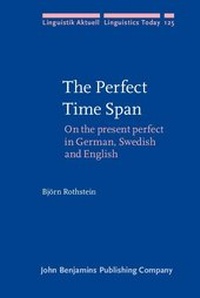
The Perfect Time Span
On the present perfect in German, Swedish and English
1st Edition
Published on 28. August 2008
XI, 171 pages
978-90-272-9071-7 (ISBN)
Description

This book is the first book-length study on the Swedish present perfect. It provides an in-depth exploration of the present perfect in English, German and Swedish. It is claimed that only a discourse-based ExtendedNow-approach fully accounts for the present perfect. The main claim is that the length of the ExtendedNow-interval varies cross-linguistically. The book is couched within the framework of the Discourse Representation Theory and also within Distributed Morphology. It is shown that Swedish provides empirical evidence against all previous research in the field. The following questions are investigated: Is it possible to assign a single uniform meaning to the present perfect? How can we account for the different readings of the perfect? How can we account for the cross-linguistic variation? These issues are addressed from a comparative perspective by integrating previous research on the present perfect. This book is of interest to all those working in the field of tense and aspect.
More details
Other editions
Additional editions
Book
08/2008
John Benjamins Publishing Co
€121.90
Shipment within 10-15 days
Person
Content
- The Perfect Time Span
- Editorial page
- Title page
- LCC data
- Table of contents
- Acknowledgements
- Chapter 1
- Preliminaries
- 1. Outline
- 2. Time and tense
- 3. On Reichenbach's approach to tense
- 4. Different notions of the reference time
- 5. Why there is a reference time in the present perfect
- 6. On tense again
- 7. On the formal implementation of tense
- 8. Conclusion
- Chapter 2
- The components of the perfect meaning
- 1. The present perfect
- 2. The German data
- 3. The Swedish data
- 4. The English data
- 5. Former approaches to the German present perfect
- 5.1 Introduction: Tense and aspect approaches to the perfect
- 5.2 Anteriority-approaches
- 5.3 ExtendedNow-theories
- 6. Former approaches to the Swedish present perfect
- 7. Former approaches to the English present perfect
- 8. A (new) ExtendedNow-analysis for the present perfect
- 9. Identifying the stative component
- 9.1 Introduction
- 9.2 The present perfect as a stative construction
- 9.3 The present perfect as a non-stative construction
- 9.4 Conclusion so far
- 9.5 Accounting for stative and non-stative uses
- 9.6 A short note on the pluperfect
- 9.7 Conclusion
- 10. Why the present perfect differs cross-linguistically
- The perfect conclusion
- Chapter 3
- Adverbials and the perfect
- 1. Introduction
- 2. Prior analyses
- 3. The meaning of the present perfect
- 4. On temporal adverbials
- 5. On the present perfect puzzle
- 6. Conclusion
- Chapter 4
- The inferential present perfect in Swedish
- 1. Introduction
- 2. Former approaches
- 3. On the status of the inferential present perfect
- 3.1 The inferential present perfect is not a present perfect
- 3.2 The inferential present perfect is not a past tense
- 4. The inferential meaning of the present perfect
- 5. The meaning contribution of evidential markers
- 6. The inferential present perfect is an infinitival perfect
- 7. On parasitic morphology in Swedish
- 7.1 Parasitic morphology sheds light on architecture of grammar
- 7.2 Distributed Morphology
- 7.3 An account of parasitic morphology in the framework of DM
- 8. Perfect parasitism in inferential contexts
- 9. The null modal hypothesis
- 10. The lost present perfect puzzle
- 11. DRT and DM
- 12. Conclusion
- Chapter 5
- Perfect readings
- 1. Introduction
- 2. The meaning of the present perfect
- 3. The readings of the present perfect
- 4. The approach by Musan(1999, 2002)
- 5. Present perfect and event time modification
- 6. Preterite reading and situation type aspect (Aktionsart)
- 7. Present perfect in discourse
- 8. Present perfect that is followed by a present perfect/past tense
- 9. Present perfect that is followed by a present tense
- 10. The present perfect in a context without context
- 11. Universal and experiential readings of the present perfect
- 11.1 Introduction
- 11.2 Semantic vs. pragmatic accounts of the perfect perfect readings
- 11.3 Situation type aspect, adverbials and the perfect readings
- 11.4 The readings are context sensitive
- 12. Conclusion
- Chapter 6
- Conclusion
- References
- Index
- The series Linguistik Aktuell/Linguistics Today
