

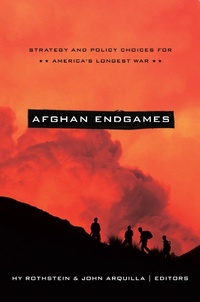
Afghan Endgames
Description

The United States and its allies have been fighting the Taliban and al-Qaeda in Afghanistan for a decade in a war that either side could still win. While a gradual drawdown has begun, significant numbers of US combat troops will remain in Afghanistan until at least 2014, perhaps longer, depending on the situation on the ground and the outcome of the US presidential election in 2012. Given the realities of the Taliban's persistence and the desire of US policymakers-and the public-to find a way out, what can and should be the goals of the US and its allies in Afghanistan?
Afghan Endgames brings together some of the finest minds in the fields of history, strategy, anthropology, ethics, and mass communications to provide a clear, balanced, and comprehensive assessment of the alternatives for restoring peace and stability to Afghanistan. Presenting a range of options-from immediate withdrawal of all coalition forces to the maintenance of an open-ended, but greatly reduced military presence-the contributors weigh the many costs, risks, and benefits of each alternative.
This important book boldly pursues several strands of thought suggesting that a strong, legitimate central government is far from likely to emerge in Kabul; that fewer coalition forces, used in creative ways, may have better effects on the ground than a larger, more conventional presence; and that, even though Pakistan should not be pushed too hard, so as to avoid sparking social chaos there, Afghanistan's other neighbors can and should be encouraged to become more actively involved. The volume's editors conclude that while there may never be complete peace in Afghanistan, a self-sustaining security system able to restore order swiftly in the wake of violence is attainable.
More details
Other editions
Additional editions
Persons
Hy Rothstein served in the US Army as a Special Forces officer for more than 26 years, spending much of his time training and advising governments threatened by active insurgencies. He is currently a senior lecturer in the Department of Defense Analysis at the US Naval Postgraduate School. He is the author of Afghanistan and the Troubled Future of Unconventional Warfare.
John Arquilla is a professor of defense analysis at the US Naval Postgraduate School and is the author of Insurgents, Raiders, and Bandits: How Masters of Irregular Warfare Have Shaped Our World.
Content
Preface
Part I: Overview
1. Understanding the Afghan Challenge
Hy Rothstein and John Arquilla
2. A Familiar Western Experience in Ancient Afghanistan
Victor Davis Hanson
3. Afghan Paradoxes
Thomas Barfield
4. America's Longest War
Hy Rothstein
Part II: Strategic Alternatives
5. A Case for Withdrawal
Andrew J. Bacevich
6. A Case for Staying the Course
Frederick W. Kagan
7. Afghanistan: A Third Way
Edward N. Luttwak
8. Beyond Victory and Defeat
Scott Sigmund Gartner and Leo Blanken
Part III: Other Perspectives
9. The Ethics of Exit: Moral Obligation in the Afghan Endgame
Russell Muirhead
10. Shaping Strategic Communication
Robert Reilly
11. Civil and Uncivil Society
Jade I. Rodriguez and Rebecca Lorentz
Part IV: Conclusion
12. Conclusion: Assessing the Strategic Alternatives
John Arquilla and Hy Rothstein
Contributors
Index
