

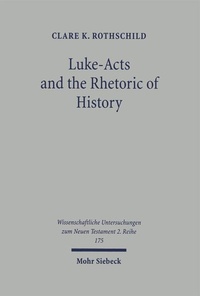
Luke-Acts and the Rhetoric of History
An Investigation of Early Christian Historiography
1st Edition
Published on 10. December 2019
371 pages
978-3-16-157159-6 (ISBN)
Description

Obwohl die Ansicht, daß die Apostelgeschichte römische Geschichtsschreibung darstellt, weit verbreitet ist, sind doch immer noch viele Wissenschaftler anderer Auffassung. Aufgrund eines sehr engen Verständnisses von alter Geschichtsschreibung bevorzugen Skeptiker den theologischen' als einen dem historischen' entgegengesetzten Ansatz und ziehen damit eine zu scharfe Trennung zwischen beiden.
Im Gegensatz zum Interesse, theologische Motive in der Apostelgeschichte aufzudecken und zu verteidigen, zeigt Clare K. Rothschild in ihrer Untersuchung gerade bestimmte historiographische Methoden und Interessen auf. Sie vertritt die These, daß einige der kompositorischen Elemente, die bisher von Forschern als Charakteristika der Theologie des Lukas gelesen wurden, gerade und vor allem Elemente der rhetorischen Historiographie sind, die sich auch in anderen Geschichtswerken aus der hellenistischen und frührömischen Zeit finden lassen.
Im Gegensatz zum Interesse, theologische Motive in der Apostelgeschichte aufzudecken und zu verteidigen, zeigt Clare K. Rothschild in ihrer Untersuchung gerade bestimmte historiographische Methoden und Interessen auf. Sie vertritt die These, daß einige der kompositorischen Elemente, die bisher von Forschern als Charakteristika der Theologie des Lukas gelesen wurden, gerade und vor allem Elemente der rhetorischen Historiographie sind, die sich auch in anderen Geschichtswerken aus der hellenistischen und frührömischen Zeit finden lassen.
More details
Other editions
Additional editions

Clare K. Rothschild
Luke-Acts and the Rhetoric of History
An Investigation of Early Christian Historiography
Book
04/2004
1st Edition
Mohr Siebeck
€89.00
Article exhausted; check different version
Person
Content
- Cover
- Titel
- Acknowledgments
- Table of Contents
- Abbreviations and References
- Chapter 1: Introduction
- Chapter 2: History of Interpretation
- 2.1 Introduction: Critical Investigations of the Purpose of Acts
- 2.1.1 Tübingen School and Reactions
- 2.1.2 Franz Overbeck
- 2.2 Critical Investigations of Acts as History
- 2.2.1 Martin Dibelius
- 2.2.2 Henry Joel Cadbury
- 2.2.3 Hans Conzelmann
- 2.2.4 Ernst Haenchen
- 2.2.5 C. Kingsley Barrett
- 2.2.6 Paul Schubert's Festschrift
- 2.2.7 Recent American Approaches
- 2.2.8 Gregory E. Sterling
- 2.2.9 Hubert Cancik
- 2.2.10 Mark Reasoner
- 2.3 Summation
- Chapter 3: Methods of Authentication in Hellenistic and Early Roman Period Historiography
- 3.1 Introduction
- 3.1.1 The Rhetoric of History: An Analogy
- 3.1.2 Historical Prologues
- 3.2 History of Interpretation
- 3.2.1 Rhetorical Historiography
- 3.2.2 Rhetorical Historiography as the Degradation of Classical Exemplars
- 3.2.3 Two 'School' Split
- 3.3 Ancient Sources on Historiographical Method
- 3.3.1 T. P. Wiseman
- 3.3.2 Lucian's ?a??? of Historiography
- 3.4 Imitation in Ancient Historiography
- 3.5 Authenticating Strategies in Luke-Acts
- 3.6 Summation
- 3.6.1 Four Features of Historical Rhetoric in Luke-Acts
- Chapter 4: Historical Recurrence as Rhetoric
- 4.1 Introduction
- 4.1.1 Philosophical Background for Patterns of Recurrence
- 4.2 History of Interpretation
- 4.2.1 G. W. Trompf's Analysis of Historical Recurrence in Luke-Acts
- 4.3 Theoretical Basis for Reenactment as Rhetoric
- 4.3.1 S?????s??
- 4.3.2 E????
- 4.3.3 Two Forms of Rhetorical Imitation: Verbal Echoes and Historical Characterization
- 4.4 Analysis
- 4.4.1 Verbal Echoes
- 4.4.2 Historical Characterizations
- 4.4.3 Other Types of Repetition
- 4.5 Summation
- Chapter 5: Prediction in Historiography
- 5.1 Introduction
- 5.1.1 History of Interpretation
- 5.2 Prediction in Ancient Historiography
- 5.2.1 Prediction in Hellenistic Historiography
- 5.3 Analysis
- 5.3.1 Introduction to LXX Citations in Luke-Acts
- 5.3.1.1 Comparative Methodology: The Gospel of Matthew
- 5.3.1.2 LXX Citations as Prediction in The Gospel of Luke
- 5.3.1.3 LXX Citations as Prediction in Acts
- 5.3.2 Other Prediction in Luke-Acts
- 5.3.2.1 Divine Prediction
- 5.3.2.2 Human Prediction
- 5.4 Summation
- Chapter 6: Divine Guidance as Rhetoric
- 6.1 Introduction
- 6.2 History of Interpretation of Lukan Use of the Auxiliary Verb ???
- 6.3 Analysis
- 6.3.1 Introduction
- 6.3.2 Gospel of Luke
- 6.3.3 Acts of the Apostles
- 6.4 Related Examples in Hellenistic and Early Roman Period Historiography
- 6.5 Summation
- Chapter 7: Eyewitnesses and Epitomizing as Historical Rhetoric
- 7.1 Introduction
- 7.2 History of Interpretation
- 7.3 Eyewitnesses and Epitomizing as Historical Rhetoric in Ancient Historiography and Ancient Rhetoric
- 7.3.1 ????????
- 7.4 Analysis
- 7.4.1 Introduction to the Rhetoric of Eyewitnesses
- 7.4.2 Introduction to Epitomizing Rhetoric
- 7.4.3 Special Manifestations of the Rhetoric of Eyewitnesses
- 7.4.4 Multiplication of Eyewitnesses: The Gospel of Luke
- 7.4.5 Multiplication of Eyewitnesses: The Acts of the Apostles
- Excursus: The 'We-passages' as Eyewitness Rhetoric
- 7.4.6 Promotion of Eyewitnesses: The Gospel of Luke
- 7.4.7 Promotion of Eyewitnesses: The Acts of the Apostles
- 7.4.8 Epitomizing Rhetoric: Introduction
- 7.4.9 Epitomizing Rhetoric: The Gospel of Luke
- 7.4.10 Epitomizing Rhetoric: The Acts of the Apostles
- 7.5 Certain Exceptions to the Amplification of Eyewitnesses
- 7.6 Summation
- Chapter 8: Conclusions: Summation and Some Implications of the Analysis
- Bibliography
- Indices
- References
- Modern Authors
- Subjects
