

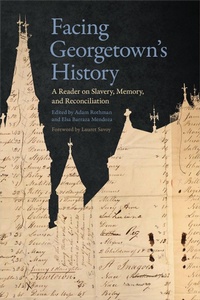
Facing Georgetown's History
Description

These essays, articles, and documents introduce readers to the history of Georgetown University's involvement in slavery and recent efforts to confront its troubling past. It traces Georgetown's ?Slavery, Memory, and Reconciliation Initiative? and the role of universities?uniquely situated to conduct that reckoning through research, teaching, and modeling thoughtful discussion?in this movement.
More details
Other editions
Additional editions
Persons
Adam Rothman is a professor in Georgetown University's Department of History. He is the author of Beyond Freedom's Reach: A Kidnapping in the Twilight of Slavery, which was named the Humanities Book of the Year by the Louisiana Endowment for the Humanities and received the American Civil War Museum's book award. He is also the author of Slave Country: American Expansion and the Origins of the Deep South and the coauthor of Major Problems in Atlantic History. He served on Georgetown's Working Group on Slavery, Memory, and Reconciliation from 2015?16, and is currently the principal curator of the Georgetown Slavery Archive. He was a Distinguished Visiting Scholar at the John W. Kluge Center at the Library of Congress in 2018, where he created the podcast ?African-American Passages: Black Lives in the 19th Century?.
Elsa Barraza Mendoza is a PhD candidate in history at Georgetown University and the assistant curator of the Georgetown Slavery Archive. She is a former Fulbright-Garcia Robles fellow. Her research has been supported by the Cushwa Center for the Study of American Catholicism and the Omohundro Institute of Early American History and Culture. She is currently writing her dissertation on the history of slavery on Georgetown's campus.
Lauret Savoy is the David B. Truman Professor of environmental studies at Mount Holyoke College, where she explores the marks of history on the land. The author of Trace: Memory, History, Race, and the American Landscape, she also descends from people enslaved by Jesuits.
Content
Foreword, Lauret Savoy
Acknowledgments
Editors' Note
Introduction, Adam Rothman
Part 1: History
Essays
1. Craig Steven Wilder, ?War and Priests: Catholic Colleges and Slavery in the Age of Revolution?
2. Robert Emmet Curran, ? 'Splendid Poverty': Jesuit Slaveholding in Maryland, 1805-1838?
3. Elsa Barraza Mendoza, ?Catholic Slave Owners and the Development of Georgetown University's Slave Hiring System, 1792-1862?
4. James O'Toole, ?Passing: Race, Religion, and the Healy Family, 1820-1920?
Documents
5. Enslaved People Named in a Deed, 1717
6. A Sermon on the Treatment of Slaves, 1749
7. Edward Queen Petitions for Freedom, 1791
8. Isaac Runs Away from Georgetown College, 1814
9. A Jesuit Overseer Calculates the Cost of Slave Labor, 1815
10. Baptism of Sylvester Greenleaf at Newtown, 1819
11. Fr. James Ryder, SJ, Criticizes Abolitionism, 1835
12. The Society of Jesus Sets Conditions on the Sale of the Maryland Slaves, 1836
13. Articles of Agreement between Thomas Mulledy, Henry Johnson, and Jesse Batey, 1838
14. A Jesuit Priest Witnesses Anguish at Newtown, 1838
15. Bill of Sale for Len, 1843
16. A Jesuit Priest Reports on the Fate of the Ex-Jesuit Enslaved Community in Louisiana, 1848
17. Aaron Edmonson, the Last Enslaved Worker at Georgetown, 1859-62
18. Labor Contract at West Oak Plantation, Iberville Parish, Louisiana, 1865
19. Photograph of Frank Campbell, ca. 1900
Part 2. Memory and Reconciliation
Essays
20. Ira Berlin, ?American Slavery in History and Memory and the Search for Social Justice?
21. Ta-Nehisi Coates, ?The Case for Reparations?
22. Alondra Nelson, ?The Social Life of DNA: Racial Reconciliation and Institutional Morality after the Genome?
The Working Group
23. Matthew Quallen, ?Slavery's Remnants, Buried and Overlooked?
24. Toby Hung, ?Student Activists Sit in outside DeGioia's Office?
25. "Report of the Georgetown University Working Group on Slavery, Memory, and Reconciliation, to the President of Georgetown University?
26. James Martin, SJ, ?How Georgetown is Coming to Terms with Slavery in Its past?
The GU272 Descendants
27. Rachel L. Swarns, ?272 Slaves were Sold to Save Georgetown. What Does It Owe Their Descendants??
28. Rachel L. Swarns and Sona Patel, ? 'A Million Questions' from Descendants of Slaves Sold to Aid Georgetown?
29. Terry L. Jones, ?Louisiana Families Dig into Their History, Find They Are Descendants of Slaves Sold by Georgetown University?
30. Cheryllyn Branche, ?My Family's Story in Georgetown's Slave Past?
31. Rick Boyd, ?Many in Slave Sale Cited by Georgetown Toiled in Southern Md.?
Reconciliation and Reparation
32. Remarks of Sandra Green Thomas at Georgetown University's Liturgy of Remembrance, Contrition, and Hope
33. Remarks of Fr. Timothy Kesicki, SJ, at Georgetown University's Liturgy of Remembrance, Contrition, and Hope
34. Terrence McCoy, ?Her Ancestors Were Georgetown's Slaves. Now, at Age 63, She's Enrolled There-as a College Freshman?
35. Marc Parry, ?A New Path to Atonement?
36. Jesús A. Rodríguez, ?This Could Be the First Slavery Reparations Policy in America?
37. Javon Price, ?Changing Perceptions on the GU272 Referendum?
Epilogue, Elsa Barraza Mendoza
Timeline
Further Reading
Index
