

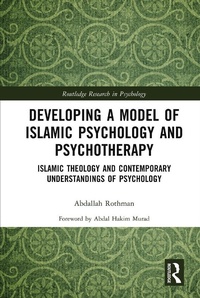
Developing a Model of Islamic Psychology and Psychotherapy
Islamic Theology and Contemporary Understandings of Psychology
1st Edition
Published on 29. July 2021
224 pages
978-1-000-41621-3 (ISBN)
Description

At a time when there is increasing need to offer psychotherapeutic approaches that accommodate clients' religious and spiritual beliefs, and acknowledge the potential for healing and growth offered by religious frameworks, this book explores psychology from an Islamic paradigm and demonstrates how Islamic understandings of human nature, the self, and the soul can inform an Islamic psychotherapy.
Drawing on a qualitative, grounded theory analysis of interviews with Islamic scholars and clinicians, this unique volume distils complex religious concepts to reconcile Islamic theology with contemporary notions of psychology. Chapters offer nuanced explanations of relevant Islamic tradition and theological sources, consider how this relates to Western notions of psychotherapy and common misconceptions, and draw uniquely on first-hand data to develop a new theory of Islamic psychology. This, in turn, informs an innovative and empirically driven model of practice that translates Islamic understandings of human psychology into a clinical framework for Islamic psychotherapy.
An outstanding scholarly contribution to the modern and emerging discipline of Islamic psychology, this book makes a pioneering contribution to the integration of the Islamic sciences and clinical mental health practice. It will be a key resource for scholars, researchers, and practicing clinicians with an interest in Islamic psychology and Muslim mental health, as well as religion, spirituality and psychology more broadly.
Drawing on a qualitative, grounded theory analysis of interviews with Islamic scholars and clinicians, this unique volume distils complex religious concepts to reconcile Islamic theology with contemporary notions of psychology. Chapters offer nuanced explanations of relevant Islamic tradition and theological sources, consider how this relates to Western notions of psychotherapy and common misconceptions, and draw uniquely on first-hand data to develop a new theory of Islamic psychology. This, in turn, informs an innovative and empirically driven model of practice that translates Islamic understandings of human psychology into a clinical framework for Islamic psychotherapy.
An outstanding scholarly contribution to the modern and emerging discipline of Islamic psychology, this book makes a pioneering contribution to the integration of the Islamic sciences and clinical mental health practice. It will be a key resource for scholars, researchers, and practicing clinicians with an interest in Islamic psychology and Muslim mental health, as well as religion, spirituality and psychology more broadly.
Reviews / Votes
"This book is both timely and meaningful as it captures the context, methodologies, and author's reflections on the emerging field of Islamic Psychology. It is an impressive addition to the literature, and I recommend it highly for those in academia and clinical practice."-- Amber Haque, PhD, Professor of Psychology, Doha Institute for Graduate Studies, Qatar
"This much anticipated book by one of the leading contemporary figures in Islamic psychology is one of the most important contributions to date on this topic. Rothman's goal of advancing an understanding of human psychology rooted in an authentic, indigenous Islamic perspective is both noble and of critical importance. His work is also a beautiful example of the continuation of the development of psychological theory and application from within the larger legacy of the Islamic intellectual tradition as well as modern psychology. To the benefit of readers, the text is imbued with insight gained from almost 20 years of clinical experience that Rothman brings to his discussion and is underpinned by his humility and sincerity, both of which come through in his writing, making this work not only scientifically rigorous, but incredibly heartfelt and accessible. This book has relevance to so many areas of inquiry and should be mandatory reading in courses on Islamic psychology and psychotherapy, courses that delve into the intersection of science, psychology and religion, or by anyone interested in this topic."
-- Carrie York Al-Karam, PhD, President, Alkaram Institute, USA
"This is a ground-breaking book that fills an important void in the current psychological literature and sets the ground for a much needed Islamic orientation to psychotherapy that is suited to address the psycho-spiritual issues of Muslim patients, globally. Thus far, Eurocentric models have been insufficient to meet this need, and even 'Islamic' adaptations of these models have served to undermine and underestimate the richness found in the Islamic intellectual tradition. This book is a demonstration of the richness of the Islamic heritage and its ability to be authentically translated into therapeutic application to address practical mental health needs of Muslim populations."
-- Hooman Keshavarzi, PsyD, Executive Director, Khalil Center, USA & Canada "This book is both timely and meaningful as it captures the context, methodologies, and author's reflections on the emerging field of Islamic Psychology. It is an impressive addition to the literature, and I recommend it highly for those in academia and clinical practice."
-- Amber Haque, PhD, Professor of Psychology, Doha Institute for Graduate Studies, Qatar
"This much anticipated book by one of the leading contemporary figures in Islamic psychology is one of the most important contributions to date on this topic. Rothman's goal of advancing an understanding of human psychology rooted in an authentic, indigenous Islamic perspective is both noble and of critical importance. His work is also a beautiful example of the continuation of the development of psychological theory and application from within the larger legacy of the Islamic intellectual tradition as well as modern psychology. To the benefit of readers, the text is imbued with insight gained from almost 20 years of clinical experience that Rothman brings to his discussion and is underpinned by his humility and sincerity, both of which come through in his writing, making this work not only scientifically rigorous, but incredibly heartfelt and accessible. This book has relevance to so many areas of inquiry and should be mandatory reading in courses on Islamic psychology and psychotherapy, courses that delve into the intersection of science, psychology and religion, or by anyone interested in this topic."
-- Carrie York Al-Karam, PhD, President, Alkaram Institute, USA
"This is a ground-breaking book that fills an important void in the current psychological literature and sets the ground for a much needed Islamic orientation to psychotherapy that is suited to address the psycho-spiritual issues of Muslim patients, globally. Thus far, Eurocentric models have been insufficient to meet this need, and even 'Islamic' adaptations of these models have served to undermine and underestimate the richness found in the Islamic intellectual tradition. This book is a demonstration of the richness of the Islamic heritage and its ability to be authentically translated into therapeutic application to address practical mental health needs of Muslim populations."
-- Hooman Keshavarzi, PsyD, Executive Director, Khalil Center, USA & Canada
"Abdallah Rothman has accomplished the commendable task of providing a much-needed framework for the understanding of the theory and practice of Islamic psychology."
-- Samuel Bendeck Sotillos, Spiritual Psychology And Counseling
More details
Series
Edition
1. Auflage
Language
English
Place of publication
London
United Kingdom
Publishing group
Taylor & Francis Ltd
Target group
College/higher education
Product notice
Reflowable
Illustrations
7 Tables, black and white; 4 Line drawings, black and white; 4 Illustrations, black and white
ISBN-13
978-1-000-41621-3 (9781000416213)
Copyright in bibliographic data and cover images is held by Nielsen Book Services Limited or by the publishers or by their respective licensors: all rights reserved.
Schweitzer Classification
Other editions
Additional editions
Abdallah Rothman
Developing a Model of Islamic Psychology and Psychotherapy
Islamic Theology and Contemporary Understandings of Psychology
Book
01/2023
1st Edition
Routledge
€55.00
Shipment within 15-20 days
Abdallah Rothman
Developing a Model of Islamic Psychology and Psychotherapy
Islamic Theology and Contemporary Understandings of Psychology
Book
07/2021
1st Edition
Routledge
€206.30
Shipment within 15-20 days
Abdallah Rothman
Developing a Model of Islamic Psychology and Psychotherapy
Islamic Theology and Contemporary Understandings of Psychology
Book
07/2021
Routledge
Unfortunately, price unknown
Available (delivery time upon request)
Person
Abdallah Rothman is Executive Director of the International Association of Islamic Psychology, US and Principal at Cambridge Muslim College, UK.
Content
Author's Note
Acknowledgements
Foreword by Abdal Hakim Murad
1: Beyond Islamization: Re-envisioning Western Psychotherapy within an Indigenous Psychological Paradigm
2: Islam and Psychology: The Development of a New Field
Reflection 1: A Journey of the Soul, A Journey to Islam
3: Grounded Theory and Theology: A Methodological Approach to Constructing a Religiously Inspired Theoretical Framework
Reflection 2: A Believer and a Scholar
4: An Islamic Model of the Soul: Theoretical Foundations for Islamic Psychology and Psychotherapy
Reflection 3: In the field: A Finite Pool of Clinicians and a Sea of Reluctant Scholars
5: The Nature and Structure of the Soul: Therapeutic Conceptualisations in Islamic Psychotherapy
Reflection 4: The Analytic Process: A Symphony of Voices with One Conductor
6: Stages and Development of the Soul: The Clinical Scope of Islamic Psychotherapy
7: Reflections Upon a Framework for an Islamic Psychology and Psychotherapy: An Agenda for Research and Practice
Reflection 5: An Unwitting Academic in a New World of Theoretical Possibility
Acknowledgements
Foreword by Abdal Hakim Murad
1: Beyond Islamization: Re-envisioning Western Psychotherapy within an Indigenous Psychological Paradigm
2: Islam and Psychology: The Development of a New Field
Reflection 1: A Journey of the Soul, A Journey to Islam
3: Grounded Theory and Theology: A Methodological Approach to Constructing a Religiously Inspired Theoretical Framework
Reflection 2: A Believer and a Scholar
4: An Islamic Model of the Soul: Theoretical Foundations for Islamic Psychology and Psychotherapy
Reflection 3: In the field: A Finite Pool of Clinicians and a Sea of Reluctant Scholars
5: The Nature and Structure of the Soul: Therapeutic Conceptualisations in Islamic Psychotherapy
Reflection 4: The Analytic Process: A Symphony of Voices with One Conductor
6: Stages and Development of the Soul: The Clinical Scope of Islamic Psychotherapy
7: Reflections Upon a Framework for an Islamic Psychology and Psychotherapy: An Agenda for Research and Practice
Reflection 5: An Unwitting Academic in a New World of Theoretical Possibility
