

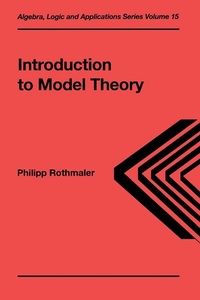
Introduction to Model Theory
1st Edition
Published on 7. December 2018
324 pages
978-0-429-66850-0 (ISBN)
Description

Model theory investigates mathematical structures by means of formal languages. So-called first-order languages have proved particularly useful in this respect.
This text introduces the model theory of first-order logic, avoiding syntactical issues not too relevant to model theory. In this spirit, the compactness theorem is proved via the algebraically useful ultrsproduct technique (rather than via the completeness theorem of first-order logic). This leads fairly quickly to algebraic applications, like Malcev's local theorems of group theory and, after a little more preparation, to Hilbert's Nullstellensatz of field theory.
Steinitz dimension theory for field extensions is obtained as a special case of a much more general model-theoretic treatment of strongly minimal theories. There is a final chapter on the models of the first-order theory of the integers as an abelian group. Both these topics appear here for the first time in a textbook at the introductory level, and are used to give hints to further reading and to recent developments in the field, such as stability (or classification) theory.
This text introduces the model theory of first-order logic, avoiding syntactical issues not too relevant to model theory. In this spirit, the compactness theorem is proved via the algebraically useful ultrsproduct technique (rather than via the completeness theorem of first-order logic). This leads fairly quickly to algebraic applications, like Malcev's local theorems of group theory and, after a little more preparation, to Hilbert's Nullstellensatz of field theory.
Steinitz dimension theory for field extensions is obtained as a special case of a much more general model-theoretic treatment of strongly minimal theories. There is a final chapter on the models of the first-order theory of the integers as an abelian group. Both these topics appear here for the first time in a textbook at the introductory level, and are used to give hints to further reading and to recent developments in the field, such as stability (or classification) theory.
More details
Series
Edition
1. Auflage
Language
English
Place of publication
London
United Kingdom
Publishing group
Taylor & Francis Ltd
Target group
College/higher education
File size
10,21 MB
ISBN-13
978-0-429-66850-0 (9780429668500)
Copyright in bibliographic data and cover images is held by Nielsen Book Services Limited or by the publishers or by their respective licensors: all rights reserved.
Schweitzer Classification
Other editions
Additional editions
Philipp Rothmaler
Introduction to Model Theory
Book
10/2000
1st Edition
Taylor & Francis
€117.50
Shipment within 15-20 days
Philipp Rothmaler
Introduction to Model Theory
Book
10/2000
1st Edition
Taylor & Francis
€178.27
Article not available at the moment
Content
Basics, Structures, Languages, Semantics. Beginnings of Model Theory, The Finiteness Theorem, First Consequences of Finiteness Theorem, Malcev's Applications to Group Theory, Some Theory of Ordering. Basic Properties of Theories, Elementary Maps, Elimination, Chains. Theories and Types, Types, Thick and Thin Models, Countable Complete Theories. Two Applications, Strong Minimal Theories, Hints to Selected Exercise, Solutions for Selected Exercises.
