

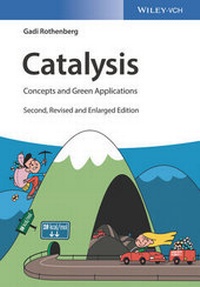
Catalysis
Description

Following an introduction to green chemistry and the basics of catalysis, the book covers the principles and applications of homogeneous catalysis, heterogeneous catalysis and biocatalysis. Each chapter includes up-to-date industrial examples, that demonstrate how catalysis helps our society reach the goals of sustainable development.
Since its publication in 2008, Catalysis: Concepts and Green Applications has become the most popular textbook in catalysis. This second edition is updated with the latest developments in catalysis research in academia and industry. It also contains 50 additional exercises, based on the suggestions of students and teachers of chemistry and chemical engineering from all over the world.
The book is also available in the Chinese language (https://detail.tmall.com/item.htm?spm=a212k0.12153887.0.0.4e60687dUTEDKm&id=619581126247).
Additional teaching material (original figures as PowerPoint lecture slides) is freely available in the Supplementary Material.
More details
Other editions
Additional editions
Person
and scientific writing. He has published over 180 papers in peer-reviewed journals, was awarded 15 patents, and co-founded the companies Sorbisense A/S, Yellow Diesel BV and Plantics BV. Rothenberg?s current research interests
include fuel cells, biomass conversion and multifunctional materials. His latest invention is a simple catalytic process for removing cyanide from industrial waste streams.
Content
Green chemistry and sustainable development
What is catalysis and why is it important?
Tools in catalysis research
Exercises
THE BASICS OF CATALYSIS
Catalysis is a kinetic phenomenon
Practical approaches in kinetic studies
An overview of the basic concepts in catalysis
Exercises
HOMOGENEOUS CATALYSIS
Metal complex catalysis in the liquid phase
Homogeneous catalysis without metals
Scaling up and down: Pros and cons
"Click chemistry" and homogeneous catalysis
Exercises
HETEROGENEOUS CATALYSIS
Classic gas/solid systems
Liquid/solid and liquid/liquid catalytic systems
Advanced process solutions using heterogeneous catalysis
Exercises
BIOCATALYSIS
The basics of enzymatic catalysis
Applications of enzyme catalysis
Developing new biocatalysts: Better than nature's best
Non-enzymatic biocatalysts
Industrial examples
Exercises
COMPUTER APPLICATIONS IN CATALYSIS RESEARCH
Computers as research tools in catalysis
Modelling catalysts and catalytic cycles
Predictive modelling and rational catalyst design
An overview of data mining methods in catalysis
Exercises
1
Introduction
This chapter outlines the principles of green chemistry, and explains the connection between catalysis and sustainable development. It covers the concepts of environmental impact, atom economy, and life-cycle analysis, with hands-on examples. Then, it introduces the reader to heterogeneous catalysis, homogeneous catalysis, and biocatalysis, explaining what catalysis is and why it is important. The last two sections give an overview of the tools used in catalysis research, and a list of recommended books on specialised subjects in catalysis.
1.1 Green Chemistry and Sustainable Development
Chemistry affects every day of our lives. The chemical and petrochemical industry has shaped our modern technological society by supplying us with energy, medicines, crop protection, foodstuffs and new materials. Thanks to the chemical industry people in the twentyfirst century live longer, have abundant food, and enjoy an unprecedented quality of life. Yet despite these benefits, chemicals and the chemical industry suffer from a negative public image. Most of this is due to misconceptions and media scares, but there are also real reasons: If they are mismanaged, petrochemical plants and chemical factories can cause serious environmental hazards. Anyone who has stepped outside in mega-cities such as Delhi, Beijing or Mexico City, for example, will tell you that the air pollution from energy and chemical factories cannot be ignored. Accidents such as the Deepwater Horizon oil spill in the Gulf of Mexico in 2010, where over 4.9 million barrels of oil were discharged into the ocean, haven't helped improve this image either [1].
But even with superb management, planning and safety procedures, the challenges of resource scarcity and end-of-life product disposal remain. The short-term prices of fossil-based raw materials fluctuate because of politics, but these resources will run out sooner or later. Similarly, while we enjoy the attractive price/performance ratios of chemical products such as plastic bottles, the accumulation of plastic garbage is making more and more people realise the importance of product life-cycles. All these factors are slowly causing a change. Two popular terms associated with this change are sustainability and sustainable development. A sustainable society is one that 'meets the needs of the current generation without sacrificing the ability to meet the needs of future generations'. Sustainable development is a strategic goal. It can be reached using various approaches, and this is where green chemistry comes in. Figure 1.1 shows the relationship between the strategic goals, the practical approaches, and the operational and monitoring tools. Thus, green chemistry is just one step (albeit an important one) on the road to sustainability.
Figure 1.1 The strategic goal of sustainable development relies on practical approaches such as green chemistry, industrial ecology, and green engineering. These approaches use various operational tools (such as catalysis), and monitoring tools (such as life-cycle assessment).
1.1.1 What Is 'Green Chemistry'?
In the 1990s, the concept of 'green chemistry' was initiated in both the US and Europe, and has since been adopted widely by the chemical industry [2]. Green chemistry deals with designing chemical products and processes that generate and use less (or preferably no) hazardous substances. By applying the principles of green chemistry, companies embrace cleaner and more efficient technologies, with an a priori commitment to a cleaner and healthier environment. The green chemistry message is simple: 'Seek prevention, not cure'. In 1998, Anastas and Warner formulated the following twelve principles of green chemistry [3, 4] (I've rephrased these in the active voice, in keeping with the spirit of this book):
Figure 1.2 Green chemistry initiatives are driven by government legislation, societal pressure, and economic benefits.
I Prevent waste instead of treating it. II Design atom-efficient synthetic methods. III Choose synthetic routes using non-toxic compounds where possible. IV Design new products that preserve functionality while reducing toxicity. V Minimise the use of auxiliary reagents and solvents. VI Design processes with minimal energy requirements. VII Preferably use renewable raw materials. VIII Avoid unnecessary derivatisation. IX Replace stoichiometric reagents with catalytic cycles. X Design new products with biodegradable capabilities. XI Develop real-time and on-line process analysis and monitoring methods. XII Choose feedstocks and design processes that minimise the chance of accidents.Green chemistry offers an alternative to the traditional environmental protection agenda, mainly because it deals with avoiding hazard, rather than with treating and solving exposure problems. Three forces drive the green chemistry initiative: Government legislation, societal pressure, and economic benefit (Figure 1.2) [5]. The EU directive on the registration, evaluation, and assessment of chemicals (REACH), has changed the chemical industry across Europe [6]. Similar regulations are expected worldwide in the coming decade. But legislation is just one of the drivers. Societal pressure is also important: The public favours industrial green chemistry initiatives, as they lead to safer and eco-friendly products and processes. This creates goodwill for the company, something that is difficult to quantify but undoubtedly important.
The third driver is real economic benefit. Applying the principles of green chemistry decreases both capital investment and operating costs. If you use less (or no) solvents, your reactor space-time yields go up. If you replace costly reagents with cheaper and more abundant ones by using catalytic cycles, your chemicals bill goes down. Similarly, processes running at ambient temperatures are less energy-intensive. This means doing the same work using smaller and safer equipment. Eliminating waste also eliminates the need for waste treatment and disposal, and replacing toxic reagents with benign ones saves on safety costs during transportation and storage. Thus, more and more companies are adopting green chemistry practices simply because it improves their bottom-line performance.
1.1.2 Quantifying Environmental Impact: Efficiency, E-Factors, and Atom Economy
Everyone agrees that green chemistry and 'green manufacturing' are good things. The websites of all the major chemical companies emphasise their concern for the environment. They all say that their processes and products are 'efficient', 'green', and 'environmentally friendly'. But how should we compare these processes? How should we judge such claims?
Let's define first some key terms. One method for quantifying a reaction's efficiency is by examining the reactant conversion, the product selectivity, and the product yield over time. The conversion is that fraction of reactant molecules that have transformed to product molecules (regardless of which product it is). The selectivity to product P is the fraction (or percentage) of the converted reactant that has turned into this specific product P. The yield of P is simply conversion × selectivity. High conversions in short time spans mean smaller and safer reactors. Similarly, high selectivity means less waste, and simpler and cheaper separation units. Thus, conversion, selectivity, and yield are all measures of the reaction efficiency.
In addition to those, there are specific rulers for measuring the 'greenness' or 'eco-friendliness' of processes and products. One such measure is the E-factor, introduced by Roger Sheldon in 1994 [7, 8]. A reaction's E-factor equals the quotient kgwaste : kgproduct (here 'waste' is everything formed in the reaction except the desired product). The waste can be gases such as CO2 or NOx, water, common inorganic salts (e.g. NaCl, Na2SO4 or (NH4)2SO4), heavy metal salts, and/or organic compounds. Table 1.1 compares the production tonnage and E-factors of various industrial sectors. Note that the petrochemicals and the bulk chemicals sectors are the least polluting. This is surprising, as we're used to think of such chemicals as pollutants. In fact, E-factors increase substantially when going from bulk chemicals to fine chemicals and specialties. This is because the production of fine-chemicals and pharmaceuticals often involves multi-step syntheses, which require protecting groups and other reagents that are absent from the final product.
Table 1.1 Annual production and E-factors in the chemical industry.
Industrial sector Production ton/y E-factor Petrochemicals 106-108 < 0.1 Bulk...