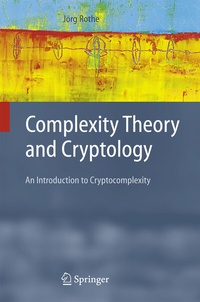
Complexity Theory and Cryptology
Description

Modern cryptology increasingly employs mathematically rigorous concepts and methods from complexity theory. Conversely, current research topics in complexity theory are often motivated by questions and problems from cryptology. This book takes account of this situation, and therefore its subject is what may be dubbed "cryptocomplexity'', a kind of symbiosis of these two areas.
This book is written for undergraduate and graduate students of computer science, mathematics, and engineering, and can be used for courses on complexity theory and cryptology, preferably by stressing their interrelation. Moreover, it may serve as a valuable source for researchers, teachers, and practitioners working in these fields. Starting from scratch, it works its way to the frontiers of current research in these fields and provides a detailed overview of their history and their current research topics and challenges.
Reviews / Votes
From the reviews:
"The book . provides introduction to both cryptology and complexity theory with special emphasis on their mutual pervasion. . All chapters have a set of exercises and problems as well as a summary describing the historical development of the notions and results presented and providing bibliographic remarks and references for further study. A comprehensive bibliography makes the book a valuable source for the researchers, teachers, and even practitioners working in complexity theory and cryptology. A useful book." (Jozef Vyskoc, Zentralblatt MATH, Vol. 1082, 2006)
"This book of 478 pages is an introduction to complexity theory and cryptology. It is very well suited for the reader who wants to learn these two closely related areas in theoretical computer science. . The nice aspect of this book is that it treats the two topics in an integrated approach. . The book could be used as a textbook for undergraduate and graduate students in computer sciences, mathematics, and engineering. Each chapter ends with pages of summary and bibliographic remarks." (Yongge Wang, Mathematical Reviews, Issue 2006 c)
"The book is intended as a textbook for advanced undergraduate and graduate students and is based on author's long experience of teaching a series of interrelated courses on cryptocomplexity. . the book contains a very well organized index. . The book is well written and interesting. . I like the book and I think it is a good textbook for graduate students and for advanced undergraduate students. . a solid textbook for advanced students and a very good, comprehensive, reference for researchers." (Piotr Faliszewski, SIGACT News, Vol. 38 (2), 2007)
More details
Other editions
Additional editions