

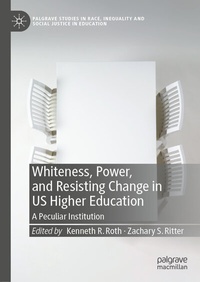
Whiteness, Power, and Resisting Change in US Higher Education
Description

This edited volume connects the origins of US higher education during the Colonial Era with current systemic characteristics that maintain white supremacist structures and devalue students and faculty of color, as well as areas of study that interrogate Whiteness. The authors examine power structures within the academy that scaffold Whiteness and promote inequality at all levels by maintaining a two-tier faculty system and a dearth of Faculty and Administrators of Color. Finally, contributors offer systemic and collective solutions toward a more equitable redistribution of power, primarily among faculty and administration, through which other inequities may be identified and more easily addressed.
Reviews / Votes
"Roth and Ritter's edited volume offers a searing, deeply researched indictment of the manifold ways Whiteness, capitalism, and power play out in the neoliberal academy. The depth and breadth of terrain covered in brilliantly nuanced fashion makes this an essential guide for all who seek to make true the promise and hope of higher education"- Sumun L. Pendakur , Chief Learning Officer, USC Race and Equity Center, University of Southern California, USA
"An insightful, revealing examination of how higher education supports-and is implicated in-the creation and perpetuation of white supremacy. We see how 'Whiteness ideology' distorts all aspects of a supposed meritocracy to provide sophisticated machinery for racial inequality and exploitation. The predictable outcome is universities where Blacks and People of Color are routinely denigrated, devalued, disadvantaged, and in far too many cases.... destroyed."
-
Walter R. Allen
, Allan Murray Cartter Professor of Higher Education and Distinguished Professor of Education, Sociology, and African American Studies, University of California, Los Angeles, USA
"The concept of Whiteness as a social process is a difficult concept for many to understand. Whiteness brings up a lot of discomfort for people who do not have a clear understanding of it as a power dynamic. The editors of the volume have done an excellent job of assembling scholars who provide readers with a clear understanding of the power dynamic of whiteness."
-
Cleveland Hayes
, Associate Dean of Academic Affairs, School of Education, Indiana University, USA
More details
Other editions
Additional editions
Persons
Kenneth R. Roth is a Research Associate with the CHOICES program at the University of California, Los Angeles, USA, where he examines access and equity issues in higher education, with particular emphasis on the challenges and paths to graduation experienced by students of color, particularly Black males.
Zachary S. Ritter is Interim Associate Dean of Students at California State University, Dominguez Hills, USA. He also teaches social justice history at both California State University, Dominguez Hills, USA, and University of California, Los Angeles, USA. He recently co-edited Marginality in the Urban Center: The Costs and Challenges of Continued Whiteness in the Americas and Beyond (2019).
