

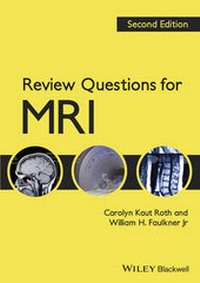
Review Questions for MRI
Description

Reviews / Votes
"This is a great tool that MRI technologists could use as a trial run for the examination. This is the best type of review book, since it mimics the format of the actual exam. It also would be helpful for seasoned MRI technologists who want to remain fresh in this ever-advancing field." (Doody's, 5 July 2013)More details
Other editions
Additional editions
Persons
Carolyn Kaut Roth, RT (R)(MR)(CT)(M)(CV) FSMRT, is a registered radiographer, who majored in physics at the University of Pennsylvania and received a clinical Master's degree (MSc) in Magnetic Resonance for Radiographers at Anglia Polytechnic Cambridge United Kingdom. She has served on MRI Educational Task forces for The American Council for Education with the Department of Education for the Federal Government of the United States. She is currently the CEO of Imaging Education Associates, which is an education services company serving the medical imaging industry with a focus on continuing education programs for radiographers.
William H. Faulkner, Jr., B.S.,R.T.(R)(MR)(CT) is MRI Education and Operations Consultant, William Faulkner Associates.
Content
Part B
Imaging Procedures
Clinical Applications, Enhancement Agents, Cross-Sectional Anatomy
Introduction
Although imaging protocols vary with facility, there are a number of aspects of clinical imaging that are universal. Despite slight procedural variations, the fundamental components are basically the same, including T1-weighted images (usually acquired to evaluate anatomy) and T2-weighted images (usually acquired for pathology). Also, when small anatomy is to be imaged, high-resolution imaging is required [small field of view (FOV), thin slice thickness, and/or high imaging matrix]. Such fundamental parameters are of importance to most practicing technologists.
MRI procedure questions make up roughly 30% of the examination.
Part B offers review questions that pertain to cross-sectional anatomy, physiology, clinical imaging (including parameters and options, coil selection, positioning, and landmark), and contrast enhancement (dose, administration, effects on the image).
Type of study Focus of questions 1. Head and Neck a. Brain b. Internal auditory canal c. Pituitary d. Orbit e. Soft tissue neck f. Angiography g. Spectroscopy h. fMRI 2. Spine a. Cervical b. Thoracic c. Lumbo-sacral 3. Thorax a. Brachial plexus b. Cardiac c. Breast d. Mediastinum e. Angiography 4. Abdomen a. Liver, spleen, pancreas b. Kidneys, adrenals c. Peritoneum, retroperitoneum d. Biliary e. Angiography 5. Pelvis a. Female pelvis b. Male pelvis 6. Musculoskeletal a. Temporo-mandibular joint (TMJ) b. Upper extremities- Shoulder
- Elbow
- Wrist
- Hand
- Hip
- Knee
- Ankle
- Foot
- Imaging planes
- Pathological considerations
- Protocol considerations
- Type of agent (FDA approved)
- Contraindications
- Dose calculation
- Administration route
- Effects on image
- Coil selection and position
- Patient orientation
- Centering and landmark
- Physiologic gating and triggering
MRI of the Head and Neck
Although protocols vary from site to site, there are general protocols that are used for brain imaging in MRI. A typical brain protocol includes: three-plane localizer (or scout), sagittal T1WI, axial T2WI, axial FLAIR imaging, and diffusion imaging. If the patient is imaged for “specialized” imaging of the head [such as the internal auditory canals (IACs) or pituitary], high resolution would be acquired for the visualization of smaller structures associated with the pituitary gland and/or within the IACs.
Questions 1–137 concern the head and neck.
MRI of the Spine
MRI spine protocols vary from site to site, but there are general protocols that are used for spine imaging in MRI. A typical spine protocol includes: three-plane localizer (or scout), sagittal T1WI (high resolution), sagittal T2WI (high resolution), axial T1 and T2*, and 3D gradient echo imaging. If the patient is imaged for “specialized” imaging of the spine, contrast-enhanced imaging would be acquired for the visualization of enhancing lesions and/or the postoperative lumbar spine.
Questions 138–194 concern the spine.
MRI of the Thorax
MRI thorax (chest, heart, vasculature, and breast) protocols vary from site to site, but there are general protocols that are used for thorax imaging in MRI. A typical thorax protocol includes: three-plane localizer (or scout), coronal T1WI (high resolution), axial T1 and T2, and 3D gradient echo imaging (with contrast enhancement for vasculature and breast lesions).
Questions 195–285 concern the thorax.
MRI of the Abdomen and Pelvis
MRI abdomen protocols vary from site to site, but there are general protocols that are used for abdomen imaging in MRI. A typical abdomen protocol includes: three-plane localizer (or scout), coronal T1WI or T2W axial T2WI, and axial T1W gradient echo imaging acquired in-phase and out-of-phase. Additional abdominal imaging includes 3D gradient echo imaging (with contrast enhancement for visceral and/or vasculature lesions). Most abdominal imaging is acquired with breath-hold rapid imaging and/or respiratory triggering techniques to reduce the motion artifact caused by breathing.
Questions 286–435 concern the anatomy and imaging procedures for visceral structures, including the liver, spleen, pancreas, kidneys, adrenals, stomach, and bowel.
MRI of the Musculoskeletal System
MRI musculoskeletal protocols vary from site to site, but there are general protocols that are used for musculoskeletal imaging in MRI. A typical musculoskeletal protocol includes: three-plane localizer (or scout) and three planes (sagittal, axial, coronal – to the plane of the joint acquired with oblique imaging) acquired with both T1 and T2 contrast. Also, most facilities will acquire a STIR sequence in the plane that best demonstrates the anatomy and/or pathology of interest.
Questions 436–596 concern the anatomy and imaging procedures for musculoskeletal structures, including the temporo-mandibular joint (TMJ), shoulder, elbow, wrist, hand, hip, knee, ankle, and foot.
Part B: Questions
MRI of the Head and Neck
1. Figure B.1 was acquired in the: a. Axial imaging plane b. Sagittal imaging plane c. Coronal imaging plane d. Off-axis (oblique) imaging plane 2. Figure B.1 is an example of a: a. T1-weighted image b. T2-weighted image c. Spin (proton) density-weighted image d. T2*-weighted image e. None of the above 3. Figure B.1 is likely to be acquired with: a. Short TR and short TE b. Short TR and Long TE c. Long TR and Long TE d. Long TR and short TE 4. On Figure B.1 arrow A is pointing to the: a. Cerebrospinal fluid (CSF) b. Subcutaneous fat c. Superior sagittal sinus d. Frontal sinus 5. On Figure B.1 the tissue indicated by arrow A is made up primarily of: a. White matter b. Gray matter c. Cerebrospinal fluid (CSF) d. Flowing blood 6. On Figure B.1 arrow B is pointing to the: a. Frontal lobe b. Parietal lobe c. Occipital lobe d. Temporal lobe 7. On Figure B.1 the tissue indicated by arrow B is made up primarily of: a. White matter b. Gray matter c. Cerebrospinal fluid (CSF) d. Bone 8. On Figure B.1...
