

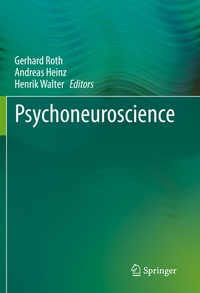
Psychoneuroscience
Description

The textbook builds a bridge between the "neurosciences" (theoretical and experimental neurobiology, neurology) and the "psychosciences" (psychology, psychiatry, psychotherapy) and aims to help provide the other disciplines with the most important and scientifically validated knowledge in an understandable form.
The question of how mental experience and brain processes relate to each other has long been considered mysterious. In this book you will learn, based on the latest scientific findings, that the two areas form an indissoluble unity, even if we experience and study them differently. We present this unity in concrete terms in psychological-neurobiological theory and psychiatric-psychotherapeutic practice. We treat the principles of neurobiological excitation and information processing, the structure and function of the limbic system, the development of the personality and the interaction of genetic-epigenetic factors and prenatal and postnatal environmental influences, which may be favourable or unfavourable. On this basis, the exemplary presentation of important mental disorders such as addictive disorders, schizophrenic disorders, affective disorders and anxiety disorders takes place. Finally, following in the footsteps of the eminent psychotherapist Klaus Grawe, the concept of "neuropsychotherapy" is introduced and it is shown why psychotherapy and neurobiology belong together and can enrich each other. Our psychoneuroscientific approach paints a picture of man that is not based on opposites, but on an integration of psyche, brain, behavior and experience.
More details
Other editions
Additional editions
Persons
Prof. Dr. phil. Dr. rer. nat Gerhard Roth researches and teaches at the Brain Research Institute, University of Bremen.
Prof. Dr. med. Dr. phil. Andreas Heinz is Clinic Director at the Clinic for Psychiatry and Psychotherapy at the Charité Berlin.
Prof. Dr. med. Dr. phil. Henrik Walter is head of the research area "Mind and Brain" at the Department of Psychiatry and Psychotherapy of the Charité Berlin and deputy medical director of the clinic.
Content
1 The search for the nature of the soul.- 2 The functional neuroanatomy of the limbic system.- 3 Neuro- and psychopharmacology.- 4 Neurophysiology.- 5 Developmental neurobiology.- 6 Emotion, motivation, personality and their neurobiological foundations.- 7 Neurobiological consequences of early stress experiences.- 8 Psychological and neurobiological foundations of consciousness.- 9 Nature, diagnosis and classification of mental illness.- 10 Psyche and mental illness - addiction.- 11 Psychotic illness ("schizophrenia").- 12 Affective disorders using the example of unipolar depression.- 13 Anxiety disorders.- 14 Neuropsychotherapy - psychotherapy methods and their effects.- 15 Psychoneuroscience and its significance for practice.
