

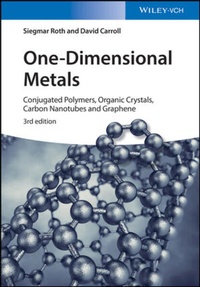
One-Dimensional Metals
Conjugated Polymers, Organic Crystals, Carbon Nanotubes and Graphene
3rd Edition
Published on 23. July 2015
360 pages
978-3-527-69019-0 (ISBN)
Description

Low-dimensional solids are of fundamental interest in materials science due to their anisotropic properties. Written not only for experts in the field, this book explains the important concepts behind their physics and surveys the most interesting one-dimensional systems and discusses their present and emerging applications in molecular scale electronics. Chemists, polymer and materials scientists as well as students will find this book a very readable introduction to the solid-state physics of electronic materials.
In this completely revised and expanded third edition the authors also cover graphene as one of the most important research topics in the field of low dimensional materials for electronic applications. In addition, the topics of nanotubes and nanoribbons are widely enlarged to reflect the research advances of the last years.
In this completely revised and expanded third edition the authors also cover graphene as one of the most important research topics in the field of low dimensional materials for electronic applications. In addition, the topics of nanotubes and nanoribbons are widely enlarged to reflect the research advances of the last years.
All prices
More details
Other editions
Additional editions
Siegmar Roth | David Carroll
One-Dimensional Metals
Conjugated Polymers, Organic Crystals, Carbon Nanotubes and Graphene
Book
09/2015
3rd Edition
Wiley-VCH
€159.00
Article exhausted; check different version
Siegmar Roth | David Carroll
One-Dimensional Metals 3e - Conjugated Polymers, Organic Crystals, Carbon Nanotubes and Graphene
Software
07/2015
Wiley-VCH
€198.26
No shipping information available
Previous edition
Siegmar Roth | David Carroll
One-Dimensional Metals
Conjugated Polymers, Organic Crystals, Carbon Nanotubes
E-Book
03/2006
2nd Edition
Wiley-VCH
€120.99
Available for download
Persons
Siegmar Roth is founding director of Sineurop Nanotech GmbH Stuttgart, Germany, a company synthesizing carbon nanotubes, graphene and related materials.
He has obtained his PhD in Physics at the University of Vienna, Austria, and his Habilitation at the University of Karlsruhe, Germany. After some years at Siemens in Erlangen, Germany, he joined the Institut Laue Langevin and later on the High Field Magnet Lab in Grenoble, from where he moved to Stuttgart to become leader of the Research Group on Synthetic Nanostructures at the Max Planck Institute for Solid State Research. Between 2009 and 2012 he was visiting professor at the School of Electrical Engineering of Korea University.
David L. Carroll is professor at the Wake Forest University. He is a trained materials scientist and received his PhD from Wesleyan University, Middletown, USA. After a stay as postdoctoral fellow at the department of materials science and engineering, University of Pennsylvania, Philadelphia from 1993-1995, he joined the Max-Planck-Institute for solid state research in Stuttgart, Germany. In 1997 he became Assistant Professor at Clemson University and 2001 Associate Professor. He moved with his group to Wake Forest University in 2003, where he founded the Center for Nanotechnology and Molecular Materials.
He has obtained his PhD in Physics at the University of Vienna, Austria, and his Habilitation at the University of Karlsruhe, Germany. After some years at Siemens in Erlangen, Germany, he joined the Institut Laue Langevin and later on the High Field Magnet Lab in Grenoble, from where he moved to Stuttgart to become leader of the Research Group on Synthetic Nanostructures at the Max Planck Institute for Solid State Research. Between 2009 and 2012 he was visiting professor at the School of Electrical Engineering of Korea University.
David L. Carroll is professor at the Wake Forest University. He is a trained materials scientist and received his PhD from Wesleyan University, Middletown, USA. After a stay as postdoctoral fellow at the department of materials science and engineering, University of Pennsylvania, Philadelphia from 1993-1995, he joined the Max-Planck-Institute for solid state research in Stuttgart, Germany. In 1997 he became Assistant Professor at Clemson University and 2001 Associate Professor. He moved with his group to Wake Forest University in 2003, where he founded the Center for Nanotechnology and Molecular Materials.
Content
Introduction
One-Dimensional Substances
One-Dimensional Solid State Physics
Electron-Phonon Coupling, Peierls Transition
Conducting Polymers: Solitons and Polarons
Conducting Polymers: Conductivity
Superconductivity
Charge Density Waves
Molecular Electronics
Applications
One-Dimensional Substances
One-Dimensional Solid State Physics
Electron-Phonon Coupling, Peierls Transition
Conducting Polymers: Solitons and Polarons
Conducting Polymers: Conductivity
Superconductivity
Charge Density Waves
Molecular Electronics
Applications

