
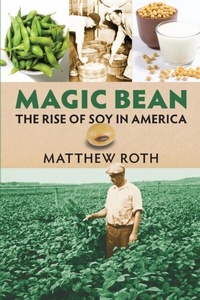
Magic Bean
Description
Alles über E-Books | Antworten auf Fragen rund um E-Books, Kopierschutz und Dateiformate finden Sie in unserem Info- & Hilfebereich.
Choice Outstanding Academic Title
At the turn of the twentieth century, soybeans grew on so little of America's land that nobody bothered to track the total. By the year 2000, they covered upward of 70 million acres, second only to corn, and had become the nation's largest cash crop. How this little-known Chinese transplant, initially grown chiefly for forage, turned into a ubiquitous component of American farming, culture, and cuisine is the story Matthew Roth tells in Magic Bean: The Rise of Soy in America.
The soybean's journey from one continent into the heart of another was by no means assured or predictable. In Asia, the soybean had been bred and cultivated into a nutritious staple food over the course of centuries. Its adoption by Americans was long in coming?the outcome of migration and innovation, changing tastes and habits, and the transformation of food, farming, breeding, marketing, and indeed the bean itself, during the twentieth century. All come in for scrutiny as Roth traces the ups and downs of the soybean's journey. Along the way, he uncovers surprising developments, including a series of catastrophic explosions at soy-processing plants in the 1930s, the widespread production of tofu in Japanese-American internment camps during World War II, the decades-long project to improve the blandness of soybean oil, the creation of new southern soybean varieties named after Confederate generals, the role of the San Francisco Bay Area counterculture in popularizing soy foods, and the discovery of soy phytoestrogens in the late 1980s. We also encounter fascinating figures in their own right, such as Yamei Kin, the Chinese American who promoted tofu during World War I, and African American chemist Percy Lavon Julian, who played a critical role in the story of synthetic human hormones derived from soy sterols.
A thoroughly engaging work of narrative history, Magic Bean: The Rise of Soy in America is the first comprehensive account of the soybean in America over the entire course of the twentieth century.
All prices
More details
Other editions
Additional editions
Person
Matthew D. Roth holds a Ph.D. in history from Rutgers University. He has taught environmental history at Philadelphia University and is on the staff of the University of Pennsylvania's Andrea Mitchell Center for the Study of Democracy.
Content
Acknowledgments
List of Illustrations
Introduction
1. Crossing Oceans
2. Jumping the Gun
3. Taking Root
4. Exploring All Avenues
5. Answering the Call
6. Pushing the Boundaries
7. Thriving in the Shade
8. Rising into View
9. Creating the Peak
Epilogue: Here to Stay?
Notes
Select Bibliography
Index

System requirements
File format: ePUB
Copy protection: Adobe-DRM (Digital Rights Management)
System requirements:
- Computer (Windows; MacOS X; Linux): Install the free reader Adobe Digital Editions prior to download (see eBook Help).
- Tablet/smartphone (Android; iOS): Install the free app Adobe Digital Editions or the app PocketBook before downloading (see eBook Help).
- E-reader: Bookeen, Kobo, Pocketbook, Sony, Tolino and many more (not Kindle).
The file format ePub works well for novels and non-fiction books – i.e., „flowing” text without complex layout. On an e-reader or smartphone, line and page breaks automatically adjust to fit the small displays.
This eBook uses Adobe-DRM, a „hard” copy protection. If the necessary requirements are not met, unfortunately you will not be able to open the eBook. You will therefore need to prepare your reading hardware before downloading.
Please note: We strongly recommend that you authorise using your personal Adobe ID after installation of any reading software.
For more information, see our ebook Help page.
File format: PDF
Copy-Protection: Adobe-DRM (Digital Rights Management)
System requirements:
- Computer (Windows; MacOS X; Linux): Install the free reader Adobe Digital Editions prior to download (see eBook Help).
- Tablet/smartphone (Android; iOS): Install the free app Adobe Digital Editions or the app PocketBook before downloading (see eBook Help).
- E-reader: Bookeen, Kobo, Pocketbook, Sony, Tolino and many more (only limited: Kindle).
The file format PDF always displays a book page identically on any hardware. This makes PDF suitable for complex layouts such as those used in textbooks and reference books (images, tables, columns, footnotes). Unfortunately, on the small screens of e-readers or smartphones, PDFs are rather annoying, requiring too much scrolling.
This eBook uses Adobe-DRM, a „hard” copy protection. If the necessary requirements are not met, unfortunately you will not be able to open the eBook. You will therefore need to prepare your reading hardware before downloading.
Please note: We strongly recommend that you authorise using your personal Adobe ID after installation of any reading software.
For more information, see our eBook Help page.
File format: ePUB
Copy protection: Watermark-DRM (Digital Rights Management)
System requirements:
- Computer (Windows; MacOS X; Linux): Use a reading software that can process the file format ePUB: e.g., Adobe Digital Editions or FBReader – both free (see eBook Help).
- Tablet/Smartphone (Android; iOS): Before downloading, install the free app Adobe Digital Editions (see eBook Help).
- E-reader: Bookeen, Kobo, Pocketbook, Sony, Tolino and many more (not Kindle).
The file format ePUB works well for novels and non-fiction books – i.e., „flowing” text without complex layout. On an e-reader or smartphone, line and page breaks automatically adjust to fit the small displays.
This eBook uses Watermark-DRM, a „soft” copy protection. This means that there are no technical restrictions to prevent illegal distribution. However, there is a personalised watermark embedded in the eBook that can be used to identify the purchaser of the eBook in the event of misuse and to provide evidence for legal purposes.
For more information, see our eBook Help page.
