

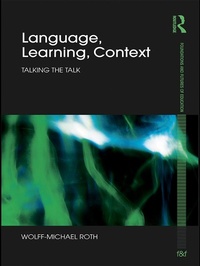
Language, Learning, Context
Talking the Talk
Published on 10. June 2010
256 pages
978-1-136-98179-1 (ISBN)
Description

In what way do educators understand the language they use to make sense of the educational environment?
How does language enable educators and how can they consciously make the most of its potential?
Using the right language and setting the correct tone in the school classroom has repercussions for all involved; whether it affects the linguistic development of a student or the effective delivery of a lesson, language plays an important factor in any educational context.
As such, this innovative book focuses right at the heart of learning, arguing that current theories of speech in classrooms do not, and cannot, capture the essentially passive aspects of talking. Until now, these verbal and physical expressions of communication have been left untheorised, leaving the potential of an entire secondary area of language untapped.
Exploring his argument along three clear, but interrelated lines of investigation, the author focuses on our understanding, on language itself and finally on communication. Thus he argues:
that language is unintentional and our understanding of it is limited
as soon as we speak, language appears beyond us in a highly singular, situated context
that communication cannot be reduced to the simple production of words.
Building on the work of linguistic philosophers such as Martin Heidegger, Donald Davidson, Paul Ricoeur and Jacques Derrida, these salient points are further elaborated to fully develop the relationship between thinking and talk in educational settings.
This invaluable book makes recommendations for the praxis of teaching and will appeal to students, researchers, and practising science and mathematics teachers, as well as those with interests in language and literacy.
How does language enable educators and how can they consciously make the most of its potential?
Using the right language and setting the correct tone in the school classroom has repercussions for all involved; whether it affects the linguistic development of a student or the effective delivery of a lesson, language plays an important factor in any educational context.
As such, this innovative book focuses right at the heart of learning, arguing that current theories of speech in classrooms do not, and cannot, capture the essentially passive aspects of talking. Until now, these verbal and physical expressions of communication have been left untheorised, leaving the potential of an entire secondary area of language untapped.
Exploring his argument along three clear, but interrelated lines of investigation, the author focuses on our understanding, on language itself and finally on communication. Thus he argues:
that language is unintentional and our understanding of it is limited
as soon as we speak, language appears beyond us in a highly singular, situated context
that communication cannot be reduced to the simple production of words.
Building on the work of linguistic philosophers such as Martin Heidegger, Donald Davidson, Paul Ricoeur and Jacques Derrida, these salient points are further elaborated to fully develop the relationship between thinking and talk in educational settings.
This invaluable book makes recommendations for the praxis of teaching and will appeal to students, researchers, and practising science and mathematics teachers, as well as those with interests in language and literacy.
More details
Series
Language
English
Place of publication
London
United Kingdom
Publishing group
Taylor & Francis Ltd
Target group
College/higher education
Illustrations
21 s/w Abbildungen, 12 s/w Photographien bzw. Rasterbilder
12 Halftones, black and white; 21 Illustrations, black and white
File size
2,87 MB
ISBN-13
978-1-136-98179-1 (9781136981791)
Copyright in bibliographic data and cover images is held by Nielsen Book Services Limited or by the publishers or by their respective licensors: all rights reserved.
Schweitzer Classification
Other editions
Additional editions
Book
09/2012
1st Edition
Routledge
€76.50
Shipment within 15-20 days
Book
05/2010
1st Edition
Routledge
€231.80
Shipment within 15-20 days
Person
Wolff-Michael Roth is Lansdowne Professor of Applied Cognitive Science at the University of Victoria, British Columbia.
Content
Preface 1. Walking the Walk 2. Making Context in Talking 3. Speaking | Thinking as Distributed Process 4. Agency | Passivity in Communication 5. Cultured Conceptions 6. Talking Identity 7. Culturing Emotional Contexts 8. When is Grammar? 9. Con/Textures 10. Differance Epilogue
