

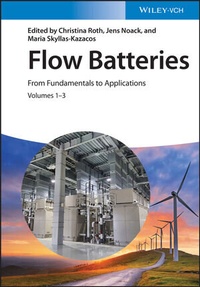
Flow Batteries
From Fundamentals to Applications
1st Edition
Published on 6. December 2022
1312 pages
978-3-527-83278-1 (ISBN)
Description

From basics to commercial applications, Flow Batteries covers the main aspects and recent developments of (Redox) Flow Batteries (FBs or RFBs), encompassing the electrochemical fundamentals, the used materials, and their characterization. Edited by a team of leading experts, including the 'founding mother of flow battery technology' Maria Skyllas-Kazacos, key topics covered in Flow Batteries include:
- FB computational modeling and simulation, including quantum mechanical considerations, cell, stack, and system modeling, techno-economics, and grid behavior
- The mature vanadium FB variant as well as the new and emerging FBs using different chemistries and how they will change the field
- Commercially available FBs from different manufacturers, their technology and application ranges
- The role of FBs in overcoming the global energy crisis
Flow Batteries is an invaluable resource for researchers and engineers in academia and industry who want to understand this exciting new technology and the full range of its current and future applications.
- FB computational modeling and simulation, including quantum mechanical considerations, cell, stack, and system modeling, techno-economics, and grid behavior
- The mature vanadium FB variant as well as the new and emerging FBs using different chemistries and how they will change the field
- Commercially available FBs from different manufacturers, their technology and application ranges
- The role of FBs in overcoming the global energy crisis
Flow Batteries is an invaluable resource for researchers and engineers in academia and industry who want to understand this exciting new technology and the full range of its current and future applications.
More details
Other editions
Additional editions
Book
01/2023
1st Edition
Wiley-VCH
€435.00
Available immediately

Christina Roth | Jens Noack | Maria Skyllas-Kazacos
Flow Batteries - From Fundamentals to Applications
Software
01/2023
Wiley-VCH
€578.27
Article exhausted; check different version
Persons
Christina Roth is Full Professor at the University of Bayreuth and the Chair of Electrochemical Process Engineering. Having obtained her academic degrees from the Technical University of Darmstadt and after a post-doctoral stay at Liverpool University, UK, she began her career as junior group leader at the Karlsruhe Institute of Technology (KIT). In 2012, she became professor at the Freie Universität Berlin, before taking up her present appointment at the Faculty of Engineering Sciences at the University of Bayreuth in 2019. Her research interests comprise methodical and materials development for electrochemical energy technologies, such as fuel cells and batteries.
Jens Noack is an Adjunct Associate Professor at the University of New South Wales (UNSW) in Sydney and works since 2007 for the Fraunhofer Institute for Chemical Technology (ICT) in the Department for Applied Electrochemistry. He studied chemical engineering and environmental technology at the Dresden University of Applied Sciences and received his PhD from Karlsruhe Institute of Technology. His research and development focuses on stationary energy storage systems for renewable energies and the development of novel energy storage and conversion systems. He has authored over 100 publications and 29 patent applications and is a member of several standardisation committees in IEC and DKE and the chairman of the German national committee on flow batteries.
Maria Skyllas-Kazacos is Professor Emeritus in the School of Chemical Engineering at UNSW Sydney where she has been a member of the academic staff since 1980, initially as Queen Elizabeth Fellow and Lecturer, reaching Full Professor in 1993. She and her research team are the pioneers of the vanadium redox flow battery technology that was patented by UNSW in 1986. She is a Member of the Australian Academy of Technological Sciences and Engineering and has received a number of Honours for her work on the VRB, including Member of the Order of Australia, the Castner Medal of the UK Chemical Industry Group, the Chemeca Medal of the Australian Institute of Engineers and the RK Murphy Medal of the Royal Australian Chemical Institute. She is the author or co-author of numerous book chapters on batteries and energy storage and of more than 200 publications, and she holds over 40 patents in the field.
Jens Noack is an Adjunct Associate Professor at the University of New South Wales (UNSW) in Sydney and works since 2007 for the Fraunhofer Institute for Chemical Technology (ICT) in the Department for Applied Electrochemistry. He studied chemical engineering and environmental technology at the Dresden University of Applied Sciences and received his PhD from Karlsruhe Institute of Technology. His research and development focuses on stationary energy storage systems for renewable energies and the development of novel energy storage and conversion systems. He has authored over 100 publications and 29 patent applications and is a member of several standardisation committees in IEC and DKE and the chairman of the German national committee on flow batteries.
Maria Skyllas-Kazacos is Professor Emeritus in the School of Chemical Engineering at UNSW Sydney where she has been a member of the academic staff since 1980, initially as Queen Elizabeth Fellow and Lecturer, reaching Full Professor in 1993. She and her research team are the pioneers of the vanadium redox flow battery technology that was patented by UNSW in 1986. She is a Member of the Australian Academy of Technological Sciences and Engineering and has received a number of Honours for her work on the VRB, including Member of the Order of Australia, the Castner Medal of the UK Chemical Industry Group, the Chemeca Medal of the Australian Institute of Engineers and the RK Murphy Medal of the Royal Australian Chemical Institute. She is the author or co-author of numerous book chapters on batteries and energy storage and of more than 200 publications, and she holds over 40 patents in the field.
Content
VOLUME 1
PART 1: FUNDAMENTALS
The Need for Stationary Energy Storage
History of Flow Batteries
General Electrochemical Fundamentals of Batteries General Aspects and Fundamentals of Flow Batteries
Redox-mediated Processes
Membranes for Flow Batteries
Standards for Flow Batteries
Safety Considerations of the Vanadium Flow Battery
A Student Workshop in Sustainable Energy Technology: The Principles and Practice of a Rechargeable Flow Battery
PART 2: CHARACTERIZATION OF FLOW BATTERIES AND MATERIALS
Characterization Methods in Flow Batteries: A General Overview
Electrochemical Methods
Radiography and Tomography
Characterization of Carbon Materials
Characterization of Membranes for Flow Batteries
PART 3: MODELING AND SIMULATION
Quantum Mechanical Modeling of Flow Battery Materials
Mesoscale Modeling and Simulation for Flow Batteries
Continuum Modelling and Simulation of Flow Batteries
Pore-scale Modeling of Flow Batteries
Dynamic Modelling of Vanadium Flow Batteries for System Monitoring and Control
Techno-economic Modelling and Evaluation of Flow Batteries
Machine Learning for FB Electrolyte Screening
VOLUME 2
PART 4: VANADIUM FLOW BATTERIES
The History of the UNSW All-Vanadium Flow Battery Development
Vanadium Electrolytes and Related Electrochemical Reactions
Electrodes for Vanadium Flow Batteries (VFBs)
Membranes for Vanadium Flow Batteries
Advanced Flowfield Architecture for Vanadium Flow Batteries
State-of-Charge Monitoring for Vanadium Redox Flow Batteries
Rebalancing/Regeneration of Vanadium Flow Batteries
Life Cycle Analysis of Vanadium Flow Batteries
Next-Generation Vanadium Flow Batteries
Asymmetric Vanadium-based Aqueous Flow Batteries
PART 5: OTHER IMPORTANT INORGANIC FLOW BATTERY TECHNOLOGIES
Zn/Br Battery - Early Research and Development
An Overview of the Polysulfide/Bromine Flow Battery
Fe/Fe Flow Battery
Zinc-Cerium and Related Cerium-Based Flow Batteries: Progress and Challenges
Undivided Copper-Lead Dioxide Flow Battery Based on Soluble Copper and Lead in Aqueous
All-copper Flow Batteries
Hydrogen-Based Flow Batteries
VOLUME 3
PART 6: ORGANIC FLOW BATTERIES
Aqueous Organic Flow Batteries
Metal Coordination Complexes for Flow Batteries
Organic Redox Flow Batteries: Lithium-Ion-based FBs
Nonaqueous Metal-Free Flow Batteries
Polymeric Flow Batteries
PART 7: INDUSTRIAL AND COMMERCIALIZATION ASPECTS OF FLOW BATTERIES
Inverter Interfacing and Grid Behaviour
Flow-Battery System Topologies and Grid Connection
Vanadium FBESs installed by Sumitomo Electric Industries, Ltd
Industrial Applications of Flow Batteries
Applications of VFB in Rongke Power
Metal-Free Flow Batteries Based on TEMPO
Commercialization of All-Iron Redox Flow-Battery Systems
Application of Hydrogen-Bromine Flow Batteries: Technical Paper
Some Notes on Zinc/Bromine Flow Batteries
Mobile Applications of the ZBB
PART 1: FUNDAMENTALS
The Need for Stationary Energy Storage
History of Flow Batteries
General Electrochemical Fundamentals of Batteries General Aspects and Fundamentals of Flow Batteries
Redox-mediated Processes
Membranes for Flow Batteries
Standards for Flow Batteries
Safety Considerations of the Vanadium Flow Battery
A Student Workshop in Sustainable Energy Technology: The Principles and Practice of a Rechargeable Flow Battery
PART 2: CHARACTERIZATION OF FLOW BATTERIES AND MATERIALS
Characterization Methods in Flow Batteries: A General Overview
Electrochemical Methods
Radiography and Tomography
Characterization of Carbon Materials
Characterization of Membranes for Flow Batteries
PART 3: MODELING AND SIMULATION
Quantum Mechanical Modeling of Flow Battery Materials
Mesoscale Modeling and Simulation for Flow Batteries
Continuum Modelling and Simulation of Flow Batteries
Pore-scale Modeling of Flow Batteries
Dynamic Modelling of Vanadium Flow Batteries for System Monitoring and Control
Techno-economic Modelling and Evaluation of Flow Batteries
Machine Learning for FB Electrolyte Screening
VOLUME 2
PART 4: VANADIUM FLOW BATTERIES
The History of the UNSW All-Vanadium Flow Battery Development
Vanadium Electrolytes and Related Electrochemical Reactions
Electrodes for Vanadium Flow Batteries (VFBs)
Membranes for Vanadium Flow Batteries
Advanced Flowfield Architecture for Vanadium Flow Batteries
State-of-Charge Monitoring for Vanadium Redox Flow Batteries
Rebalancing/Regeneration of Vanadium Flow Batteries
Life Cycle Analysis of Vanadium Flow Batteries
Next-Generation Vanadium Flow Batteries
Asymmetric Vanadium-based Aqueous Flow Batteries
PART 5: OTHER IMPORTANT INORGANIC FLOW BATTERY TECHNOLOGIES
Zn/Br Battery - Early Research and Development
An Overview of the Polysulfide/Bromine Flow Battery
Fe/Fe Flow Battery
Zinc-Cerium and Related Cerium-Based Flow Batteries: Progress and Challenges
Undivided Copper-Lead Dioxide Flow Battery Based on Soluble Copper and Lead in Aqueous
All-copper Flow Batteries
Hydrogen-Based Flow Batteries
VOLUME 3
PART 6: ORGANIC FLOW BATTERIES
Aqueous Organic Flow Batteries
Metal Coordination Complexes for Flow Batteries
Organic Redox Flow Batteries: Lithium-Ion-based FBs
Nonaqueous Metal-Free Flow Batteries
Polymeric Flow Batteries
PART 7: INDUSTRIAL AND COMMERCIALIZATION ASPECTS OF FLOW BATTERIES
Inverter Interfacing and Grid Behaviour
Flow-Battery System Topologies and Grid Connection
Vanadium FBESs installed by Sumitomo Electric Industries, Ltd
Industrial Applications of Flow Batteries
Applications of VFB in Rongke Power
Metal-Free Flow Batteries Based on TEMPO
Commercialization of All-Iron Redox Flow-Battery Systems
Application of Hydrogen-Bromine Flow Batteries: Technical Paper
Some Notes on Zinc/Bromine Flow Batteries
Mobile Applications of the ZBB
