

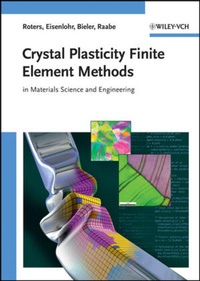
Crystal Plasticity Finite Element Methods
in Materials Science and Engineering
1st Edition
Published on 5. August 2011
XI, 197 pages
978-3-527-64209-0 (ISBN)
Description

Written by the leading experts in computational materials science, this handy reference concisely reviews the most important aspects of plasticity modeling: constitutive laws, phase transformations, texture methods, continuum approaches and damage mechanisms. As a result, it provides the knowledge needed to avoid failures in critical systems udner mechanical load.
With its various application examples to micro- and macrostructure mechanics, this is an invaluable resource for mechanical engineers as well as for researchers wanting to improve on this method and extend its outreach.
With its various application examples to micro- and macrostructure mechanics, this is an invaluable resource for mechanical engineers as well as for researchers wanting to improve on this method and extend its outreach.
More details
Other editions
Additional editions
Software
11/2010
Wiley-VCH
€190.00
No shipping information available
Franz Roters | Philip Eisenlohr | Thomas R. Bieler
Crystal Plasticity Finite Element Methods
in Materials Science and Engineering
Book
10/2010
Wiley-VCH
€135.00
Article exhausted; check different version
Persons
Franz Roters heads the research group "Theory and Simulation" at the Max Planck Institute for Iron Research in Düsseldorf, Germany. After he completed his PhD in physics at the RWTH Aachen University, Germany, he worked for the VAW Aluminium AG in Bonn. Franz Roters serves as head of the technical committee for computer simulation of the German Society for Materials Research (DGM) and as a lecturer at the RWTH.
Philip Eisenlohr is project leader of the Joint Max-Planck-Fraunhofer Initiative on Computational Mechanics of Polycrystals (CMCn) at the Max Planck Institute for Iron Research. He earned his PhD at the University of Erlangen-Nürnberg elucidating the role of dislocation dipoles in the deformation of crystals. For his outstanding diploma degree he received the 2001 Young Scientist Award of the DGM.
Thomas R. Bieler is Professor of Materials Science in the College of Engineering at Michigan State University, USA. He received his PhD in Materials Science in 1989 from the University of California, Davis, before he became Assistant Professor at Michigan State University. He
has taken sabbaticals at the Air Force Research Laboratory (Dayton OH) in the Materials and Manufacturing Directorate in 1999, and at the Max Planck Institute for Iron Research in 2006, where he has focused on deformation characteristics of titanium and titanium alloys.
Dierk Raabe is Chief Executive of the Max Planck Institute for Iron Research and Professor at RWTH Aachen University. After his PhD in Metal Physics and Physical Metallurgy at RWTH Aachen he was visiting scientist in the Department of Materials Science and Engineering at the Carnegie Mellon University in Pittsburgh, USA, and at the National High Magnetic Field Laboratory in Tallahassee, USA. For his outstanding accomplishments he was honored with numerous awards, including the highest German science award, namely the Gottfried Wilhelm Leibniz Award, and the Lee Hsun Lecture Award of the Chinese Academy of Sciences.
Philip Eisenlohr is project leader of the Joint Max-Planck-Fraunhofer Initiative on Computational Mechanics of Polycrystals (CMCn) at the Max Planck Institute for Iron Research. He earned his PhD at the University of Erlangen-Nürnberg elucidating the role of dislocation dipoles in the deformation of crystals. For his outstanding diploma degree he received the 2001 Young Scientist Award of the DGM.
Thomas R. Bieler is Professor of Materials Science in the College of Engineering at Michigan State University, USA. He received his PhD in Materials Science in 1989 from the University of California, Davis, before he became Assistant Professor at Michigan State University. He
has taken sabbaticals at the Air Force Research Laboratory (Dayton OH) in the Materials and Manufacturing Directorate in 1999, and at the Max Planck Institute for Iron Research in 2006, where he has focused on deformation characteristics of titanium and titanium alloys.
Dierk Raabe is Chief Executive of the Max Planck Institute for Iron Research and Professor at RWTH Aachen University. After his PhD in Metal Physics and Physical Metallurgy at RWTH Aachen he was visiting scientist in the Department of Materials Science and Engineering at the Carnegie Mellon University in Pittsburgh, USA, and at the National High Magnetic Field Laboratory in Tallahassee, USA. For his outstanding accomplishments he was honored with numerous awards, including the highest German science award, namely the Gottfried Wilhelm Leibniz Award, and the Lee Hsun Lecture Award of the Chinese Academy of Sciences.
Content
Preface
INTRODUCTION TO CRYSTALLINE ANISOTROPY AND THE CRYSTAL PLASTICITY FINITE ELEMENT METHOD
PART I: Fundamentals
METALLURGICAL FUNDAMENTALS OF PLASTIC DEFORMATION
Introduction
Lattice Dislocations
Deformation Martensite and Mechanical Twinning
CONTINUUM MECHANICS
Kinematics
Mechanical Equilibrium
Thermodynamics
THE FINITE ELEMENT METHOD
The Principle of Virtual Work
Solution Procedure - Discretization
Non-Linear FEM
THE CRYSTAL PLASTICITY FINITE ELEMENT METHOD AS A MULTI-PHYSICS FRAMEWORK
PART II: The Crystal Plasticity Finite Element Method
CONSTITUTIVE MODELS
Dislocation Slip
Displacive Transformations
Damage
HOMOGENIZATION
Introduction
Statistical Representation of Crystallographic Texture
Computational Homogenization
Mean-Field Homogenization
Grain-Cluster Methods
NUMERICAL ASPECTS OF CRYSTAL PLASTICITY FINITE ELEMENT METHOD IMPLEMENTATIONS
General Remarks
Explicit Versus Implicit Integration Methods
Element Types
PART III: Application
MICROSCOPIC AND MESOSCOPIC EXAMPLES
Introduction to the Field of CPFE Experimental Validation
Stability and Grain Fragmentation in Aluminum under Plane Strain Deformation
Texture and Dislocation Density Evolution in a Bent Single-Crystalline Copper-Nanowire
Texture and Microstructure underneath a Nanoindent in a Copper Single Crystal
Application of a Nonlocal Dislocation Model Including Geometrically Necessary Dislocations to Simple Shear Tests of Aluminum Single Crystals
Application of a Grain Boundary Constitutive Model to Simple Shear Tests of Aluminum Bicrystals with Different Misorientation
Evolution of Dislocation Density in a Crystal Plasticity Model
Three-Dimensional Aspects of Oligocrystal Plasticity
Simulation of Recrystallization Using Micromechanical Results of CPFE Simulations
Simulations of Multiphase TRIP Steels
Damage Nucleation Example
The Grain Size-Dependence in Polycrystal Models
MACROSCOPIC EXAMPLES
Using Elastic Constants from Ab Initio Simulations for Predicting Textures and Texture-Dependent Elastic Properties of Beta-Titanium
Simulation of Earing during Cup Drawing of Steel and Aluminum
Simulation of Lankford Values
Virtual Material Testing for Sheet Stamping Simulations
OUTLOOK AND CONCLUSIONS
INTRODUCTION TO CRYSTALLINE ANISOTROPY AND THE CRYSTAL PLASTICITY FINITE ELEMENT METHOD
PART I: Fundamentals
METALLURGICAL FUNDAMENTALS OF PLASTIC DEFORMATION
Introduction
Lattice Dislocations
Deformation Martensite and Mechanical Twinning
CONTINUUM MECHANICS
Kinematics
Mechanical Equilibrium
Thermodynamics
THE FINITE ELEMENT METHOD
The Principle of Virtual Work
Solution Procedure - Discretization
Non-Linear FEM
THE CRYSTAL PLASTICITY FINITE ELEMENT METHOD AS A MULTI-PHYSICS FRAMEWORK
PART II: The Crystal Plasticity Finite Element Method
CONSTITUTIVE MODELS
Dislocation Slip
Displacive Transformations
Damage
HOMOGENIZATION
Introduction
Statistical Representation of Crystallographic Texture
Computational Homogenization
Mean-Field Homogenization
Grain-Cluster Methods
NUMERICAL ASPECTS OF CRYSTAL PLASTICITY FINITE ELEMENT METHOD IMPLEMENTATIONS
General Remarks
Explicit Versus Implicit Integration Methods
Element Types
PART III: Application
MICROSCOPIC AND MESOSCOPIC EXAMPLES
Introduction to the Field of CPFE Experimental Validation
Stability and Grain Fragmentation in Aluminum under Plane Strain Deformation
Texture and Dislocation Density Evolution in a Bent Single-Crystalline Copper-Nanowire
Texture and Microstructure underneath a Nanoindent in a Copper Single Crystal
Application of a Nonlocal Dislocation Model Including Geometrically Necessary Dislocations to Simple Shear Tests of Aluminum Single Crystals
Application of a Grain Boundary Constitutive Model to Simple Shear Tests of Aluminum Bicrystals with Different Misorientation
Evolution of Dislocation Density in a Crystal Plasticity Model
Three-Dimensional Aspects of Oligocrystal Plasticity
Simulation of Recrystallization Using Micromechanical Results of CPFE Simulations
Simulations of Multiphase TRIP Steels
Damage Nucleation Example
The Grain Size-Dependence in Polycrystal Models
MACROSCOPIC EXAMPLES
Using Elastic Constants from Ab Initio Simulations for Predicting Textures and Texture-Dependent Elastic Properties of Beta-Titanium
Simulation of Earing during Cup Drawing of Steel and Aluminum
Simulation of Lankford Values
Virtual Material Testing for Sheet Stamping Simulations
OUTLOOK AND CONCLUSIONS
