

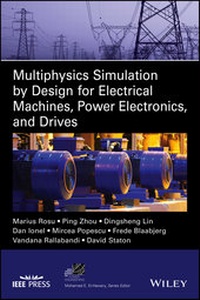
Multiphysics Simulation by Design for Electrical Machines, Power Electronics and Drives
Description

This book combines the knowledge of experts from both academia and the software industry to present theories of multiphysics simulation by design for electrical machines, power electronics, and drives. The comprehensive design approach described within supports new applications required by technologies sustaining high drive efficiency. The highlighted framework considers the electric machine at the heart of the entire electric drive. The book also emphasizes the simulation by design concept--a concept that frames the entire highlighted design methodology, which is described and illustrated by various advanced simulation technologies.
Multiphysics Simulation by Design for Electrical Machines, Power Electronics and Drives begins with the basics of electrical machine design and manufacturing tolerances. It also discusses fundamental aspects of the state of the art design process and includes examples from industrial practice. It explains FEM-based analysis techniques for electrical machine design--providing details on how it can be employed in ANSYS Maxwell software. In addition, the book covers advanced magnetic material modeling capabilities employed in numerical computation; thermal analysis; automated optimization for electric machines; and power electronics and drive systems. This valuable resource:
* Delivers the multi-physics know-how based on practical electric machine design methodologies
* Provides an extensive overview of electric machine design optimization and its integration with power electronics and drives
* Incorporates case studies from industrial practice and research and development projects
Multiphysics Simulation by Design for Electrical Machines, Power Electronics and Drives is an incredibly helpful book for design engineers, application and system engineers, and technical professionals. It will also benefit graduate engineering students with a strong interest in electric machines and drives.
More details
Other editions
Additional editions
Persons
Marius Rosu, PhD, is Lead Product Manager for the Electromechanical Product Line at Electronic Business Unit (EBU) of ANSYS Inc., USA.
Ping Zhou, PhD, FIEEE, is Director of Research and Development at Electronic Business Unit (EBU) of ANSYS Inc., USA.
Dingsheng Lin, PhD, is a Principal Research and Development Engineer at Electronic Business Unit (EBU) of ANSYS Inc., USA.
Dan Ionel, PhD, FIEEE, is Professor of Electrical Engineering and L. Stanley Pigman Chair in Power at University of Kentucky, Lexington, KY.
Mircea Popescu, PhD, FIEEE, is Head of Engineering of Motor Design Ltd., U.K., a company that develops software for the analysis and design of electrical machines.
Frede Blaabjerg, PhD, FIEEE, is a Professor in Power Electronics and Villum Investigator the Department of Energy Technology at Aalborg University, Denmark.
Vandana Rallabandi, PhD, is a Post-doctoral Researcher in the SPARK Laboratory, Electrical and Computer Engineering Department, University of Kentucky, Lexington, KY.
David Staton, PhD, is President and Founder of Motor Design Ltd, UK, a company that develops software for the analysis and design of electrical machines.
Content
PREFACE vii
ACKNOWLEDGMENTS xv
CHAPTER 1 BASICS OF ELECTRICAL MACHINES DESIGN AND MANUFACTURING TOLERANCES 1
Marius Rosu, Mircea Popescu, and Dan M. Ionel
1.1 Introduction 1
1.2 Generic Design Flow 3
1.3 Basic Design and How to Start 4
1.4 Efficiency Map 16
1.5 Thermal Constraints 19
1.6 Robust Design and Manufacturing Tolerances 22
References 42
CHAPTER 2 FEM-BASED ANALYSIS TECHNIQUES FOR ELECTRICAL MACHINE DESIGN 45
Ping Zhou and Dingsheng Lin
2.1 T-O Formulation 45
2.2 Field-Circuit Coupling 56
2.3 Fast AC Steady-State Algorithm 70
2.4 High Performance Computing-Time Domain Decomposition 82
2.5 Reduced Order Modeling 93
References 106
CHAPTER 3 MAGNETIC MATERIAL MODELING 109
Dingsheng Lin and Ping Zhou
3.1 Shape Preserving Interpolation of B-H Curves 109
3.2 Nonlinear Anisotropic Model 115
3.3 Dynamic Core Loss Analysis 125
3.4 Vector Hysteresis Model 137
3.5 Demagnetization of Permanent Magnets 150
References 162
CHAPTER 4 THERMAL PROBLEMS IN ELECTRICAL MACHINES 165
Mircea Popescu and David Staton
4.1 Introduction 165
4.2 Heat Extraction Through Conduction 167
4.3 Heat Extraction Through Convection 170
4.4 Heat Extraction Through Radiation 186
4.5 Cooling Systems Summary 188
4.6 Thermal Network Based on Lumped Parameters 188
4.7 Analytical Thermal Network Analysis 192
4.8 Thermal Analysis Using Finite Element Method 193
4.9 Thermal Analysis Using Computational Fluid Dynamics 195
4.10 Thermal Parameters Determination 200
4.11 Losses in Brushless Permanent Magnet Machines 202
4.12 Cooling Systems 210
4.13 Cooling Examples 214
References 218
CHAPTER 5 AUTOMATED OPTIMIZATION FOR ELECTRIC MACHINES 223
Dan M. Ionel and Vandana Rallabandi
5.1 Introduction 223
5.2 Formulating an Optimization Problem 224
5.3 Optimization Methods 226
5.4 Design of Experiments and Response Surface Methods 228
5.5 Differential Evolution 233
5.6 First Example: Optimization of an Ultra High Torque Density PM Motor for Formula E Racing Cars: Selection of Best Compromise Designs 234
5.7 Second Example: Single Objective Optimization of a Range of Permanent Magnet Synchronous Machine (PMSMS) Rated Between 1 kW and 1 MW Derivation of Design Proportions and Recommendations 238
5.8 Third Example: Two- and Three-Objective Function Optimization of a Synchronous Reluctance (SYNREL) and PM Assisted Synchronous Reluctance Motor 241
5.9 Fourth Example: Multi-Objective Optimization of PM Machines Combining DOE and DE Methods 245
5.10 Summary 248
References 248
CHAPTER 6 POWER ELECTRONICS AND DRIVE SYSTEMS 251
Frede Blaabjerg, Francesco Iannuzzo, and Lorenzo Ceccarelli
6.1 Introduction 251
6.2 Power Electronic Devices 253
6.3 Circuit-Level Simulation of Drive Systems 264
6.4 Multiphysics Design Challenges 274
References 281
INDEX 283
Preface
Electric machines are being used in wide and novel applications throughout the world, driven by the need for greater power efficiency in the transportation, aerospace and defense, and industrial automation markets. The automotive sector is driven by the need for hybrid and electric vehicle technology to meet ever-stringent miles-per-gallon standards. The aerospace and defense sectors are focused on replacing existing power transfer technologies in an aircraft such as the central hydraulic system, with fault-tolerant electric power, where major subsystems such as engine starting, primary flight control actuation, pumps, and braking would be controlled and driven electronically. In the US industrial sector, over 40 million electric motors convert electricity into useful work in manufacturing operations. Industry spends over $30 billion (US) annually on electricity, dedicated to electric motor-driven systems that drive pumps, fan and blower systems, air compression, and motion control. Globally, 42% of all electricity is used in power industries, where two-thirds of this is consumed by electric motors. There is a clear global demand for a comprehensive design methodology to support these new applications and satisfy power efficiency requirements.
With the present trend of global industrial automation, the application of electric drive systems (including power electronics and drive control) is expected to grow rapidly in the next decade. In the automotive sector, the utilization of power electronics and their control to drive electric motors can significantly contribute to control environmental pollution. In addition, intensive environmentally clean photovoltaic and wind energy resources also show a bright future.
As part of electric drive systems, the power semiconductor devices at the heart of modern power electronics are under continuous development. The improved technology in semiconductor processing, device fabrication, and packaging to produce high-density, high-performance, high-reliability, and high-yielding microelectronic chips, together with new semiconductor material discovery, made possible significant reduction in energy consumption, driving these systems to an incredible economical price.
Without doubt, these achievements force the control strategy techniques to evolve rapidly to the newly created drive conditions and adapt to the overall systems performance requirements. In recent years, soft switching converters became the center of interest when compared with more conventional hard switching converters due to their major advantages such as:
- Minimization of switching loss
- Improved efficiency
- Improved reliability due to soft stress
- Reduced electromagnetic emission
The continuous growing interest in the electric drive area relates to the intelligent power electronics modules, where the power and the control are embedded in the same package and interface directly with logic signals. For variable frequency drives, the converter modules and control are mounted directly on the machine for the low and medium power applications.
Readers' Advantage
The book is mainly addressed to design engineers, application engineers, technical professionals, and graduate engineering students with a strong interest in electric machines and drives.
The comprehensive design approach described in this book supports new applications required by technologies, sustaining high drive efficiency. The highlighted framework considers the electric machine at the heart of the entire electric drive. The book delivers the multiphysics know-how based on practical electric machine design methodologies. Simulation by design concept elevated in the book constitutes the new paradigm that frames the entire highlighted design methodology, which is described and illustrated by various advanced simulation technologies.
Which Design Problems Are We Trying to Solve?
Throughout this book, we apply knowledge of design best practices into multiphysics and multidomain simulation processes to address a complete electrical machine and drive design.
In the face of global competition, electric machine manufacturers, like manufacturers in most industries, are searching for ways to reduce cost, optimize designs, and deliver them quickly to market. Companies able to achieve these objectives hold a competitive advantage in the marketplace. The ability to predict design performance with simulation software without the time and expense of constructing prototypes plays a significant role in creating this competitive advantage.
Several computation approaches are available to predict electric machine performance, including classical closed-form analytical analysis, lumped parameter models based on the determination of detailed parameters from finite element analysis, and nonlinear time-domain finite element analysis. Each method has advantages and disadvantages. Selecting the best method may not be straightforward because it requires the user to understand the differences among the calculation methods. The fundamental issue differentiating these methods is the trade-off among model complexity, accuracy, and computing time. Engineers use a combination of these calculation techniques as the optimal solution to simulate electric machine performances.
What Motivated Us to Write This Book?
This collaborative work brought together a group of experts from both academia and software industry with strong expertise on electrical machine design and manufacturing. The main idea that fueled our initiative and commitment to make this project a reality was to bring back to the engineering and academic communities a comprehensive expertise and validated know-how on designing electrical machines by simulation.
Why Simulation by Design?
The advancements in modern digital computers brought CAD (computer-aided design) and CAE (computer-aided engineering) tools at the heart of virtual prototyping, reducing the time to design and market and saving cost by reducing and eliminating the physical prototyping need. The embedded 3D-physics design into drive system coupling with the power electronics and control algorithms enables the electric drive community to accurately predict the efficiency and performance of the electrical machine at the heart of the entire drive system.
Without doubt, the design of a simulation model-a virtual prototype-can help tremendously the engineers to build confidence on validating the required technical specifications making critical decisions on design realization and understanding the level of design complexity considering inter-dependencies and design parameter variations, and collaboratively to examine strategic choices for optimization and robustness.
Chapter Description
Chapter 1: Basics of Electrical Machines Design and Manufacturing Tolerances
This chapter discusses fundamental aspects of the state-of-the-art design process and includes examples from industrial practice and case studies to introduce basic concepts and methods. This chapter emphasizes the basic steps in designing a typical electrical machine using power traction application as an example. The chapter starts with magnetic sizing steps and it extends the basic design to thermal constraints. Typical electric motor characteristics used in traction applications such as efficiency map of standardized driving cycles are considered to highlight the electric motor sustainability on dynamic performance. The chapter concludes with the robust design analysis framing a methodology that applies stochastic analysis to study manufacturing tolerances.
Chapter 2: FEM-Based Analysis Techniques for Electrical Machine Design
In this chapter, a detailed description of finite element method (FEM) employed in ANSYS Maxwell software is presented. The numerical technique developed to account for eddy currents in conductive domains on configurations that involve rigid motion is presented, the numerical technique related to multiply connected regions is highlighted, and it also presents the algorithms used for nonlinear iterations and strategies to accelerate the nonlinear convergence. Filed-circuit coupling technology is explained and specific algorithms used to reduce the computation time to reach steady-state conditions are described. High-performance computing (HPC) is a key technology, increasing the capacity of solving large design spaces and reducing significantly the total time computation by solving the time steps on magnetic transient problem simultaneously rather than sequentially. All technologies highlighted in this chapter are explained through sets of case studies.
Chapter 3: Magnetic Material Modeling
This chapter introduces advanced magnetic material modeling capabilities employed in numerical computation. From isotropic nonlinear characteristics to anisotropic behavior corresponding to grain-oriented magnetic materials, the chapter describes the implementation aspects and detailed modeling techniques. Lamination topologies are considered based on special modeling technique with emphasis on core loss computation. Advanced magnetic modeling on vector magnetic hysteresis is presented and specific case studies are used to highlight the computational merits.
Chapter 4: Thermal Problems in Electrical Machines
In this chapter, the heat generation and extraction in...
