

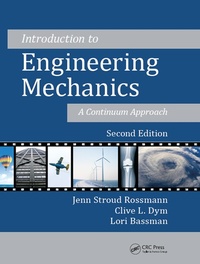
Introduction to Engineering Mechanics
A Continuum Approach, Second Edition
2nd Edition
Published on 24. March 2015
462 pages
978-1-4822-1949-4 (ISBN)
Description

Integrated Mechanics Knowledge Essential for Any EngineerIntroduction to Engineering Mechanics: A Continuum Approach, Second Edition uses continuum mechanics to showcase the connections between engineering structure and design and between solids and fluids and helps readers learn how to predict the effects of forces, stresses, and strains. T
Reviews / Votes
"This unique book by Rossmann, Dym, and Bassman provides an integrated foundation in solid and fluid mechanics that underpins a range of fields from bioengineering to water resources to aerospace design. Rather than being rooted in a particular engineering discipline (such as mechanical or civil), the book highlights the fundamental nature of continuum mechanics that makes it relevant to all engineers. With traditional disciplinary boundaries being crossed and new disciplines being created, this approach is just what is needed for today's engineer."-Andrew J. Guswa, Picker Engineering Program, Smith College, Northampton, Massachusetts, USA
"This book would be a good textbook for engineering mechanics and biomechanics courses. It provides a concise description of solid and fluid mechanics using a continuum perspective. The book is written by building gradually from one-dimensional to two- and three-dimensional formulations, and by including illustrative and interesting real-world case study examples. ... a unified introduction to solid and fluid mechanics and the connection between them."
-Professor Long-yuan Li, University of Plymouth, UK
"... a very good mix of conceptual approaches and hands on examples. It covers concisely the most important topics without getting lost in too many specialty cases and examples. Compared to other classical books that spend most of the time on beam bending, this book covers the concepts of how forces act on matter in a generally applicable way which gives students a good feeling for what is going on inside the material rather than just how to use the formulas. The book also introduces some nice and very powerful techniques such as singularity functions that are often missing in other introductory books."
-Prof. Georg E. Fantner, Ecole Polytechnique Federal de Lausanne
More details
Edition
2nd edition
Language
English
Place of publication
London
United Kingdom
Publishing group
Taylor & Francis Ltd
Target group
College/higher education
ISBN-13
978-1-4822-1949-4 (9781482219494)
Copyright in bibliographic data and cover images is held by Nielsen Book Services Limited or by the publishers or by their respective licensors: all rights reserved.
Schweitzer Classification
Other editions
Additional editions
Jenn Stroud Rossmann | Clive L. Dym | Lori Bassman
Introduction to Engineering Mechanics
A Continuum Approach, Second Edition
Book
03/2015
2nd Edition
CRC Press
€249.90
Article not available for order
Persons
Jenn Stroud Rossmann is an associate professor of mechanical engineering at Lafayette College. She earned her BS and PhD from the University of California, Berkeley. Her research interests include the study of blood flow in vessels affected by atherosclerosis and aneurysms. She has a strong commitment to teaching engineering methods and values to non-engineers, and she has developed several courses and workshops for liberal arts majors.
Clive L. Dym served as Fletcher Jones Professor of Engineering Design for 21 years, and is now professor emeritus of engineering, at Harvey Mudd College. He earned his BS from Cooper Union and his PhD from Stanford University. His primary interests are in engineering design and structural mechanics. He is the author of 18 books and has edited 11 others, including Analytical Estimates of Structural Behavior (with Harry Williams), CRC Press, 2012. Among his awards are the Merryfield Design Award (ASEE, 2002), the Spira Outstanding Design Educator Award (ASME, 2004), and the Gordon Prize (NAE, 2012).
Lori Bassman is a professor of engineering and director of the Laspa Fellowship Program in applied mechanics at Harvey Mudd College. She earned her BSE at Princeton University and her PhD at Stanford. Through a visiting appointment at the University of New South Wales in Australia, she pursues her research in physical metallurgy, and her other research interests include computational modeling of bird flight biomechanics.
Clive L. Dym served as Fletcher Jones Professor of Engineering Design for 21 years, and is now professor emeritus of engineering, at Harvey Mudd College. He earned his BS from Cooper Union and his PhD from Stanford University. His primary interests are in engineering design and structural mechanics. He is the author of 18 books and has edited 11 others, including Analytical Estimates of Structural Behavior (with Harry Williams), CRC Press, 2012. Among his awards are the Merryfield Design Award (ASEE, 2002), the Spira Outstanding Design Educator Award (ASME, 2004), and the Gordon Prize (NAE, 2012).
Lori Bassman is a professor of engineering and director of the Laspa Fellowship Program in applied mechanics at Harvey Mudd College. She earned her BSE at Princeton University and her PhD at Stanford. Through a visiting appointment at the University of New South Wales in Australia, she pursues her research in physical metallurgy, and her other research interests include computational modeling of bird flight biomechanics.
Content
Introduction. Strain and Stress in One Dimension. Case Study 1: Collapse of the Kansas City Hyatt Regency Walkways. Strain and Stress in Higher Dimensions. Applying Strain and Stress in Multiple Dimensions. Case Study 2: Pressure Vessels. Beams. Case Study 3: Physiological Levers and Repairs. Beam Deflections. Case Study 4: Truss-Braced Airplane Wings. Instability: Column Buckling. Case Study 5: Hartford Civic Arena. Connecting Solid and Fluid Mechanics. Case Study 6 : Mechanics of Biomaterials. Case Study 7: Engineered Composite Materials. Fluid Statics. Case Study 8: St. Francis Dam. Fluid Dynamics: Governing Equations. Case Study 9: China's Three Gorges Dam. Fluid Dynamics: Applications. Case Study 10: Living with Water, and the Role of Technological Culture. Solid Dynamics: Governing Equations. References. Appendices. Index.
