

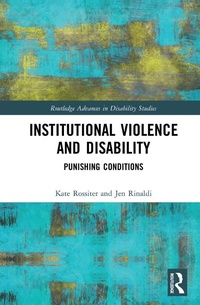
Institutional Violence and Disability
Punishing Conditions
Published on 3. September 2018
124 pages
978-1-351-02280-4 (ISBN)
Description

"This was several times with that damn cribbage board. I hate cribbage boards to this very day. They never beat us on the arms or legs or stuff, it was always on the bottom of the feet, I couldn't figure it out." Brian L., Huronia Regional Centre Survivor
Over the past two decades, the public has borne witness to ongoing revelations of shocking, intense, and even sadistic forms of violence in spaces meant to provide care. This has been particularly true in institutions designed to care for people with disabilities. In this work, the authors not only describe institutional violence, but work to make sense of how and why institutional violence within care settings is both so pervasive and so profound.
Drawing on a wide range of primary data, including oral histories of institutional survivors and staff, ethnographic observation, legal proceedings and archival data, this book asks: What does institutional violence look like in practice and how might it be usefully categorized? How have extreme forms violence and neglect come to be the cultural norm across institutions? What organizational strategies in institutions foster the abdication of personal morality and therefore violence? How is institutional care the crucial "first step" in creating a culture that accepts violence as the norm?
This highly interdisciplinary work develops scholarly analysis of the history and importance of institutional violence and, as such, is of particular interest to scholars whose work engages with issues of disability, health care law and policy, violence, incarceration, organizational behaviour, and critical theory.
Over the past two decades, the public has borne witness to ongoing revelations of shocking, intense, and even sadistic forms of violence in spaces meant to provide care. This has been particularly true in institutions designed to care for people with disabilities. In this work, the authors not only describe institutional violence, but work to make sense of how and why institutional violence within care settings is both so pervasive and so profound.
Drawing on a wide range of primary data, including oral histories of institutional survivors and staff, ethnographic observation, legal proceedings and archival data, this book asks: What does institutional violence look like in practice and how might it be usefully categorized? How have extreme forms violence and neglect come to be the cultural norm across institutions? What organizational strategies in institutions foster the abdication of personal morality and therefore violence? How is institutional care the crucial "first step" in creating a culture that accepts violence as the norm?
This highly interdisciplinary work develops scholarly analysis of the history and importance of institutional violence and, as such, is of particular interest to scholars whose work engages with issues of disability, health care law and policy, violence, incarceration, organizational behaviour, and critical theory.
More details
Series
Language
English
Place of publication
London
United Kingdom
Publishing group
Taylor & Francis Ltd
Target group
College/higher education
Product notice
Reflowable
Illustrations
9 Halftones, black and white
File size
1,72 MB
ISBN-13
978-1-351-02280-4 (9781351022804)
Copyright in bibliographic data and cover images is held by Nielsen Book Services Limited or by the publishers or by their respective licensors: all rights reserved.
Schweitzer Classification
Other editions
Additional editions
Book
06/2020
1st Edition
Routledge
€64.50
Shipment within 15-20 days
Book
08/2018
1st Edition
Routledge
€215.41
Shipment within 10-20 days
Book
08/2018
Taylor & Francis
Unfortunately, price unknown
Available (delivery time upon request)
Persons
Kate Rossiter is an Associate Professor in the Department of Health Studies at Wilfrid Laurier University's Brantford campus, and is the Principal of "Recounting Huronia: An Arts-Based Participatory Research Project." Kate's background combines the critical social scientific study of public health and embodiment with theatre and performance studies. Kate lives in Brantford, Ontario with her partner and two children.
Jen Rinaldi is an Assistant Professor in the Legal Studies Program at the University of Ontario Institute of Technology. Her research takes up how non-normative-particularly cripped, Mad, fat, and queer-bodies are read, marked, and produced in and through socio-legal discourse. She explores these themes using collaborative and narrative-based methodologies and community arts praxis. Jen lives in Toronto, Ontario.
Jen Rinaldi is an Assistant Professor in the Legal Studies Program at the University of Ontario Institute of Technology. Her research takes up how non-normative-particularly cripped, Mad, fat, and queer-bodies are read, marked, and produced in and through socio-legal discourse. She explores these themes using collaborative and narrative-based methodologies and community arts praxis. Jen lives in Toronto, Ontario.
Content
Acknowledgements; Chapter 1: Introduction; Chapter 2: The Institutional Cases & the Conditions for Moral Abdication; Chapter 3: The Institutional Violence Continuum; Chapter 4: Thoughtlessness & Violence as Work Culture; Chapter 5: Quantifying & Re-Inscribing Violence; Chapter 6: Embedded Trauma & Embodied Resistance; Chapter 7: Conclusion; Bibliography
