

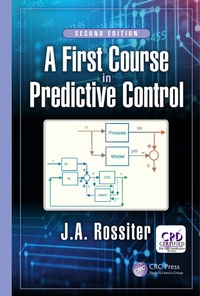
A First Course in Predictive Control
2nd Edition
Published on 17. April 2018
426 pages
978-1-351-59716-6 (ISBN)
Description

The book presents a significant expansion in depth and breadth of the previous edition. It includes substantially more numerical illustrations and copious supporting MATLAB code that the reader can use to replicate illustrations or build his or her own. The code is deliberately written to be as simple as possible and easy to edit. The book is an excellent starting point for any researcher to gain a solid grounding in MPC concepts and algorithms before moving into application or more advanced research topics. Sample problems for readers are embedded throughout the chapters, and in-text questions are designed for readers to demonstrate an understanding of concepts through numerical simulation.
Reviews / Votes
"The book seems to be one of the first in presenting teaching level concepts of predictive control. Indeed, it is a view from industrial point of view since it discusses the PFC which was one of the first ideas of predictive control in the 70s. Since then, of course, things evolved drastically with the computational power, allowing a fiddler's paradise of predictive control algorithms and designs, and some of the most popular are mentioned in the book (GPC, DMC). I find it commendable of the author, a well-established scholar in our community, to pursue such a project, and I am very happy to promote it. I myself am teaching predictive control and I already have found that the content of this book (as it is at this moment in time) is very useful and approachable for engineering students.The comparison with PID controller is of course necessary and justified, since 95% of the loops in industry are indeed performed by PID controllers. The remaining ones need optimization and thus predictive control has gained a broad access in manufacturing and process industry. I believe the section "why is predictive control logical" will stir and stimulate a lot of brainstorming sessions in both academia and research community, which is very nice indeed. The examples and overall structure of the book is excellently constructed to allow step-by-step systematic teaching structure and thus enhancing the potential impact on the student's learning curve. The supplementing with Matlab code is very useful indeed. The pedagogical skills exercised by the author are indeed expected since he is an active member in control education community.
Overall, this book bears a significant added value to the academic and why not, the research community."
- Clara Mihaela Ionescu, Ghent University, Belgium "The book seems to be one of the first in presenting teaching level concepts of predictive control. Indeed, it is a view from industrial point of view since it discusses the PFC which was one of the first ideas of predictive control in the 70s. Since then, of course, things evolved drastically with the computational power, allowing a fiddler's paradise of predictive control algorithms and designs, and some of the most popular are mentioned in the book (GPC, DMC). I find it commendable of the author, a well-established scholar in our community, to pursue such a project, and I am very happy to promote it. I myself am teaching predictive control and I already have found that the content of this book (as it is at this moment in time) is very useful and approachable for engineering students.
The comparison with PID controller is of course necessary and justified, since 95% of the loops in industry are indeed performed by PID controllers. The remaining ones need optimization and thus predictive control has gained a broad access in manufacturing and process industry. I believe the section "why is predictive control logical" will stir and stimulate a lot of brainstorming sessions in both academia and research community, which is very nice indeed. The examples and overall structure of the book is excellently constructed to allow step-by-step systematic teaching structure and thus enhancing the potential impact on the student's learning curve. The supplementing with Matlab code is very useful indeed. The pedagogical skills exercised by the author are indeed expected since he is an active member in control education community.
Overall, this book bears a significant added value to the academic and why not, the research community."
- Clara Mihaela Ionescu, Ghent University, Belgium
More details
Edition
2nd edition
Language
English
Place of publication
London
United Kingdom
Publishing group
Taylor & Francis Ltd
Target group
College/higher education
Illustrations
3 Tables, black and white; 29 Halftones, color; 107 Halftones, black and white
File size
5,44 MB
ISBN-13
978-1-351-59716-6 (9781351597166)
Copyright in bibliographic data and cover images is held by Nielsen Book Services Limited or by the publishers or by their respective licensors: all rights reserved.
Schweitzer Classification
Other editions
Additional editions
J.A. Rossiter
A First Course in Predictive Control
Book
07/2022
2nd Edition
CRC Press
€70.00
Shipment within 10-20 days
J.A. Rossiter
A First Course in Predictive Control
Book
04/2018
2nd Edition
CRC Press
€193.45
Shipment within 10-20 days
Person
Dr. Rossiter has been researching predictive control since the late 1980s, and he has published over 300 articles in journals and conferences on the topic. His particular contributions have focused on stability, feasibility and computational simplicity. He also has a parallel interest in developing good practice in university education. He has a Bachelor's degree and a doctorate from the University of Oxford. He spent 9 years as a Lecturer at Loughborough University, and he is currently a Reader at the University of Sheffield.
Content
Introduction and the industrial need for predictive control. Prediction in model predictive control. Predictive functional control. Predictive control - the basic algorithm. Tuning GPC: good and bad choices of the horizons. Dual mode MPC (OMPC and SOMPC) and stability guarantees. Constraint handling in GPC/finite horizon predictive control. Constraint handling in dual mode predictive control. Conclusions. Appendix A: Tutorial and exam questions and case studies. Appendix B: Further reading. Appendix C: Notation, models and useful background.
