

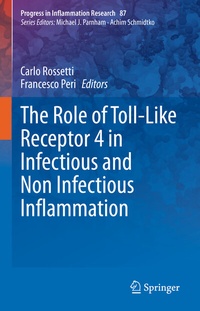
The Role of Toll-Like Receptor 4 in Infectious and Non Infectious Inflammation
Description

TLR4 is one of the most important innate immunity receptors, its function mainly consisting in the activation of inflammatory pathways in response to stimulation by Pathogen-Associated Molecular Patterns (PAMPs) and Damage Associated Molecular Pattern molecules (DAMPs).
This volume critically reviews the different types of TLR4 activators and inhibitors, discusses the role of molecular aggregates in agonism/antagonism as well as the pivotal role of the CD14 receptor in the modulation of TLR4 signal and the molecular details and actors of the intracellular cascade.
The book presents the role of TLR4 in several pathologies, such as sepsis and septic shock caused by receptor activation by gram-negative bacterial lipopolysaccharide (LPS), in neurodegenerative and neurological diseases such as Parkinson and Alzheimer's diseases, and Amyotrophic Lateral Sclerosis (ALS). It reviews the role of TLR4 in neural stem cell-mediated neurogenesis andneuroinflammation and in Human Induced Pluripotent Stem Cells and Cerebral Organoids and discusses the emerging role of micro-RNA (miRNA) regulation by TLR4.
More details
Other editions
Additional editions
Persons
Carlo Rossetti
Carlo Rossetti was born in Brescia in 1958, and graduated in Biological Sciences in 1982. Currently, he is Associate Professor in Applied Biology at the University of Insubria (Varese, Italy). His research focuses on the role of Toll Like Receptors in tissue regeneration and activation of the innate immunity. In 2008 he founded a start-up for the development of TLR4-antagonist natural molecules.
Francesco Peri
Full Professor (Organic and Medicinal Chemistry) at the Department of Biotechnology and Biosciences, of the University of Milano-Bicocca (Milano, Italy). He holds a permanent professorship at the Ecole Normale Supérieure (ENS) of Lyon (France) where he teaches a course of Medicinal Chemistry (Master level). In 2012, he had a permanent professorship in Organic Chemistry at the University Paris 5, and in 2012 he was for 1 year Visiting Professor at the Department of Chemistry, University of California, Davis (USA) giving graduate courses.
His research activity focuses on medicinal chemistry, bioorganic chemistry and drug development. New TLR4 modulators have been developed by his group, and novel cardiac drug leads modulating the activity of the Serca2a protein.
He has numerous international and national collaborations, holds national and international grants, and is the president of the MicrobiotaMi association, whose mission is to diffuse the knowledge and the culture related to studies on human microbiota. He is committed to technology transfer: he is Delegate of the Rector for the University of Innovation Foundation (www.u4i.it), an organism devoted to the valorization of innovation and to decisional support to University start-ups.
He is founder of the academic spin-off CP2 Biotech, whose mission is the valorization of new drug hits and the development of innovative therapeutic approaches to vaccine adjuvants and inflammatory diseases.
Content
Chapter 1. Chemically synthesized TLR4 ligands, their immunological functions and potential as vaccine adjuvant.- Chapter 2. Intracellular TLR4 signaling.- Chapter 3. TLR4 Ligands: Single Molecules and Aggregates.- Chapter 4. CD14: not just chaperone, but a key-player in inflammation.- Chapter 5. Toll-Like Receptor 4 interactions with Neisseria.- Chapter 6. Toll-Like Receptor4 and Damage-Associated Molecular Patterns (DAMPS).- Chapter 7. TLR4 in neurodegenerative diseases: Alzheimer and Parkinson disease.- Chapter 8. TLR4-mediated Neuroinflammation in Human Induced Pluripotent Stem Cells and Cerebral Organoids.- Chapter 9. The role of TLR4 in neural stem cells-mediated neurogenesis and neuroinflammation.- Chapter 10. Toll-Like Receptor 4 and the world of microRNAs.- Chapter 11. Metabolic reprogramming of myeloid cells upon TLR4 stimulation.
