

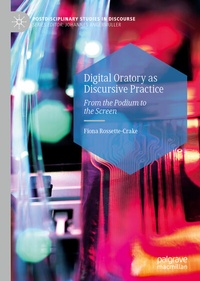
Digital Oratory as Discursive Practice
Description

This book offers an appraisal of oratory, old and new, relating former discourse practice to a specific sub-set of contemporary, digital practices. The author explores the interface between language and society, providing an interdisciplinary study at the crossroads of discourse, linguistics, communication and rhetoric. The comparisons she draws are particularly pertinent in light of the steep rise in presentations given during video-conferences, webinars, and other online events during the COVID-19 pandemic, an event which accelerated previous moves towards digital communication and which is likely to have a long-term impact on communication styles. This book will be of interest to academics and students in fields including discourse analysis, applied linguistics, communication studies, digital studies and business studies.
Reviews / Votes
"Digital Oratory as Discursive Practice: From the Podium to the Screen is a comprehensive study of communicative choices contemporary orators make in particular contexts, the technologies prompting them to make those choices, and the cultural and economic ideologies that render those choices meaningful. . The book is an indispensable guide for all communication scholars interested in how oratory is done . ." (David Boromisza-Habashi, International Journal of Communication, Vol. 17, 2023)More details
Other editions
Additional editions
Person
Fiona Rossette-Crake is Professor in English Linguistics at the Department of Applied Languages at Université Paris Nanterre, France. Her research applies theory from linguistics and discourse analysis to rhetoric, spoken and digital communication, and workplace communication. Her work includes a focus on cultural issues (comparisons across cultures; the global impact of Anglo-American communication culture, notably corporate communication).
Content
1 Approaching oratory in the 21st century.- 2 Oratory as communication setup: definitions.- 3 Oratory as communication setup (ii): towards a typology that incorporates technological mediation.- 4 Oratory as rhetorical practice: the renewal of memoria and actio.- 5 Multimodality and Technology.- 6 Oratory as social practice (I): Discursive genre, culture and power.- 7 Oratory as social practice (II): Presentation of the self in a digital, neoliberal age.- 8 Ethos, or the discursive enactment of the presentation of the self.- 9 The move from Rhetorical to Dialogic Staging.- 10 TED talks: a case study.- 11 Enacting oratory on social media.
