

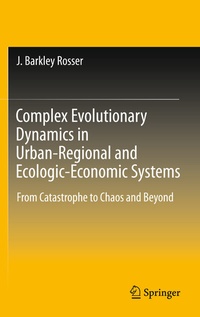
Complex Evolutionary Dynamics in Urban-Regional and Ecologic-Economic Systems
Description

Drawing on the middle chapters from the first edition of J. Barkley Rosser's seminal work, From Catastrophe to Chaos, this book presents an unusual perspective on economics and economic analysis. Current economic theory largely depends upon assuming that the world is fundamentally continuous. However, an increasing amount of economic research has been done using approaches that allow for discontinuities such as catastrophe theory, chaos theory, synergetics, and fractal geometry. The spread of such approaches across a variety of disciplines of thought has constituted a virtual intellectual revolution in recent years. This book reviews the applications of these approaches in various subdisciplines of economics and draws upon past economic thinkers to develop an integrated view of economics as a whole from the perspective of inherent discontinuity.
Reviews / Votes
Praise for the first edition of FromCatastrophe to Chaos :
"What this book really amounts to is a very literate and wide-ranging survey of the chaos and catastrophe theory literature. Professor Rosser deserves great credit for drawing together an enormous number of sources (the bibliography contains about 1200 references)both inside and outside economics and in neighboring fields like ecology, history, biology, and mathematics, and weaving them into a compelling story." - Journal of Economic Literature
"One of the greatest virtues of Rosser's book is his evenhanded presentation of models from both the mainstream neoclassicals and the alternative postmodern evolutionary economists. In fact, by discussing both research programs without denigrating either, Rosser makes a contribution unique among the books addressing these topics." - Southern Economic Journal
"...effectively brings together a disparate and voluminous literature on a catastrophe and chaos theory to tell a compelling story about the need to comprehend economic discontinues.This book will become a standard reference in the area that it has chosen to concentrate on and I recommend the book to readers who are interested in learning more about the intricacies of a fundamentally discontinuous world." - American Journal of Agricultural Economics (2001)
More details
Other editions
Additional editions
Content
- Intro
- Preface
- Contents
- 1 Discontinuous Evolution of Urban Historical Forms
- 1.1 Introduction
- 1.2 Agglomeration and the Formation and Sudden Growth of Cities
- 1.2.1 The Debate
- 1.2.2 Instability and Agglomeration
- 1.2.2.1 A General View
- 1.2.2.2 A Local Instability Model
- 1.2.2.3 A Catastrophe Theory Interpretation
- 1.2.2.4 Some Further Variations
- 1.2.2.5 The Role of Production Made Explicit
- 1.3 Long-Distance Trade and Instability
- 1.3.1 Another View: Open Versus Closed Cities
- 1.3.2 The Mees Version of Pirenne's Hypothesis
- 1.3.3 Comparative Advantage and City Size
- 1.3.4 Logistical Networks and Long-Distance Trade
- 1.4 A Possible Synthesis: The Role of Technological Change
- 1.4.1 Agglomeration, Logistical Networks, and Technology
- 1.4.2 Rome Was Not Built in a Day
- Notes
- 2 The New Economic Geography Approach and Other Views
- 2.1 The Setting
- 2.2 The Three Returns to Scale
- 2.3 The Dixit--Stiglitz Model of Monopolistic Competition
- 2.4 Bifurcations of the NEG Core--Periphery Model
- 2.5 The Core--Periphery Model at the Global Level
- 2.6 Chaotic Dynamics in a Discrete Version of the Core-Periphery Model
- 2.7 Criticisms of the New Economic Geography
- Notes
- 3 Discontinuities in Intraurban Systems
- 3.1 Some General Remarks
- 3.2 The Role of Transportation in Urban Structural Bifurcations
- 3.2.1 Modal Choice in Transportation
- 3.2.2 Urban Retail Structure
- 3.2.2.1 Economies of Scale Versus Transportation Costs
- 3.2.2.2 Chaotic Dynamics
- 3.2.2.3 Leeds Versus Brussels: A Comparison of Approaches
- 3.3 An Ecological View
- 3.3.1 Density--Rent Cycles
- 3.3.2 Intraurban Lotka--Volterra Instability
- 3.3.2.1 Centralization Versus Suburbanization
- 3.3.2.2 Slum Formation Versus Historical Preservation
- 3.3.2.3 Neighborhood Tipping and Gentrification
- 3.3.2.4 A Note on Bifurcation Categories
- 3.4 Static and Dynamic Boundary Discontinuities
- 3.4.1 Neighborhood Boundary Dynamics
- 3.4.1.1 A Static Model
- 3.4.1.2 A Moving Boundary
- 3.4.2 Land Use Boundaries
- 3.4.2.1 Static Land Value Discontinuities
- 3.4.2.2 Dynamic Discontiguities in Land Use and Polycentrism
- Notes
- 4 Morphogenesis of Regional Systems
- 4.1 The Continuous Flow Model
- 4.1.1 Linear and Nonlinear Variations
- 4.1.2 Structural Change of the Flow Pattern
- 4.1.3 Wave Patterns in the Continuous Flow Model
- 4.1.4 Multiplier--Accelerator Cycles in the Continuous Flow Model
- 4.1.4.1 The Single-Region Case
- 4.1.4.2 The Two-Region Case
- 4.2 Evolution of Urban and Regional Systems
- 4.2.1 Predator--Prey Cycles in Single Cities
- 4.2.2 Interregional Predator--Prey Cycles
- 4.2.3 The Emergence of Chaotic Dynamics
- 4.2.3.1 Relative Stock Models
- 4.2.3.2 A Production Model
- 4.3 Self-Organizing Regional Morphogenesis
- 4.3.1 Order Through Fluctuations
- 4.3.2 Time Scales and Slaves
- 4.3.3 A Fractal Synergesis
- Notes
- 5 Complex Dynamics in Spatial Systems
- 5.1 Complexity and Socioeconomic Spatial Systems
- 5.2 The Generality of the Schelling Model
- 5.3 An Evolutionary Game Theoretic View of the Schelling Model
- 5.4 Network Analysis of the Schelling Model
- 5.5 Zipf's Law and Urban Hierarchy
- 5.6 Urban Hierarchy with Discrete Levels
- 5.7 Bottom-Up or Top-Down Development of Urban Hierarchies?
- Notes
- 6 Perspectives on Economic and Ecologic Evolution
- 6.1 Historical Perspectives
- 6.1.1 Origins
- 6.1.2 Dialectical Difficulties
- 6.1.3 Evolution and the Equilibrium Concept
- 6.1.4 Cycles and Chaos
- 6.2 Continuous Versus Discontinuous Theories of Evolution
- 6.2.1 Gradualism
- 6.2.2 Saltationalism
- 6.2.2.1 Ecological
- 6.2.2.2 Economics
- 6.3 Hypercyclic Morphogenesis of Higher-Level Structures
- Notes
- 7 Evolution and Complexity
- 7.1 The Ups and Downs of the Darwinian View of Evolution
- 7.2 The Ups and Downs of Darwinian Evolutionary Economics
- 7.3 The Multilevel Complication
- 7.4 Self-Organization and Natural Selection
- Notes
- 8 Ecosystems and Economics
- 8.1 Nonlinear Bionomic Dynamics
- 8.1.1 Single-Species Models with Density Dependence
- 8.1.2 Two-Species Lotka--Volterra Models
- 8.1.3 Complexity and Stability in Multispecies Ecosystems
- 8.2 The Bioeconomics Synthesis
- 8.2.1 The Perversities of Open-Access Renewable Resource Use
- 8.2.1.1 The Basic Tendency to Overexploitation
- 8.2.1.2 Sources of Dynamic Discontinuities and Instabilities
- 8.2.1.3 Management Approaches to Open-Access Fisheries
- 8.2.2 The Special Problem of Extinction
- 8.2.2.1 ''Optimal'' Extinction
- 8.2.2.2 The Complicated Role of the Discount Rate
- Notes
- 9 Complex Ecologic-Economic Dynamics
- 9.1 The Intertemporally Optimal Fishery
- 9.2 Complex Expectational Dynamics in the Optimal Fishery
- 9.3 Complexity Problems of Optimal Rotation in Forests
- 9.4 Problems of Forestry Management Beyond Optimal Rotation
- 9.5 Complex Lake Dynamics
- 9.6 Stability and Resilience of Ecosystems Revisited
- Notes
- 10 The Limits to Growth and Global Catastrophe Revisited
- 10.1 Neo-Malthusian Collapse Models
- 10.2 Renewable Versus Nonrenewable Resources
- 10.3 Managing Potential Catastrophe
- 10.4 The Entropy Argument
- 10.4.1 Entropy as the Ultimate Limit
- 10.4.2 Entropy and Value
- 10.4.3 The Vision of the Steady-State Economy
- Notes
- 11 How Nonlinear Dynamics Complicate the Issue of Global Warming
- 11.1 Prologue on the Science of Global Warming
- 11.2 Could a Combined Global Climate--Economic System Be Chaotic?
- 11.3 Competing IAM Models
- 11.4 The Discounting Issue Again
- 11.5 Positive Feedbacks, Fat Tails, and Fundamental Uncertainty
- Notes
- Appendix A The Mathematics of Discontinuity
- A.1 General Overview
- A.2 The Founding Fathers
- A.3 The Bifurcation of Bifurcation Theory
- A.3.1 The Road to Catastrophe
- A.3.1.1 The Theory
- A.3.1.2 The Controversy
- A.3.2 The Road to Chaos
- A.3.2.1 Preliminary Theoretical Developments
- A.3.2.2 The Emergence of the Chaos Concept
- A.4 The Special Path to Fractal Geometry
- A.5 The Complexity of Other Forms of Complexity
- A.5.1 What Is Complexity?
- A.5.2 Discontinuity and Statistical Mechanics
- A.5.3 Self-Organized Criticality and the ''Edge of Chaos''
- A.5.4 A Synergetics Synthesis
- Notes
- References
- Index
