

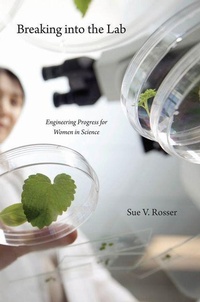
Breaking into the Lab
Engineering Progress for Women in Science
Published on 12. March 2012
262 pages
978-0-8147-7152-5 (ISBN)
Description

Why are there so few women in science? In Breaking into the Lab, Sue Rosser uses the experiences of successful women scientists and engineers to answer the question of why elite institutions have so few women scientists and engineers tenured on their faculties. Women are highly qualified, motivated students, and yet they have drastically higher rates of attrition, and they are shying away from the fields with the greatest demand for workers and the biggest economic payoffs, such as engineering, computer sciences, and the physical sciences. Rosser shows that these continuing trends are not only disappointing, they are urgent: the U.S. can no longer afford to lose the talents of the women scientists and engineers, because it is quickly losing its lead in science and technology. Ultimately, these biases and barriers may lock women out of the new scientific frontiers of innovation and technology transfer, resulting in loss of useful inventions and products to society.
Reviews / Votes
Rosser has no doubt that women are disadvantaged at every stage along the career path in small but subtle ways - what she terms 'micro-inequities' - and that this process plays a central role in the way women drop out and burn up. In this book she discusses how these micro-inequities manifest themselves at different career stages, building on the experiences and reflections of her interviewees. She also touches upon what might be done to improve the climate. * Times Higher Education * Breaking into the Lab shows us the good, the bad, and the occasionally ugly experiences of women in science. Sue Rosser's interviews with women clarify how the difficulties they face change as they move from junior to senior positions. Her review of the gender gap in patents makes clear how easily the present repeats the past. Rosser's unparalleled knowledge of the role of gender in the workings of science, colleges and universities, and federal funding agencies informs her comprehensive prescriptions for opening the laboratory doors wider. Read and heed! -- Virginia Valian,author of Why So Slow? The Advancement of Women In this & must read book, Rosser reviews thirty years of work on women in science. In addition to analyzing new areas, such as womens relative representation in patenting, Rosser draws from her experience as a scientist, National Science Foundation program officer, and high-level university administrator to provide unique insights. -- Londa Schiebinger,author of Nature's Body: Gender in the Making of Modern Science Sue Rosser has for more than three decades epitomized what is meant by feminist studies of science. In her most recent book, Breaking into the Lab: Engineering progress for women in science, she sums up a lifetime of experiences as being a female scientist who herself encounters resistance and trouble, which is equivalent to documented discrimination experienced by other female scientists. Yet Rosser has never given up and today she holds the position of provost at San Francisco State University. Thus, in a humble and intelligent way, Rosser offers her own lifetime of learning to us. At the same time, through references to her own fighting, she acts as a role-model. Along the way describing her own career path, she contributes with a myriad of solid research results from the 1980s and onwards pointing to other role models, but also showing how little progress has actually been made. Rosser offers new disconcerting research showing that history may repeat itself with new means. . . . & The more it changes, the more it stays the same may stand as a motto for the sweeping overview of what happened to women who tried to & break into the lab. Yet Rosser herself is a living example of how women should not give up trying to fight back slowly, slowly make changes in a system that in incredibly subtle and complex ways attempts to keep women in the sidetrack of scientific progress. * Review in Cultural Studies of Science Education * The book is accessible to a wide readership and is especially important reading for students and scholars of science and gender studies, higher education leaders, and individuals involved in scientific funding or policymaking. * Sex Roles * Engagingly written and full of eye-widening narratives. * Society * The book provides helpful guidance not only for potential mentors, but for women scientists and their institutions as well. * On Campus with Women * Rosser is a noted scientist/administrator who has written widely on the subject of women and science. Therefore, her perspective and insight are important to a discussion of the topichow to compensate for the dearth of women in science, particularly in the physical sciences and engineering fields. . . . Recommended [for] graduate students, researchers/faculty, and professionals. * CHOICE *More details
Edition
Library
Language
English
Place of publication
New York
United States
Target group
Professional and scholarly
File size
1,92 MB
ISBN-13
978-0-8147-7152-5 (9780814771525)
DOI
8574/nyu/9780814776452.001.0001
Copyright in bibliographic data and cover images is held by Nielsen Book Services Limited or by the publishers or by their respective licensors: all rights reserved.
Schweitzer Classification
Other editions
Additional editions
Book
10/2014
New York University Press
€36.50
Shipment within 10-20 days
Book
03/2012
New York University Press
€96.00
Shipment within 15-20 days
Person
Sue V. Rosser is the Provost Vice President for Academic Affairs and Professor of Women and Gender Studies and Sociology at San Francisco State University. She holds a PhD in Zoology from the University of Wisconsin-Madison. She is the author or editor of many books, including Diversity in Women's Health and Women, Gender, and Technology.
